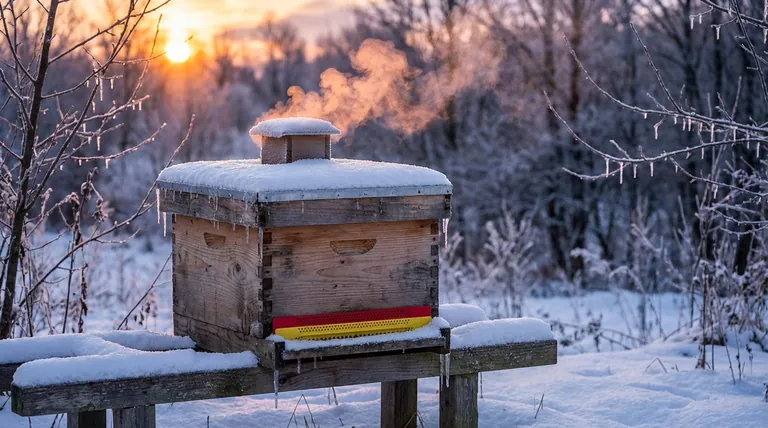
The Beekeeper's Paradox
A beekeeper’s first instinct facing a frigid winter is to protect their colony from the cold. We seal entrances, wrap hives, and do everything we can to create a warm, impenetrable fortress.
This well-intentioned impulse, however, is often what kills the hive.
The single greatest threat to a honey bee colony in winter is not the cold; it's the water they produce themselves. A healthy, dry cluster of bees is a masterful thermoregulation engine, fully capable of surviving deep freezes. But a wet bee is a dead bee. The central challenge of winter beekeeping is not a war against the cold, but a delicate balancing act of atmospheric physics inside the hive.
The Hive's Internal Atmosphere
To manage the problem, you must first understand the system. A beehive in winter is a closed environment where the byproducts of life can become lethal.
A Byproduct of Life
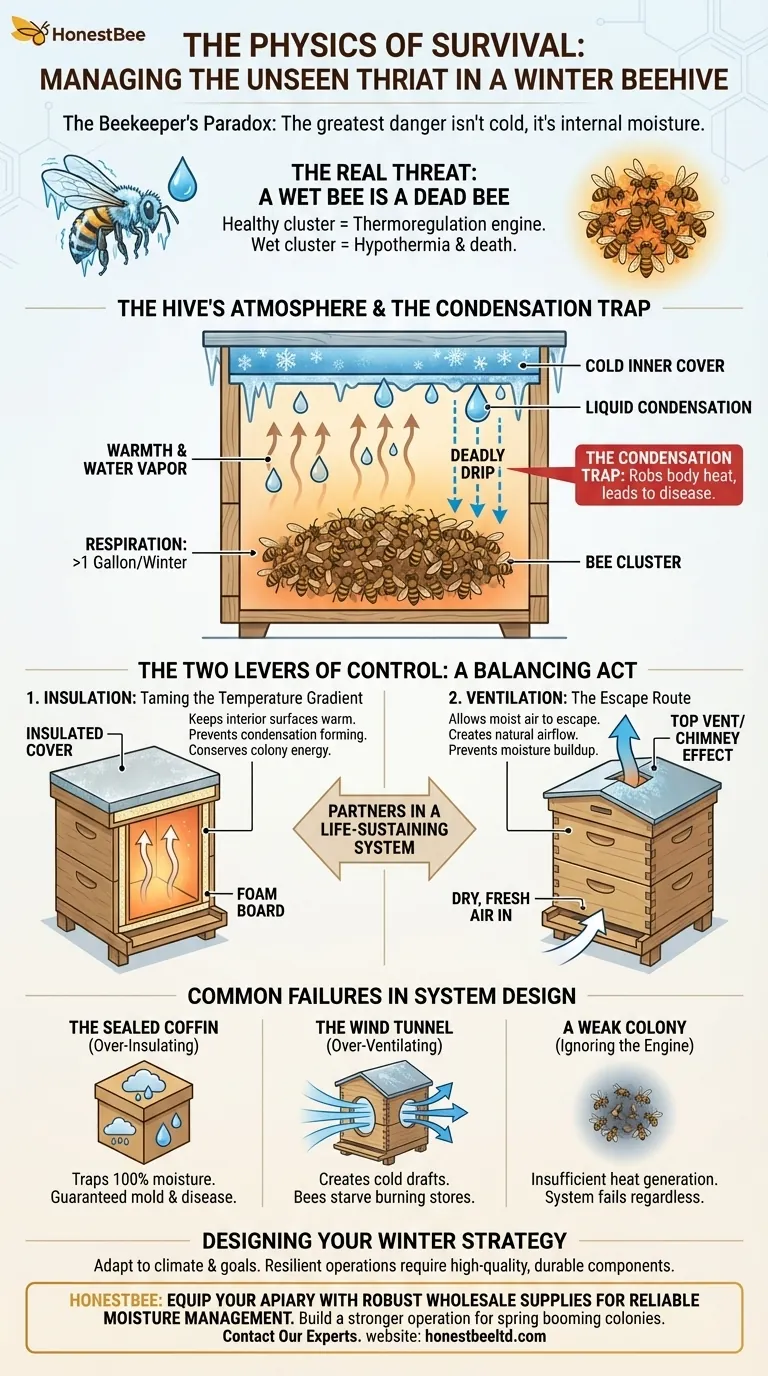
Bees metabolize honey to generate heat. Like all living creatures, their respiration releases two things: warmth and water vapor. A single colony can exhale over a gallon of water into the hive's atmosphere throughout the winter. This creates a pocket of warm, humid air rising from the cluster, much like the steam from a boiling pot.
The Condensation Trap
This warm, moist air rises until it hits a cold surface—typically the underside of the hive’s inner cover. The temperature difference causes an immediate phase change. The vapor condenses into liquid water, just as a cold glass "sweats" on a summer day.
This condensation then drips back down. A cold, steady rain falls directly onto the bee cluster, robbing them of body heat far more efficiently than cold air alone. This leads to hypothermia, disease, and the silent death of the colony.
The Two Levers of Control
Solving this deadly rain requires managing the hive’s internal environment with two complementary forces: insulation and ventilation. They are not opposites; they are partners in a life-sustaining system.
Insulation: Taming the Temperature Gradient
Insulation's primary role is not just to keep bees warm, but to keep the interior surfaces of the hive warm. By adding foam board or using insulated covers, you reduce the temperature difference between the rising air and the hive ceiling.
A warmer surface means less condensation will form. This simple act of thermal management disrupts the physics of the condensation trap. A well-insulated hive also allows the bees to conserve energy, burning less honey to stay warm.
Ventilation: The Escape Route
Insulation alone is a fatal mistake. If you trap the warm, moist air, you are simply building a more efficient rainforest. Ventilation provides the necessary escape route.
A small opening at the top of the hive creates a natural chimney effect. As the warm, damp air rises, it is pushed out, drawing dry, fresh air in from the bottom entrance. This constant, slow exchange is the key to keeping the hive's atmosphere dry.
Common Failures in System Design
Achieving this balance means avoiding common, often intuitive, errors. Your success depends on recognizing these failure states.
| Failure Mode | The System Analogy | The Consequence |
|---|---|---|
| Over-Insulating without Ventilation | The Sealed Coffin | Traps 100% of moisture inside. Condensation is guaranteed, creating a cold, damp environment perfect for mold and disease. |
| Over-Ventilating without Insulation | The Wind Tunnel | Creates a cold draft. Bees are forced to burn through their honey stores at an accelerated rate, risking starvation. |
| Ignoring the Engine | A Weak Colony | A small, weak cluster cannot generate enough heat to power the system, making both insulation and ventilation even more critical for survival. |
Designing Your Winter Strategy
Your approach must be adapted to your climate and operational goals. For commercial apiaries, where efficiency and survival rates are paramount, a reliable system is not a luxury—it's essential.
-
For Severe Cold: Prioritize heavy insulation on the top and sides, paired with a small, dedicated upper vent (around one square inch) to let moisture escape without creating a draft.
-
For Mild, Damp Winters: Emphasize top ventilation. A "quilt box" with wood shavings or a cracked outer cover provides a large surface for moisture to escape, paired with more moderate insulation.
The most effective strategy often involves specialized equipment designed to solve this exact problem. High-quality, durable components are the foundation of a resilient operation. Insulated inner covers and well-designed ventilation aids are not just hive parts; they are tools for precisely managing the hive's internal atmosphere. At HONESTBEE, we equip commercial apiaries and distributors with the robust, wholesale supplies needed to build these reliable systems.
Proper moisture management is the difference between a deadout and a booming colony come spring. Build a stronger, more resilient operation by giving your bees a dry home. Contact Our Experts to discuss your wholesale needs.
Visual Guide
Related Products
- Wholesales Dadant Size Wooden Bee Hives for Beekeeping
- Stainless Steel Round Beehive Air Vents for Ventilation
- Metal Bee Hive Stand Bee Box Stand for Beekeeping
- Durable Plastic Hive Number Set for Beekeeping
- Wooden Bee Hive Frames for Beekeeping and Wholesale
Related Articles
- The Silent Killer in the Hive: Why Moisture, Not Cold, Is Winter's Greatest Threat
- Beyond the Bee Box: Why Your First Apiary Investment Determines Your Success
- How to Assemble Wooden Beehives: A Beginner's Guide to Durable Joint Systems
- Why Wooden Beehives Outperform Modern Alternatives: A Science-Backed Guide for Beekeepers
- How Wooden Beehives Naturally Regulate Temperature for Healthier Honeybee Colonies


















