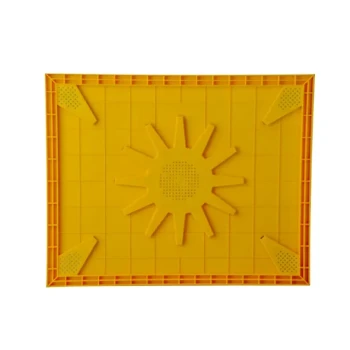
Physical verification is the cornerstone of AI validation. Sticky boards and greased diapers act as the definitive "ground truth" mechanism in apiary science. Researchers place these adhesive sheets beneath hives to capture naturally falling Varroa mites, manually count the distinct specimens, and then compare this physical dataset against the digital predictions generated by computer vision models to calculate the system's accuracy.
While AI offers speed and automation, it requires a definitive biological baseline to be trustworthy. Sticky boards provide the essential quantitative data needed to audit computer vision models, ensuring that digital detection rates align with the actual physical infestation levels within the hive.
Establishing Ground Truth
The Role of Physical Collection
Sticky boards or greased diapers serve as a physical capture layer. Placed at the bottom of a hive, they trap mites that naturally dislodge from bees.
This method creates a tangible record of infestation that does not rely on digital sensors. It provides a static snapshot of the hive's health over a specific period.
Generating Quantitative Baselines
To verify an AI model, you cannot simply guess if the model is "close enough." You need raw numbers.
Researchers manually count the mites trapped on the sticky board to generate a hard data point. This manual count serves as the absolute standard against which the AI's performance is graded.
Bridging the Biological and Digital
Comparing Predicted vs. Actual
The core verification process involves a direct comparison of two datasets.
The first dataset is the prediction generated by the computer vision model monitoring the bees. The second is the actual biological finding derived from the sticky board count.
Evaluating Model Reliability
If the AI predicts a high infestation level but the sticky board shows very few mites, the model may be generating false positives.
Conversely, if the board is covered in mites but the AI detects none, the system has a sensitivity issue. This comparison allows developers to fine-tune the AI's thresholds for greater accuracy.
Understanding the Limitations
The Lag in Feedback
Sticky boards are a lagging indicator. They capture mites that have already fallen, whereas some AI models attempt to detect live mites on bees in real-time.
This creates a temporal disconnect. You are comparing a cumulative physical count (the board) against momentary digital observations, requiring careful statistical correlation.
Manual Error in Verification
Using sticky boards to verify AI assumes the human counter is perfect.
However, debris and pollen on the board can look like mites. If the human verifyier makes a mistake in the manual count, the "ground truth" becomes flawed, potentially leading to incorrect adjustments in the AI model.
Making the Right Choice for Your Goal
Physical verification tools remain the industry standard for ensuring your technological solution reflects biological reality.
- If your primary focus is Model Development: rigorously use sticky boards to create a labeled "ground truth" dataset to train and calibrate your computer vision algorithms.
- If your primary focus is Commercial Application: use sticky boards as an occasional audit tool to spot-check your AI system if the digital readings appear anomalous or inconsistent.
True reliability is achieved when digital predictions consistently mirror physical evidence.
Summary Table:
| Verification Factor | AI-Based Detection | Sticky Boards / Greased Diapers |
|---|---|---|
| Data Type | Real-time digital prediction | Physical 'Ground Truth' baseline |
| Speed | Instantaneous automation | Lagging indicator (capture period) |
| Primary Use | Monitoring & commercial tracking | Model calibration & manual auditing |
| Human Effort | Low (automated) | High (manual counting required) |
| Accuracy Risk | Software false positives | Human counting errors & debris |
Scale Your Apiary Operations with HONESTBEE Precision
At HONESTBEE, we understand that reliable data is the foundation of successful commercial beekeeping. As a dedicated partner to commercial apiaries and distributors, we provide the professional-grade tools you need to bridge the gap between biological reality and technological efficiency.
Whether you are scaling your honey production or supplying the next generation of beekeepers, our comprehensive wholesale offering has you covered. From hive-making and honey-filling machinery to essential consumables and specialized hardware, HONESTBEE delivers the quality and reliability your business demands.
Ready to elevate your wholesale beekeeping supply? Contact us today to discuss your bulk equipment needs
References
- Yassine Kriouile, Lamine Bougueroua. Nested object detection using mask R-CNN: application to bee and varroa detection. DOI: 10.1007/s00521-024-10393-x
This article is also based on technical information from HonestBee Knowledge Base .
Related Products
- Langstroth Solid Bottom Board for Beekeeping
- Solid Bottom Board Australian Pine Wood Langstroth Bottom Board for Wholesale
- Langstroth Screen Bottom Board for Beekeeping Wholesale
- HONESTBEE Multi Exit Plastic Bee Escape Board for Efficient Honey Harvesting
- Australian Pine Wood Langstroth Screen Bottom Board for Wholesale
People Also Ask
- What are the functions of solid bottom boards for a beehive? Essential Thermal Protection and Winter Survival Tips
- What is the purpose of a solid bottom board for bee hives? Enhance Hive Health and Winter Survival
- How does climate influence the choice between a solid and screened bottom board? Optimize Your Hive for Local Weather
- What is the primary function of a bottom board in a modern modified beehive system? Essential Foundation Guide
- What are the characteristics of a solid bottom board for a beehive? Boost Colony Health and Thermal Insulation