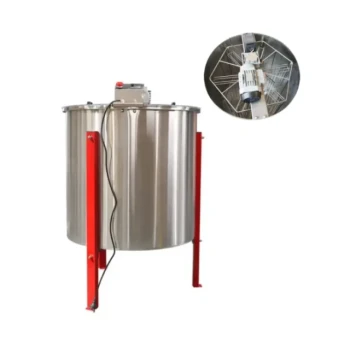
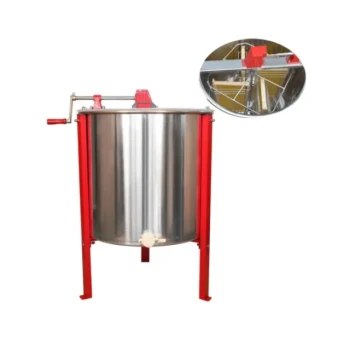
Limit switches act as the critical failsafe in honey extraction machinery by establishing physical boundaries for the equipment's movement. They contribute to safety and reliability by automatically cutting power to the motor the instant the mechanism reaches its fully open or fully closed position, preventing the system from destroying itself through over-extension.
By converting the physical position of the honeycomb mechanism into an immediate electrical stop signal, limit switches prevent the catastrophic damage caused by driving a motor against a locked mechanical linkage.
The Mechanics of Automatic Protection
Providing Position Feedback
The limit switch serves as the system's sensory input, providing definitive position feedback to the control unit. It confirms exactly when the linkage has traveled the necessary distance to fully open or close the honeycomb cells.
Without this feedback, the machine would have to rely on timing estimates, which are prone to error. The switch ensures the system acts based on physical reality rather than theoretical timing.
Stopping the DC Motor
When the linkage hits the limit switch, the device immediately triggers a signal to stop the DC motor. This reaction must be instantaneous to be effective.
By creating a hard electrical stop, the switch overrides any other command that might keep the motor running. This automation removes the margin for human error during the extraction process.
Preventing System Failure
Avoiding Motor Burnout
If a motor continues to receive power after the mechanism has hit a physical wall, it enters a stall condition. This causes the motor to draw excessive current, leading to rapid heat buildup and motor burnout.
The limit switch prevents this "over-rotation" scenario. By cutting the circuit at the exact limit of travel, it ensures the motor never exerts force against an immovable object.
Preserving Structural Integrity
Honey extraction equipment relies on precise linkages to move the honeycomb cells. If the motor forces these linkages past their design limits, it causes mechanical structural damage.
The limit switch acts as a barrier, preserving the geometry of the machine. This protection extends the lifespan of gears, arms, and the frame itself.
Ensuring Cyclic Reliability
Consistent Operation
Extraction is often a repetitive, cyclic process. Limit switches ensure the reliability of the system's cyclic operation by guaranteeing every cycle ends at the exact same spot.
Resetting the System
By stopping at a precise limit, the machine is perfectly positioned for the next phase of operation. This prevents "drift," where small errors in positioning accumulate over time to cause a jam.
Understanding the Trade-offs
Mechanical Dependencies
While limit switches are reliable, they are mechanical devices that require physical contact. If the linkage becomes misaligned, it may fail to strike the switch, rendering the protection useless.
Potential for Switch Failure
Because the switch acts as the primary guard against motor burnout, it becomes a single point of failure. If the switch itself malfunctions or jams, the system loses its protection against structural damage.
Making the Right Choice for Your Goal
To maximize the effectiveness of limit switches in your extraction setup, consider your primary operational objectives:
- If your primary focus is Equipment Longevity: Ensure the limit switch triggers slightly before the mechanical hard stop to eliminate stress on the linkage.
- If your primary focus is Motor Safety: Verify that the switch interrupts the motor current directly or signals the controller with zero latency to prevent stall currents.
Effective limit switch integration transforms a raw motor drive into an intelligent, self-protecting system.
Summary Table:
| Feature | Function in Honey Extraction | Safety Benefit |
|---|---|---|
| Position Feedback | Detects physical travel limits of linkages | Prevents mechanical over-extension |
| Automatic Stop | Immediately cuts power to the DC motor | Eliminates motor burnout from stalls |
| Cyclic Consistency | Ensures every cycle stops at the same point | Prevents positioning drift and jams |
| Structural Guard | Acts as a physical-to-electrical barrier | Preserves the integrity of gears and arms |
Scale Your Apiary Operations with HONESTBEE
At HONESTBEE, we specialize in empowering commercial apiaries and distributors with high-performance beekeeping machinery designed for longevity. From advanced honey-filling machines to robust hive-making hardware, our equipment integrates critical safety components like precision limit switches to ensure your production never stops due to mechanical failure.
Partner with HONESTBEE for:
- Wholesale Equipment: Full spectrum of beekeeping tools and industrial machinery.
- Technical Reliability: Self-protecting systems that minimize downtime and maintenance.
- Industry Consumables: A comprehensive array of essentials for large-scale honey production.
Ready to upgrade your extraction efficiency and protect your investment? Contact us today to explore our wholesale solutions!
References
- Ari Devianto, Muhammad Nasar. Internet of Things-Based Automated Honey Harvesting: A Smartphone-Integrated Solution for Efficient Beekeeping. DOI: 10.59934/jaiea.v4i3.1135
This article is also based on technical information from HonestBee Knowledge Base .
Related Products
- Honey Gate Valve with Ergonomic Ball Handle Plastic Bee Honey Tap for Beekeeping Bottling and Honey Extractor Equipment
- HONESTBEE 6 Frame Self Reversing Electric Honey Extractor for Beekeeping
- Commercial 48-Frame Stainless Steel Honey Extractor
- Stainless Steel Manual 8 Frame Radial Honey Extractor Machine for Beehives
- 10L Stainless Steel Electric Honey Press Machine
People Also Ask
- How is the flow of honey controlled using a honey gate valve? Master Precise Bottling and Extraction Techniques
- How do you adjust the flow of honey using a honey gate valve? Master Precision Control for Your Bottling Line
- What is the function of the honey gate on the honey press? Master Clean and Precise Bottling Controls
- What is a honey gate and what is its purpose? Master Precision Bottling and Waste Reduction
- Under what conditions should the honey gate be closed? Prevent Messy Spills and Ensure Extraction Efficiency