Colony dynamics directly determine hive capacity, modularity, and manufacturing precision. Highly eusocial honeybee colonies operate as large, coordinated units: one queen supports thousands of workers and drones, with populations reaching tens of thousands during the spring buildup and seasonal peak. Commercial beekeepers therefore need standardized, expandable hive systems—and manufacturers need machinery capable of producing accurate, interchangeable boxes, frames, and supers at scale.
The central requirement is controlled expansion. Hive designs must provide enough brood and storage space for rapid colony growth without sacrificing inspection, transport, wintering, or harvesting efficiency; manufacturing machinery must deliver consistent dimensions, bee space, strength, and throughput.
Why Colony Growth Requires Expandable Hives
A colony functions as one production unit
A highly eusocial colony is not simply a group of independent bees. The queen, workers, and drones operate through coordinated brood rearing, foraging, food storage, defense, and colony reproduction.
This means hive capacity must support the needs of the entire colony. A box that is adequate for a small spring cluster may become restrictive as worker numbers, brood area, and stored honey increase.
Spring population growth creates a rapid capacity requirement
During spring buildup and the main nectar flow, worker populations can rise into the tens of thousands. The colony must accommodate both expanding brood and increasing stores of honey and pollen.
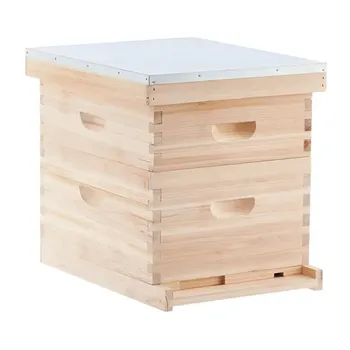
Commercial hives should therefore support the quick addition of brood chambers, frames, and honey supers. A modular system allows the beekeeper to add volume as the colony grows instead of replacing the entire hive.
Space management helps reduce swarming pressure
When brood space or storage space becomes inadequate, colonies may prepare to swarm. Swarming is a natural reproductive behavior in which the queen leaves with a large group of workers to establish another colony.
Providing properly timed expansion space does not eliminate swarming risk, but it gives the beekeeper better control over colony growth, queen management, and planned hive splits.
What This Means for Commercial Beehive Selection
Standardization is essential for efficient operations
Commercial apiaries benefit from hive components that are interchangeable across colonies. Standard-sized hive bodies, frames, and supers simplify inspections, expansion, repairs, transportation, and equipment replacement.
For distributors and wholesalers, standardized product lines also make inventory planning easier. Customers can purchase compatible components from a single portfolio rather than managing multiple incompatible hive formats.
Hive volume must match the management system
The correct hive configuration depends on colony strength, local forage conditions, seasonal timing, and the beekeeper’s management method. The practical requirement is not simply “the largest possible hive,” but sufficient usable volume that can be added or removed efficiently.
Modular equipment is especially valuable because spring population peaks and honey flows are seasonal. Beekeepers can expand during buildup and reduce or consolidate space when colonies enter less active periods.
Structural strength matters under honey loads
Honey supers become substantially heavier as bees fill them. Hive bodies, frames, joints, and lifting surfaces must therefore remain stable during stacking, inspection, transport, and harvesting.
This makes material quality and construction accuracy important selection criteria. A hive that fits poorly or flexes under load can slow operations and increase the risk of component damage.
Accurate bee space supports colony management
Hive components must maintain consistent internal clearances, commonly referred to as bee space. Correct spacing allows bees to move through the hive while limiting excessive comb attachment between components.
Precision is therefore not merely a manufacturing preference. It supports cleaner inspections, easier frame removal, more predictable comb placement, and more efficient routine management.
How Colony Dynamics Shape Hive-Manufacturing Machinery
Machinery must produce interchangeable components
Industrial hive-making machinery should consistently produce hive bodies, frames, and supers that meet the same dimensional specifications from batch to batch.
Interchangeability is critical because commercial operators routinely move frames, add supers, replace damaged boxes, and combine equipment between colonies. Inconsistent dimensions create friction at every stage of the apiary workflow.
Precision supports fast assembly and field deployment
Commercial beekeeping often requires equipment to be assembled, repaired, or deployed quickly during spring expansion. Accurate machining and repeatable component production reduce fitting problems and shorten preparation time.
This is particularly important when operators need additional hive bodies for planned splits, swarm capture, or sudden colony growth.
Throughput must match seasonal demand
Spring creates a concentrated demand for expansion equipment. Manufacturers and large apiaries may need to produce substantial quantities of boxes, frames, and supers within a limited window.
Machinery selection should therefore consider not only dimensional accuracy but also production capacity, repeatability, changeover efficiency, and service responsiveness. A machine that produces excellent components but cannot meet seasonal volume requirements may still be unsuitable for commercial use.
Production consistency protects downstream operations
Hive manufacturing affects more than the wooden equipment itself. Consistent frames and supers support standardized inspections, comb handling, honey removal, and extraction workflows.
When equipment dimensions vary, harvesting and handling become less predictable. Consistent hive components help commercial operators maintain a smoother process from colony expansion through honey extraction.
Matching Equipment to Bee Type and Operating Model
Apis mellifera operations favor standardized systems
Commercial operations using high-yielding Apis mellifera commonly depend on standardized frame-hive systems. These systems are well suited to modular expansion, routine colony inspection, and high-volume honey production.
For such customers, manufacturers and resellers should prioritize compatible hive bodies, frames, supers, replacement parts, and equipment that supports consistent commercial workflows.
Other species may require tighter dimensional control
Different honeybee species and ecotypes can vary in nesting behavior, colony size, absconding tendency, and tolerance of artificial housing. Cavity-nesting species such as Apis cerana may require hive dimensions more closely suited to their natural nesting preferences.
The implication for machinery is important: a general-purpose production line may not meet every market requirement. Adjustable or specialized manufacturing capability can help produce hive bodies tailored to different species and regional beekeeping systems.
Product portfolios should support more than one customer profile
A one-size-fits-all catalog may be insufficient for distributors serving commercial farms, small apiaries, breeders, and regional beekeepers. A stronger portfolio includes standardized high-volume equipment alongside species- or management-specific configurations.
This allows resellers to respond quickly without treating every order as a custom engineering project.
Designing a Manufacturing and Supply Strategy
Build around the expansion cycle
The highest operational pressure often occurs when colonies are expanding and beekeepers need equipment immediately. Manufacturers and distributors should plan production, component inventories, and delivery capacity around this seasonal demand.
Maintaining ready-to-ship stocks of common hive bodies, frames, supers, and assembly components can be as important as machine capacity itself.
Treat compatibility as a commercial advantage
A complete, compatible product range reduces procurement complexity for customers. Beekeepers can source expansion equipment, replacement parts, and related apiary hardware through one supplier.
For B2B resellers, this supports larger orders, faster quotations, simpler fulfillment, and stronger customer retention.
Evaluate service and delivery alongside machine specifications
A hive-making machine is a long-term production asset. Buyers should assess technical support, spare-parts availability, operator assistance, maintenance response, and delivery reliability—not only advertised output or precision.
For commercial customers facing a short spring production window, delayed support can affect the entire supply chain. Responsive service and efficient order fulfillment therefore have direct operational value.
Understanding the Trade-offs
Maximum capacity is not always the best choice
Oversizing a hive can increase material, handling, and transport requirements. It may also complicate temperature management and routine inspections when the colony does not occupy the available space.
The better approach is a modular system that allows capacity to increase progressively with colony demand.
Standardization can limit customization
Standardized components improve efficiency, but they may not suit every bee species, climate, or management method. A manufacturer focused exclusively on one format may lose customers who require different internal dimensions or hive configurations.
The practical balance is a stable core product line supported by controlled customization where biological or regional requirements justify it.
High precision does not replace good beekeeping
Accurate hive components support colony management, but they cannot compensate for poor timing, inadequate forage, weak colonies, disease pressure, or unsuitable placement.
Machinery should be viewed as an enabler of consistent management—not as a substitute for biological knowledge and skilled apiary decisions.
Large production capacity can create inventory risk
Expanding manufacturing capacity for the spring peak may leave excess stock after the main demand period. Producers should balance machine utilization with regional demand forecasts, product standardization, and flexible production planning.
Distributors can reduce this risk by combining core inventory with rapid replenishment and dependable supplier support.
How to Apply This to Your Project
Hive selection and machinery procurement should be evaluated as one connected system: colony growth determines equipment volume, while manufacturing precision determines how reliably that equipment performs.
- If your primary focus is commercial honey production: Choose modular, standardized hive systems and machinery that can produce interchangeable frames, brood boxes, and supers at high seasonal throughput.
- If your primary focus is apiary expansion: Prioritize scalable equipment, ready-to-deploy hive bodies, and manufacturing capacity that can support spring splits, swarm management, and rapid population growth.
- If your primary focus is species-specific beekeeping: Select machinery capable of producing precisely dimensioned components suited to the target species or ecotype rather than relying automatically on a universal hive format.
- If your primary focus is distribution and wholesale supply: Build a full-spectrum, compatible product portfolio supported by reliable inventory, rapid response, technical expertise, and fast fulfillment.
- If your primary focus is long-term production reliability: Evaluate dimensional repeatability, structural strength, service support, spare parts, and lifecycle operating costs alongside initial machine price.
The right combination of modular hive design and precise manufacturing gives commercial operators the capacity to manage powerful seasonal colonies without sacrificing control, efficiency, or supply reliability.
Summary Table:
| Factor | Impact on Hive Selection | Impact on Machinery |
|---|---|---|
| Spring Build-up | Need expandable, modular hives | High throughput for seasonal demand |
| Bee Space | Consistent internal dimensions | Precision manufacturing capability |
| Honey Loads | Strong, durable construction | Robust materials and joints |
| Interchangeability | Standardized components | Repeatable batch-to-batch accuracy |
Optimize your apiary with HONESTBEE's comprehensive beekeeping equipment. From modular hives and hive-making machines to honey-filling lines and consumables, we ensure precision, reliability, and fast supply for commercial apiaries and distributors. Contact us today to discuss your seasonal expansion needs and secure your competitive edge. Contact HONESTBEE.
Related Products
- High-Performance Langstroth Bee Hives for Global Professional Beekeeping
- Professional Insulated Plastic Bee Hives
- Wholesales Dadant Size Wooden Bee Hives for Beekeeping
- Professional Observation Hive: The Ultimate Portable Solution for Beekeeping Education, Exhibitions, and Colony Displays
- Australian Langstroth Beehive Boxes for Beekeeping Wholesales
People Also Ask
- What structural differences should commercial apiary operators consider when selecting between Langstroth hives and Top Bar hives for standardized honey production? Langstroth for standardized honey production
- 8-Frame vs 10-Frame Langstroth Hives: Which Is Right for Your Beekeeping?
- Why is the adoption of modern movable-frame hives, such as Langstroth hives, advantageous over traditional hive equipment for commercial apiaries? Key Benefits for Scalable Beekeeping
- What are the structural and yield differences between traditional primitive beehives and modern standard wooden hives (such as Langstroth hives) for commercial honey producers? Discover why modern hives boost yield and efficiency.
- How does transitioning to modern hives boost honey yield? Increase production and product quality for your commercial apiary