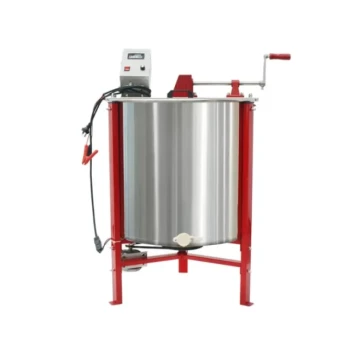
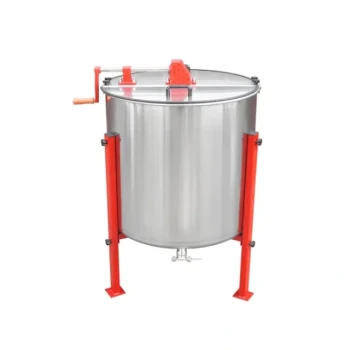
A V-belt transmission system adapts to varying honey viscosities by utilizing multi-stage cast iron pulleys to mechanically alter the rotation speed of the extractor’s main shaft. By manually shifting the belt between different pulley diameters, operators can modify the gear ratio to generate the precise centrifugal force required for specific honey types.
The core advantage of this system is the ability to mechanically "tune" the extractor, balancing the high speed needed to dislodge thick honey against the controlled speed required to prevent delicate honeycombs from shattering.
The Mechanics of Speed Adjustment
Multi-Stage Pulley Design
The heart of the adaptation lies in the multi-stage pulleys. These components feature multiple grooves of different diameters stacked together.
Changing Pulley Ratios
To change speeds, the operator moves the V-belt from one groove set to another. Shifting from a smaller diameter on the motor to a larger diameter on the shaft slows the rotation, while the reverse increases it.
Direct Shaft Control
This physical adjustment directly dictates the main shaft speed. This allows the machine to switch between high-torque, low-speed operation and high-speed, low-torque operation without changing the motor itself.
Why Viscosity Dictates Extraction Speed
The Impact of Plant Source
Honey derived from different plants possesses inherently different flow characteristics. As noted in industry data, sources like alfalfa, cotton, or citrus produce honey with vastly different viscosities.
Temperature Sensitivity
Viscosity is also strictly tied to temperature. Honey becomes more fluid when warm and significantly thicker when cold, requiring different force levels to extract effectively.
The Risk of Physical Damage
Thicker (high viscosity) honey clings tenaciously to the comb. If the extractor spins too fast immediately, the weight of the honey can blow out the wax cells; if it spins too slow, the honey remains trapped.
Optimizing the Extraction Process
Matching Centrifugal Force
The V-belt system allows the operator to select the optimal centrifugal speed. This customization ensures that the force applied is sufficient to overcome the viscosity of the specific honey batch.
Ensuring High Extraction Rates
By dialing in the correct speed, operators maximize the yield. This prevents the financial loss associated with leaving usable honey behind in the comb due to insufficient rotational force.
Preservation of Equipment and Product
Correct speed calibration protects the honeycomb structure. Preserving the comb is vital for beekeepers, as it allows them to return the intact wax frames to the hive for immediate reuse.
Understanding the Trade-offs
Manual vs. Automatic Adjustment
Unlike electronic Variable Frequency Drives (VFDs) which allow for dial-based speed changes, a V-belt system typically requires stopping the machine to physically move the belt. This offers robustness but lacks "on-the-fly" adjustability.
Stepped Speed Limitations
Multi-stage pulleys offer fixed speed steps (e.g., Low, Medium, High) rather than a continuous gradient. You are limited to the specific ratios provided by the pulley diameters, which may sometimes result in a speed that is slightly faster or slower than perfect.
Making the Right Choice for Your Goal
To get the most out of a V-belt transmission extractor, assess your current batch conditions:
- If your primary focus is Thick or Cold Honey: Use a pulley combination that provides higher torque or specifically calibrated higher speeds to dislodge the stubborn fluid without destroying the frame.
- If your primary focus is Thin or Warm Honey: Use a lower speed setting to minimize vibration and wear on the machine, as less force is required to evacuate the comb.
Summary: The V-belt system provides a robust, mechanical method to synchronize extraction force with honey thickness, ensuring maximum yield without sacrificing honeycomb integrity.
Summary Table:
| Feature | High Viscosity Honey (Cold/Thick) | Low Viscosity Honey (Warm/Thin) |
|---|---|---|
| Pulley Ratio | High Torque / Calibrated High Speed | Lower Speed Setting |
| Centrifugal Force | Stronger force to dislodge fluid | Gentler force to prevent splatter |
| Primary Goal | Overcome honey cling | Minimize vibration & wear |
| Comb Protection | High risk; requires precise speed | Lower risk; easier extraction |
Maximize Your Honey Yield with HONESTBEE Equipment
At HONESTBEE, we understand that commercial success depends on the efficiency and durability of your extraction line. Whether you are a large-scale commercial apiary or a global distributor, our comprehensive range of beekeeping machinery—from robust V-belt extractors to advanced honey-filling machines—is designed to handle the toughest industry demands.
Why partner with HONESTBEE?
- Professional Grade Hardware: High-performance machinery tailored for varying honey types.
- Complete Wholesale Catalog: Full spectrum of tools, consumables, and cultural merchandise.
- Industry Expertise: Solutions that balance high extraction rates with honeycomb preservation.
Ready to upgrade your honey processing capabilities? Contact us today to discuss our wholesale offerings and customized machinery solutions!
References
- M. A. Al-Rajhi, A. El-Sheikha. DEVELOPMENT AND EVALUATION OF A TANGENTIAL HONEY - EXTRACTOR. DOI: 10.21608/mjae.2014.98404
This article is also based on technical information from HonestBee Knowledge Base .
Related Products
- HONESTBEE 72 Frame Industrial Electric Honey Extractor for Beekeeping
- Commercial Electric 12 Frame Honey Extractor Spinner Motorized Honey Extractor
- HONESTBEE 6 Frame Self Reversing Electric Honey Extractor for Beekeeping
- HONESTBEE 3-Frame Manual Acrylic Honey Extractor
- Stainless Steel Manual 8 Frame Radial Honey Extractor Machine for Beehives
People Also Ask
- What is the importance of balancing honeycomb frames within a honey extractor? Ensure Stability and Protect Machinery
- How is honey separated from the frames after they are uncapped? Efficient Extraction Methods for High Yields
- What are the main benefits of using a honey extractor? Maximize Yields and Protect Your Honeycomb
- What are the recommended methods for removing honey from the honeycomb? Top Extraction Techniques for Maximum Efficiency
- How do manual honey extractors compare to electric honey extractors? Choosing the Right Tool for Your Apiary Growth