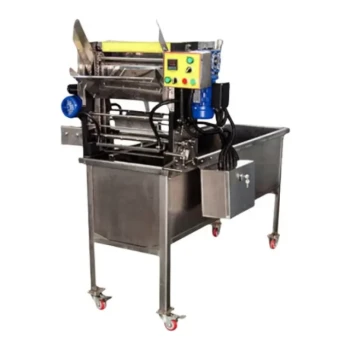
An industrial-grade honey sachet packaging machine serves as the critical bridge between raw production and institutional compliance. It allows beekeepers to convert bulk honey into uniform, portion-controlled sachets that specifically meet the logistical and nutritional mandates of public contracts, such as school feeding programs.
By shifting from raw bulk supply to automated secondary processing, producers can bypass intermediaries and bid directly on government tenders, securing higher value for their product.
The Strategic Shift to Secondary Processing
Meeting Strict Institutional Standards
Public institutions, particularly schools, rarely purchase honey in open jars or bulk containers due to hygiene and serving difficulties.
Industrial packaging machinery transforms your product into a format that governments can actually utilize. It ensures that every unit meets specific weight and packaging standards required by public health regulations.
Solving the Logistics Challenge
Portability is a primary requirement for institutional supply chains.
Sachets are lightweight, durable, and easy to distribute to thousands of individuals daily. This machinery provides the consistency needed to ensure reliable delivery without the waste or mess associated with bulk formats.
Economic Advantages for Beekeepers
Bypassing the Middleman
Traditionally, beekeepers sell to packers who then secure lucrative government contracts.
By owning the secondary processing machinery, you become the packer. This allows you to participate directly in tenders, retaining the profit margin that would otherwise go to an intermediary.
Increasing Product Valuation
Raw honey is often treated as a commodity with fluctuating prices.
Packaged sachet honey is a finished consumer product. This transformation significantly increases the value per kilogram, stabilizing your revenue stream against market volatility.
Understanding the Trade-offs
Operational Complexity
Transitioning from apiary management to industrial manufacturing requires a shift in mindset.
Operating an industrial-grade machine introduces new variables, including maintenance schedules, film stock management, and quality control protocols. You are no longer just a farmer; you are a factory operator.
Volume Requirements
These machines are designed for high throughput.
To justify the capital investment, you must have a sufficient supply of raw honey. Low-volume producers may find the machine sits idle too often to generate a return on investment (ROI).
Positioning for Institutional Success
To leverage this technology effectively, you must align your machinery choice with your business objectives.
- If your primary focus is winning large-scale government tenders: Prioritize high-speed automation to ensure you can meet the massive daily volume requirements of school feeding programs.
- If your primary focus is maximizing revenue retention: Use the machine's capabilities to vertically integrate, eliminating third-party packers to capture the full value of the supply chain.
Owning the packaging process transforms you from a raw material supplier into a strategic partner for public institutions.
Summary Table:
| Feature | Institutional Requirement | Machine Benefit |
|---|---|---|
| Portion Control | Precise nutritional tracking | Automated uniform weight per sachet |
| Hygiene | Compliance with health safety | Sealed, touchless secondary processing |
| Logistics | Ease of mass distribution | Lightweight, durable, and stackable format |
| Value Chain | Direct procurement (Bypassing middlemen) | High-margin finished consumer goods |
Scale Your Apiary with HONESTBEE Packaging Solutions
Transition from raw material supplier to a strategic institutional partner with HONESTBEE. We specialize in empowering commercial apiaries and distributors with the industrial-grade machinery needed to secure lucrative public contracts. From high-speed honey-filling machines and sachet packaging lines to specialized hive-making hardware, we provide the end-to-end equipment and consumables required for large-scale operations.
Ready to capture the full value of your honey production? Contact our team today to find the perfect equipment solution and start bidding on high-volume government tenders with confidence.
References
- Alexsandra Batista Cândido Siqueira, Eulita de Souza Morais. Beekeeping developed by family farming in Rio Grande do Norte: an analysis of the interaction with markets. DOI: 10.1590/1806-9479.2025.285791
This article is also based on technical information from HonestBee Knowledge Base .
Related Products
- Automatic Single-Dose Snap & Squeeze Honey Sachets Packing Machine
- Honey Stick Filler Vertical Paste Sachet Packing Machine for Honey Sachets
- Double Nozzle Small Honey Filling Machine Honey Sachet Packing Packaging Equipment
- Small Honey Filling Machine Sachet Packing Equipment Single Nozzle
- Precision Automated Packaging Turntable Honey Spoon Filling Sealing Packing Machine
People Also Ask
- What are the advantages of honey sachet packing machines? Boost Efficiency & Unlock New Markets
- What are the main functions of a honey sachet packing machine? Boost Efficiency with Automated Precision
- Why is automated packaging machinery essential for scaling industrial honey production? Drive Commercial Scalability
- How does the viscosity of honey influence packaging choices? Selecting the Best Containers & Machinery
- Why is it advantageous for apiaries to be located near honey processing centers? Boost Quality and Market Reach