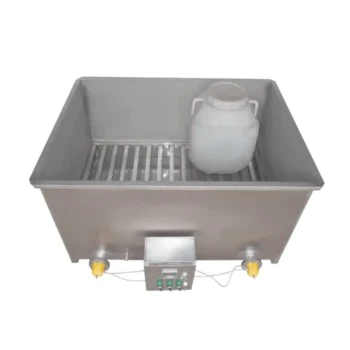
Bulk honey processing is a systematic method designed to refine large quantities of semi-processed honey for commercial packaging. This process relies on a specific sequence of controlled heating, gravity-fed filtration through concentric sieves, and a multi-day settling period to remove impurities.
Core Insight While general processing involves extraction, bulk processing specifically focuses on refining volume. It utilizes thermal reduction of viscosity combined with passive gravity straining to ensure a consistent, debris-free product without the need for aggressive high-pressure mechanical systems.
The Thermal Conditioning Phase
Sump Tank Loading
The process begins with semi-refined honey being loaded into a sump tank. This vessel serves as the initial staging area for the large volume of raw material.
Controlled Heating
Inside the sump tank, the honey is heated to a specific range of 45–50°C.
This temperature is critical. It lowers the viscosity (thickness) of the honey, allowing it to flow freely through the filtration system without requiring excessive force, which could aerate or damage the product.
The Gravity Filtration Architecture
Concentric Sieve Design
Once heated, the honey flows by gravity into a specialized straining apparatus. This system uses a series of concentric sieves (screens nested inside one another).
Coarse-to-Fine Separation
The flow is directed from the center outward. The coarsest mesh is located on the inside to catch large debris immediately.
As the honey pushes outward, it passes through increasingly finer mesh layers on the outside. This staged approach prevents the finer screens from clogging prematurely with large particles like beeswax.
Settling and Clarification
The Three-Day Rule
After passing through the strainers, the honey enters a large settling tank. It must remain here, undisturbed, for a minimum of three days.
Passive Separation
During this resting period, gravity acts as the final clarifier. Air bubbles trapped during moving and heating rise to the top, carrying remaining fine impurities with them.
Scum Removal
A layer of "scum" (foam and fine debris) eventually forms on the surface of the tank. This layer is physically removed to leave only clear, dense honey below, which is then ready for packing.
Understanding the Trade-offs
Heat Management
While heating to 50°C is necessary for flow, it requires precision. Exceeding this temperature can degrade the honey's natural enzymes and alter its flavor profile.
Time vs. Throughput
This method is not instantaneous. The requirement for a three-day settling period creates a bottleneck in production speed, but it is essential for achieving visual clarity without high-pressure filtration.
Making the Right Choice for Your Goal
- If your primary focus is Production Speed: You must ensure your sump tank capacity matches your daily intake to prevent the three-day settling requirement from halting your line.
- If your primary focus is Product Clarity: Ensure the concentric sieves are maintained rigorously; a breach in the inner coarse mesh will instantly clog the outer fine mesh and halt the gravity flow.
Mastering bulk processing requires balancing the thermal energy needed for movement with the patience required for settling.
Summary Table:
| Stage | Action | Primary Goal |
|---|---|---|
| Thermal Conditioning | Heat to 45–50°C | Lower viscosity for easier flow |
| Gravity Filtration | Pass through concentric sieves | Remove debris (coarse to fine) |
| Settling Phase | 3-day undisturbed rest | Eliminate air bubbles and fine impurities |
| Clarification | Scum removal | Achieve final visual clarity and purity |
Streamline Your Commercial Honey Production with HONESTBEE
Maximize your apiary's output and product quality with professional-grade equipment. HONESTBEE specializes in supporting commercial apiaries and distributors with a full spectrum of wholesale solutions. From high-capacity honey-filling machines and specialized hardware to essential consumables and hive-making machinery, we provide the tools you need to master bulk processing.
Ready to scale your operations or upgrade your wholesale portfolio? Contact us today to discuss your equipment needs and discover how our expertise in beekeeping technology can drive your business growth.
Related Products
- Electric Double Wall Honey Filtering Machine Purifier Equipment for Honey Processing Plant
- 0.5T Capacity Honey Dehumidifier Dryer with Vacuum Heating and Thickening Filtering Machine
- Heavy Duty Stainless Steel Honey Processing Machine Decrystallizing Tank
- Double Wall Honey Heating Stirring Homogenizer Mixing Machine with Various Capacity
- Economy Honey Homogenizer Mixer and Melting Machine for Beekeeping
People Also Ask
- What is the process of filtering honey? A Guide to Clean, Pure, and Market-Ready Honey
- What types of equipment are used in honey filtering? Build an Efficient System for Pure, Marketable Honey
- What is the overall importance of using the right equipment in honey filtering? Boost Quality & Marketability
- What are the benefits of drying honey filtering equipment after use? Protect Your Honey Quality & Equipment Investment
- What steps are involved in maintaining honey filtering equipment? A Guide to Protecting Your Honey Quality