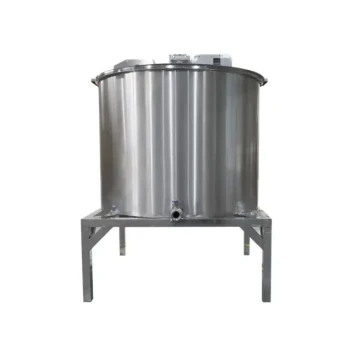
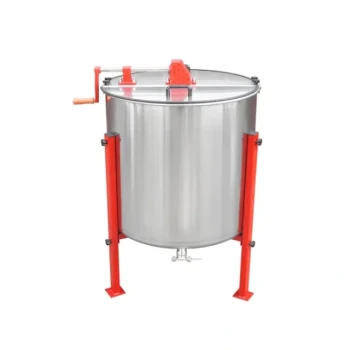
The glucose-to-fructose ratio determines how quickly honey crystallizes, while viscosity determines how much force and temperature control machinery needs to move it. High-glucose honey may crystallize in frames, pipes, filters, and filling heads, whereas dense, low-moisture, or thixotropic honey can require stronger extraction, pumping, agitation, and filling systems. Commercial operators should therefore select equipment by honey profile and target format, not by nominal machine capacity alone.
The right machinery must manage both phase stability and flow resistance. Flexible systems combine variable-speed extraction, controlled warming, suitable pumps, heated filtration stages, agitation where necessary, and adjustable filling controls to handle seasonal and varietal differences without damaging honey quality.
Why the Sugar Ratio Matters to Equipment Selection
Glucose Drives Crystallization
Honey with a relatively high glucose proportion tends to crystallize more rapidly because glucose precipitates from the supersaturated honey solution. Crystallized honey can restrict flow through strainers, pumps, valves, pipes, and filling nozzles.
The practical result is that equipment must either process the honey before significant crystallization occurs or include systems that can restore uniform flow under controlled conditions.
Fructose Supports a Longer Liquid Phase
Fructose is generally more soluble in water than glucose. Honey with a higher relative fructose content typically remains liquid for longer, although the exact behavior also depends on moisture content, temperature, floral origin, and the presence of crystallization nuclei.
This does not mean that high-fructose honey always flows easily. A honey can remain liquid while still being highly viscous, especially when its moisture content is low or its structure is thixotropic.
Use Ratio Data as a Planning Indicator
AGMARK and BIS-related guidance commonly references a minimum fructose-to-glucose ratio in the approximate range of 0.9 to 1.0, together with minimum total reducing sugar levels. These values can support quality and process planning, but they should not be treated as a complete prediction of machine performance.
Operators should combine laboratory composition data with actual measurements of viscosity, moisture, crystallization behavior, and temperature response for each major honey stream.
How Viscosity Changes the Processing Line
Moisture Has a Major Effect
Honey becomes sharply more viscous as its moisture content falls. The change can be especially significant as moisture declines from around 20% toward 18%, increasing resistance during extraction, filtration, pumping, and filling.
A line designed only for relatively fluid honey may experience lower throughput, higher pump loads, filter blockage, and inaccurate filling when processing drier honey.
Temperature Reduces Resistance
Controlled warming lowers viscosity and improves movement through the processing line. The heating system must provide uniform, gradual temperature control rather than localized high heat.
Excessive or poorly distributed heat can impair honey quality and create hot spots, particularly in small pipes, filling heads, or poorly mixed tanks. Heating should therefore be matched with temperature monitoring, agitation, and adequate residence-time control.
Thixotropic Honey Needs Agitation
Some honey types become jelly-like when undisturbed and flow more readily after movement or shear. This behavior can make ordinary gravity drainage and static storage ineffective.
Such honey may require heavy-duty agitation, suitable tank geometry, larger transfer passages, and pumps selected for viscous or structured fluids. Operators should avoid assuming that a standard centrifugal pump will perform consistently across all varietal lines.
Matching Machinery to the Processing Stage
Extraction Requires Speed and Structural Control
High-viscosity honey places greater resistance on centrifugal extraction. Variable-speed extractors allow operators to begin gently and increase speed progressively as the honey releases.
This controlled approach helps reduce the risk of comb blowout while providing enough force to process dense honey efficiently. Sturdy frames and heavy-duty extractor construction become more important for late-season or low-moisture crops.
Pumps Must Be Sized for the Actual Product
Pump selection should consider viscosity, temperature, distance, elevation, pipe diameter, and required flow rate. Dense honey may need an industrial pump with positive-displacement characteristics or another design intended for viscous food products.
Pump capacity should not be evaluated only by its advertised flow rate with water-like liquids. The relevant specification is performance under the expected honey temperature and viscosity range.
Filtration Needs Heat and Flow Management
Fine filtration improves product clarity, but dense or partially crystallized honey can quickly overload filter media. Heated sump tanks, warmed strainers, adequate filter area, and controlled differential pressure help maintain flow.
The filtration system should also include accessible clean-out procedures. A filter that is difficult to inspect or clean can become the limiting point of the entire line.
Filling Machines Need Adjustable Controls
Honey-filling equipment must accommodate changes in density and flow behavior. Adjustable volumetric settings, pressure controls, heated nozzles, and piston-based filling systems can improve accuracy across light and heavy honey batches.
Anti-drip nozzles are especially valuable because honey stretches and adheres as the filling stream stops. Without suitable shutoff and nozzle design, the result can be product waste, container contamination, and inconsistent presentation.
Seasonal and Floral Variation
Early-Season Honey May Run Through Standard Lines
Early spring honey is often lighter and less viscous than later-season honey. It may pass through standard extraction and filtration equipment with relatively low resistance.
Even so, the equipment should retain sufficient adjustment range to accommodate changes in moisture and composition between harvests.
Late-Season Honey Raises Mechanical Demand
Late summer and fall honey is often denser and heavier. It can require stronger extraction drives, slower initial spinning, heated tanks, heavy-duty pumps, and larger or better-managed filtration capacity.
A commercial line intended for year-round use should be sized around its most demanding routine product, not only its easiest early-season batch.
Floral Origin Can Require Separate Circuits
Floral origin affects sugar ratio, crystallization, viscosity, color, flavor, and market positioning. Strongly colored or intensely flavored varietals may contaminate the character of lighter honey if they are processed through shared equipment without effective cleaning and segregation.
Separate storage, dedicated transfer paths, or validated cleaning procedures may be necessary. This is both a product-quality issue and a machinery-utilization issue.
Designing a Flexible Commercial Honey Line
Build Around Controlled Warming
A controlled warming unit should be integrated with storage, pumping, filtration, and filling rather than treated as an isolated accessory. The objective is to maintain workable viscosity throughout the line while limiting unnecessary thermal exposure.
Temperature sensors at tanks, transfer points, and filling heads help identify where flow problems are occurring and prevent operators from compensating with excessive heat.
Use Variable-Speed Equipment
Variable-speed extractors, pumps, and agitators give operators more control over changing honey properties. This is particularly important when one facility processes multiple varietals or harvests with different moisture levels.
Adjustable equipment also supports different product formats, including liquid honey, creamed honey, blended products, and bulk drum filling.
Plan for Cleaning and Changeover
Honey residue can harden or crystallize in dead legs, valves, filters, and nozzles. Equipment should be arranged for drainage, inspection, sanitation, and rapid changeover between product lines.
For distributors and B2B resellers, a complete equipment portfolio should include not only primary machines but also compatible pumps, heated tanks, filters, nozzles, controls, spare parts, and technical support.
Understanding the Trade-offs
More Heat Improves Flow but Can Reduce Quality
Raising temperature can make dense honey easier to pump and fill, but excessive heat may damage quality attributes. The best solution is usually adequate equipment sizing and gradual temperature control rather than simply increasing the set point.
Thermal homogenization should be applied only as much as needed to achieve the required flow and uniformity.
Higher Pump Capacity Does Not Solve Every Problem
A stronger pump cannot compensate for undersized pipes, blocked filters, crystallized valves, or an unsuitable nozzle. Excessive pressure can also increase mechanical stress and create unstable filling behavior.
The full flow path must be evaluated as a system, including tank outlets, strainers, filters, hoses, valves, and filling heads.
One Machine May Not Suit Every Honey Style
Extracted liquid honey, comb honey, chunk honey, and creamed honey have different equipment requirements. Centrifugal extraction and filtration are appropriate for liquid honey, while comb and chunk products require cutting and handling systems that preserve beeswax structure.
Whipped or creamed honey requires controlled mixing and crystallization management. Purchasing a general-purpose liquid honey line for every format can create avoidable quality and throughput problems.
Standardized Filling Can Reduce Accuracy
A fixed nozzle, fixed pressure, or single-speed filling cycle may perform well on one honey but produce underfills, overfills, dripping, or inconsistent cycle times on another. Filling equipment should provide adjustable parameters and repeatable calibration procedures.
This is particularly important for operations serving multiple package sizes or switching between retail containers and bulk drums.
Making the Right Choice for Your Goal
The most reliable purchasing decision begins with the expected honey profile, production volume, product format, and changeover requirements.
- If your primary focus is maximum throughput: Select variable-speed extraction, viscous-product pumps, heated transfer and filtration stages, and equipment sized for the densest expected honey.
- If your primary focus is product quality: Use gentle, controlled warming, uniform agitation, temperature monitoring, and filtration systems that avoid excessive residence time and localized overheating.
- If your primary focus is filling accuracy: Choose adjustable volumetric nozzles or piston fillers with pressure regulation, heated heads, and anti-drip controls.
- If your primary focus is processing multiple varietals: Prioritize modular equipment, dedicated storage or transfer circuits, and fast, verifiable cleaning between strongly different honey types.
- If your primary focus is creamed or specialty honey: Source dedicated mixing and temperature-controlled crystallization equipment rather than relying on a standard liquid honey line.
- If your primary focus is dependable procurement: Work with a supplier that can provide a full equipment portfolio, rapid technical response, compatible accessories, spare parts, and coordinated delivery.
When glucose ratio and viscosity are treated as core design parameters, commercial honey machinery becomes more reliable, more adaptable, and better suited to consistent year-round production.
Summary Table:
| Factor | Impact on Processing | Machinery Considerations |
|---|---|---|
| Glucose-to-fructose ratio | High glucose leads to crystallization, causing flow restrictions. | Use variable-speed extractors, heated filtration, and anti-clog nozzles. |
| Viscosity | Dense honey resists flow, requiring more force and temperature control. | Select positive-displacement pumps and heated tanks. |
| Moisture content | Lower moisture increases viscosity sharply. | Ensure adequate pump capacity and heating capacity. |
| Thixotropic behavior | Honey may be jelly-like until agitated, affecting gravity drainage. | Include heavy-duty agitation and larger passages. |
| Seasonal variations | Early honey is lighter; late honey is denser. | Design line for most demanding product; use adjustable settings. |
Ensure your honey processing line handles any honey type with precision. HONESTBEE offers a complete range of beekeeping machinery designed for variable viscosities and sugar ratios. From extractors and pumps to heated filtration and precise filling systems, we provide one-stop sourcing for commercial apiaries and distributors. Our rapid response, dedicated support, and fast delivery keep your operations running smoothly. Contact us today for tailored solutions that boost your efficiency and profitability.
Related Products
- Electric Double Wall Honey Filtering Machine Purifier Equipment for Honey Processing Plant
- Honey Concentrating and Filtering Dehumidifier Machine 2T Capacity for Honey
- Stainless Steel Manual 8 Frame Radial Honey Extractor Machine for Beehives
- Double Wall Honey Heating Stirring Homogenizer Mixing Machine with Various Capacity
- Fully Automatic Honey Filling Packaging Machine for Processing Line
People Also Ask
- What is the process of filtering honey? A Guide to Clean, Pure, and Market-Ready Honey
- What types of equipment are used in honey filtering? Build an Efficient System for Pure, Marketable Honey
- What is the overall importance of using the right equipment in honey filtering? Boost Quality & Marketability
- What is a potential concern associated with filtering honey? Balancing Clarity and Pollen Preservation
- What role do professional honey harvesting and filtering equipment play in meeting honey market quality standards? Boost ROI