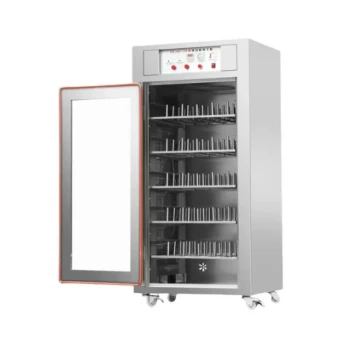
The layout of trays within a drying chamber functions as the primary regulator of airflow distribution, acting as the defining variable for process efficiency. In traditional tiered designs, particularly those relying on a single heat source inlet, the physical arrangement of the trays often impedes uniform air circulation, creating significant disparities in how quickly bee-bread dries across different levels.
Traditional tiered drying systems with single-point inlets are prone to severe airflow stratification. This lack of uniformity can create a drying time differential of up to 20 hours between the top and bottom trays, creating a production bottleneck that compromises batch consistency.
The Mechanics of Inefficiency
The Single-Inlet Constraint
Traditional drying chambers typically utilize a single heat source inlet.
When trays are stacked in a tiered layout, this solitary entry point struggles to force air evenly through the entire structure.
Airflow Obstruction
The trays themselves act as physical barriers to the air current.
As air attempts to navigate the stack, it often bypasses certain levels or loses velocity, leading to "dead zones" where moisture remains trapped.
The Impact on Production Speed
The 20-Hour Lag
The most critical metric regarding this layout is the disparity in drying time.
Evidence shows that the difference in drying completion between the top and bottom trays can reach up to 20 hours.
Batch Cycle Delays
This gap forces the entire production line to wait for the slowest drying level.
You cannot process a new batch until the wettest trays are finished, drastically reducing the overall throughput of your facility.
Understanding the Trade-offs
Simplicity vs. Uniformity
Traditional tiered layouts are mechanically simple and often less expensive to construct.
However, the trade-off is a complete lack of control over environmental uniformity, making them unsuitable for operations requiring precision.
Quality Consistency Risks
Inefficient airflow does not just waste time; it endangers the product.
While waiting for the slowest trays to dry, the faster-drying trays may be exposed to heat for too long, degrading the nutritional quality of the bee-bread. Conversely, pulling the batch early risks leaving lower trays susceptible to mold.
Optimizing Your Drying Strategy
If you are evaluating drying equipment, consider how tray layout impacts your specific goals:
- If your primary focus is Production Velocity: You must move away from single-inlet tiered designs to avoid the 20-hour latency period caused by uneven drying.
- If your primary focus is Product Quality: You require a system that guarantees uniform airflow to prevent the degradation that occurs when parts of a batch are over-dried while others remain damp.
Efficiency in bee-bread drying is not just about heat generation; it is fundamentally about how effectively your tray layout manages airflow distribution.
Summary Table:
| Inefficiency Factor | Traditional Tiered Layout Impact | Impact on Production Quality |
|---|---|---|
| Airflow Source | Single heat source inlet | Creates severe airflow stratification and "dead zones." |
| Drying Time | Up to 20-hour differential | Causes production bottlenecks and batch cycle delays. |
| Product Consistency | High variability between tiers | Risk of over-drying at top levels and mold growth at bottom. |
| Structural Constraint | Trays act as physical barriers | Reduced air velocity leading to trapped moisture. |
Maximize Your Apiary's Production Efficiency with HONESTBEE
Don't let outdated drying layouts create bottlenecks in your facility. At HONESTBEE, we specialize in empowering commercial apiaries and distributors with high-performance beekeeping machinery and tools.
Whether you need precision honey-filling machines, industrial-grade hive-making hardware, or specialized drying solutions that ensure uniform quality, our comprehensive wholesale offering is designed to scale your operations. From essential consumables to advanced mechanical equipment, we provide the tools you need to maintain nutritional integrity and maximize throughput.
Ready to upgrade your beekeeping equipment and eliminate 20-hour drying lags?
Contact HONESTBEE Today for a Professional Consultation
References
- Sergei Oskin, Dmitry Tsokur. Improving the efficiency of the bee-bread drying process. DOI: 10.1088/1755-1315/1052/1/012104
This article is also based on technical information from HonestBee Knowledge Base .
Related Products
People Also Ask
- Why use a Cabinet Drier for pollen at 38–41°С? Protect Sample Integrity and Heavy Metal Data Accuracy
- What is the role of an industrial forced-air drying oven in bee bread fermentation? Optimize Moisture and Nutrients
- What is the primary purpose of a constant temperature drying oven in bee bread production? Achieve Perfect Fermentation
- How do forced circulation drying ovens sterilize beekeeping tools? Efficient Oxidation for Metal Equipment Safety
- What are the technical requirements for using a constant temperature drying oven for raw propolis? Expert Guide