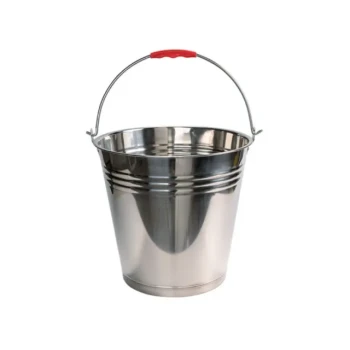
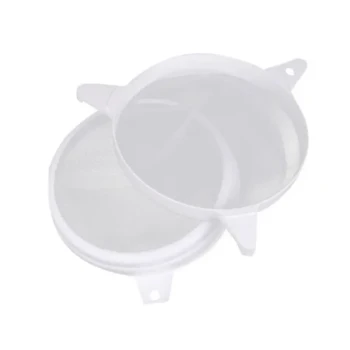
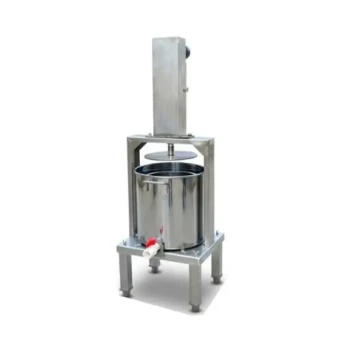
The outer bucket serves as the primary containment vessel. It surrounds the perforated inner bucket to catch the extracted honey as it flows out of the crushed comb, holding it safely until you are ready to release it via an integrated spout.
The outer bucket is the passive half of a dual-bucket system; while the inner bucket strains the wax, the outer bucket captures the yield and directs the flow, ensuring a mess-free extraction process.
The Dual-Bucket Architecture
The Role of Containment
Most bucket honey presses utilize a concentric design. The inner bucket is made of metal mesh or perforations to hold the raw honeycomb and wax.
The outer bucket is solid and larger, designed to fully encompass the inner sieve. Its primary function is to act as a reservoir, catching every drop of honey that is squeezed through the inner mesh by the pressure plate.
Structural Support
The outer bucket sits at the base of the press frame. It provides the stable foundation necessary to withstand the downward force applied by the T-shaped handle and screw mechanism.
Because it does not have perforations like the inner bucket, it prevents honey from leaking onto your work surface during the high-pressure crushing phase.
Managing the Honey Flow
The Integrated Spout
According to the primary design specifications, the outer bucket is molded with a dedicated spout.
This feature transforms the bucket from a simple holding tank into a pouring device. It allows you to direct the extracted honey into storage jars or settling tanks without tipping the entire heavy apparatus.
Flow Control Enhancements
For greater precision, a controlling honey gate can be installed onto the spout of the outer bucket.
Without a gate, honey flows freely as soon as it rises to the level of the spout. Adding a gate allows you to stop the flow instantly, preventing spills and making the bottling process significantly cleaner.
Understanding the Trade-offs
Manual Labor vs. Product Quality
The outer bucket system relies on a traditional, manual process. You must physically rotate the T-handle to generate enough pressure to fill the bucket.
This is labor-intensive and time-consuming compared to motorized radial extractors. However, many enthusiasts prefer this method because the slow, cold-press action is believed to better preserve the natural characteristics of the honey.
Batch Limitations
The capacity of the press is strictly limited by the volume of the buckets.
Once the outer bucket is full, or the inner bucket is packed with compressed wax, you must stop operations to empty the unit. This makes the system less ideal for high-volume commercial operations but perfect for hobbyists.
Making the Right Choice for Your Goal
To determine if this equipment suits your workflow, consider your volume and preservation goals.
- If your primary focus is nutrient preservation: The manual pressure applied within these buckets generates minimal heat, protecting the honey's enzymes and flavor profile.
- If your primary focus is efficiency: Be aware that the batch-based nature of the bucket system requires frequent pausing to drain the outer bucket and clear the inner sieve.
The outer bucket is a simple yet essential component that relies on gravity and geometry to deliver a clean harvest.
Summary Table:
| Feature | Function of the Outer Bucket |
|---|---|
| Core Purpose | Acts as a solid containment reservoir for filtered honey |
| Structure | Solid-walled concentric design to prevent leakage during pressure |
| Flow Mechanism | Integrated spout or honey gate for controlled pouring and bottling |
| Benefit | Protects honey purity through cold-press containment without heat |
| Base Support | Provides structural stability for the internal pressing mechanism |
Maximize Your Harvest Efficiency with HONESTBEE
At HONESTBEE, we specialize in empowering commercial apiaries and global distributors with professional-grade beekeeping solutions. From high-durability honey presses and hive-making machinery to specialized honey-filling equipment and industry consumables, our comprehensive wholesale catalog is designed to scale your operations.
Ready to upgrade your apiary’s equipment? Contact us today to explore our full spectrum of beekeeping tools and custom hardware solutions tailored to your business needs.
Related Products
- Food Grade Plastic Honey Bucket Pail for Beekeeping
- Premium Stainless Steel Honey Tank Bucket Pail with Reinforced Handle and Polished Finish
- Stainless Steel Honey Press Wax Press with Tank
- Plastic Honey Gate Spout with Wing Nut for Beekeeping Honey Bucket
- Stainless Steel Pail Perch Bucket Bench
People Also Ask
- What key operational precautions should be taken when using honey buckets and extractors fitted with bottom drain taps?
- What functions do food-grade honey buckets perform? Safeguard Your Harvest and Optimize Apiary Logistics
- Why are food-grade plastic buckets preferred for honey? Protect Quality with Modern Honey Collection Tools
- What is the significance of food-grade plastic honey collection buckets? Boost Quality in Forest Honey Logistics
- What is a honey pail? The Essential Container for Protecting Your Honey's Value