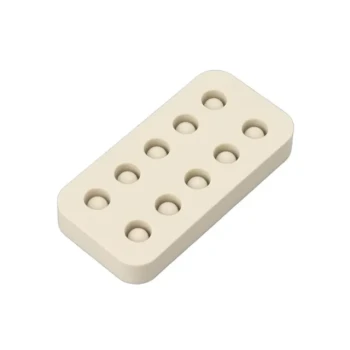
The 100-cell template serves as a precision instrument that transforms subjective observation into objective data. It is a standardized sampling tool placed directly over capped brood cells to calculate the specific ratio of missing or "skipped" cells within a defined area. This method allows you to digitize the queen's egg-laying quality and objectively assess the colony's overall developmental health.
By quantifying the integrity of the brood pattern rather than relying on visual estimates, this tool distinguishes between a thriving colony and one facing hidden stressors. A solid pattern indicates a healthy, well-mated queen, while a spotty pattern provides an immediate, mathematical indicator of reproductive failure or disease.
The Mechanics of Objective Evaluation
Standardizing the Sample
To ensure consistency, the template isolates a specific sample size of 100 potential cells within the capped brood area.
This eliminates the variability of "eyeballing" a frame. It forces the observer to look at a fixed data set, removing personal bias regarding what constitutes a "good" frame.
Measuring "Skipped" Cells
The core metric of this evaluation is the number of empty or missed cells within the template's boundary.
Rather than counting the larvae present, you are looking for gaps in the pattern. These gaps represent failures in the brood cycle, whether due to the queen failing to lay an egg or the workers removing an unhealthy larva.
Calculating Brood Integrity
The final output of this process is a "brood integrity" score.
By subtracting the number of skipped cells from the total (100), you derive a percentage that represents the solidity of the brood. This digitizes the biological performance of the colony, making it possible to track changes over time statistically.
Interpreting the Health Indicators
Assessing Queen Fecundity
A high integrity score directly reflects the reproductive quality of the queen.
A solid, organized brood pattern implies the queen is well-mated and laying eggs consistently. It serves as a direct confirmation of her fecundity without requiring you to locate the queen herself.
Identifying Colony Stressors
When the template reveals a high ratio of missing cells (a "spotty" pattern), it acts as an early warning system.
While this measures the queen's output, significant skipping also suggests external pressures. It often indicates that the hive is experiencing stress, such as significant disease or varroa mite infestations, which cause spotty brood patterns as bees remove infected pupae.
Understanding the Trade-offs
Quality vs. Quantity
The 100-cell template measures the quality of the brood pattern, not the quantity of the bees.
It tells you how well the queen is laying in a specific patch, but it does not measure the total surface area of the brood. For measuring total colony strength or biomass, a larger grid framework (such as a nylon-stringed cork frame) is required to calculate total surface area.
Contextual Blind Spots
The tool provides raw data, but it cannot explain the "why" behind an empty cell on its own.
An empty cell is usually a negative indicator, but it could occasionally be a result of "backfilling" with nectar during a heavy flow. You must still use your expertise to interpret whether the missing cells are due to poor health or resource management.
Making the Right Choice for Your Goal
If your primary focus is evaluating Queen Genetics: Use the 100-cell template to test for high brood integrity (95%+), which confirms a hygienic and well-mated queen.
If your primary focus is measuring Colony Biomass: Use a larger grid framework to measure total capped brood surface area, as the 100-cell template only samples density, not total population.
If your primary focus is Disease Monitoring: Use the template to track brood spot pattern trends; a sudden drop in integrity is a reliable leading indicator of mite pressure or brood disease.
Objective measurement is the only way to move from guessing the state of your apiary to truly managing it.
Summary Table:
| Metric | 100-Cell Template Focus | Indication of High Score (95%+) | Indication of Low Score |
|---|---|---|---|
| Brood Integrity | Ratio of filled vs. skipped cells | High-quality, well-mated queen | Reproductive failure or disease |
| Queen Fecundity | Consistency of egg-laying | Strong genetic reproductive health | Aging or poorly mated queen |
| Stress Detection | Pattern of missing larvae | Healthy environment | Varroa mites or brood disease |
| Data Type | Qualitative density sample | Precise, digitized health data | Visual bias or subjective error |
Maximize Your Apiary Productivity with HONESTBEE
At HONESTBEE, we understand that objective data is the backbone of successful commercial beekeeping. Whether you are a professional distributor or managing large-scale commercial apiaries, we provide the precision tools and machinery you need to thrive.
From specialized hive-making and honey-filling machines to a comprehensive range of wholesale beekeeping equipment and consumables, we offer high-performance solutions designed to enhance your operational efficiency. Partner with us to access professional-grade hardware and unique honey-themed cultural merchandise tailored for the global market.
Ready to scale your beekeeping business?
Contact HONESTBEE Today to explore our full spectrum of wholesale solutions!
References
- Veeranan Chaimanee, Jeffery S. Pettis. Gene expression, sperm viability, and queen (Apis mellifera) loss following pesticide exposure under laboratory and field conditions. DOI: 10.1007/s13592-019-00645-4
This article is also based on technical information from HonestBee Knowledge Base .
Related Products
- 10-Cell Silicone Beeswax Bee Queen Cups Forming Mold
- Professional Large-Format Hive Number Set for Beekeeping
People Also Ask
- How do beeswax queen cell cups function? Optimize Queen Rearing with Biological Mimicry
- What is the biological function of beeswax queen cell cups? Boost Acceptance in Artificial Queen Rearing
- What role do specialized queen rearing tools play in developing mite-resistant honeybee stock? Master Genetic Selection
- What materials are used to make artificial queen cell cups for grafting? Beeswax vs. Plastic Guide
- What roles do specialized queen cell cups play in royal jelly production? Optimize Your Hive's Secretion and Yield