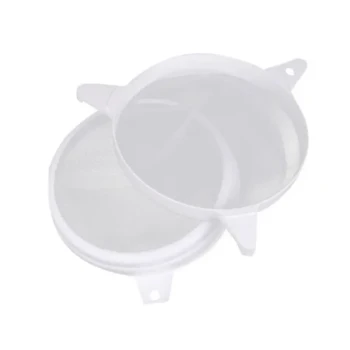
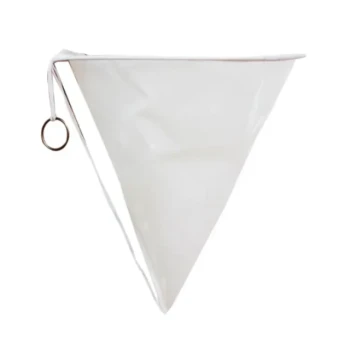
In the context of Varroa monitoring, a double-layer honey filter serves as a precise mechanical separator. It is utilized after a sample of adult bees has been agitated in a soapy water solution to dislodge the mites. The device uses two distinct mesh sizes to isolate the parasites from the host bees in a single, efficient pour.
The double-layer system streamlines the assessment process by automating the separation of biological materials. It ensures that technicians can rapidly and accurately count mites without debris interference, providing the standardized data needed to calculate infestation levels per 10 grams of bees.
The Mechanics of Separation
The Role of Agitation
Before filtration occurs, the biological sample must be prepared. Adult bee samples are submerged in soapy water and agitated vigorously.
This agitation is critical, as the soapy medium helps detach the Varroa mites that are clinging to the bodies of the bees.
The Coarse Upper Layer
Once the agitation is complete, the liquid mixture is poured through the double-layer filter. The first layer acts as a coarse screen.
This layer is designed specifically to retain the bodies of the adult honeybees, preventing them from passing through to the collection area while allowing the liquid and smaller particles to flow downward.
The Fine Lower Layer
Directly beneath the coarse screen lies the second, fine-mesh layer. This screen is engineered with specific pore sizes that are too small for Varroa mites to pass through.
While the soapy water drains away, this layer captures the detached mites, leaving them isolated and clearly visible for the technician to count.
Standardizing Infestation Data
Creating a Measurable Metric
The primary goal of using this dual-filtration method is to generate a standardized metric. By separating the mites from a specific weight of bees, technicians can determine the count per 10 grams of adult bees.
This standardization allows beekeepers to compare infestation rates accurately across different hives or over different time periods.
Supporting Control Strategies
Accurate counting is impossible if mites are hidden among wet bees or debris. The fine-mesh screen ensures precise separation, eliminating ambiguity in the visual inspection.
This high-quality data provides the factual basis required to decide whether immediate pest control strategies are necessary to save the colony.
Common Pitfalls to Avoid
Dependence on Agitation Quality
The filter is only as effective as the washing process preceding it. If the sample is not agitated sufficiently in the soapy water, mites will remain attached to the bees and will be trapped in the top coarse layer rather than falling to the fine screen.
Screen Integrity
The accuracy of the count relies entirely on the integrity of the fine mesh. If the screen is damaged or possesses incorrect pore sizes, mites may wash through with the water, leading to a falsely low infestation count and potentially disastrous management decisions.
Making the Right Choice for Your Goal
To utilize this tool effectively in your management program:
- If your primary focus is Accuracy: Ensure vigorous agitation in the soapy solution before pouring, as the filter cannot separate mites that are still attached to bee bodies.
- If your primary focus is Data Consistency: Always weigh the bee sample (e.g., 10 grams) before washing to ensure the resulting mite count can be converted into a standardized percentage.
Reliable data is the foundation of bee health; proper filtration turns a messy sample into a clear decision.
Summary Table:
| Component | Function | Result |
|---|---|---|
| Soapy Water Agitation | Detaches Varroa mites from adult bees | Prepares sample for filtration |
| Coarse Upper Layer | Retains adult bee bodies | Separates hosts from parasites |
| Fine Lower Layer | Captures detached Varroa mites | Enables accurate visual counting |
| Standardization | Calculates mites per 10g of bees | Provides comparable health metrics |
Elevate Your Beekeeping Standards with HONESTBEE
At HONESTBEE, we understand that precision is the backbone of a thriving commercial apiary. As a premier provider for commercial apiaries and distributors, we offer a comprehensive wholesale range of professional-grade beekeeping tools and machinery.
Whether you need specialized honey-filling machines, high-integrity filtration hardware, or essential consumables, our portfolio is designed to enhance your operational efficiency and colony health. From advanced hive-making equipment to honey-themed cultural merchandise, we provide the tools you need to scale your business.
Ready to optimize your apiary or expand your distribution? Contact us today to discuss your wholesale needs!
References
- Cecília Costa, J. Wilde. A Europe-Wide Experiment for Assessing the Impact of Genotype-Environment Interactions on the Vitality and Performance of Honey Bee Colonies: Experimental Design and Trait Evaluation. DOI: 10.2478/v10289-012-0015-9
This article is also based on technical information from HonestBee Knowledge Base .
Related Products
- Stainless Steel Double Layer Honey Strainer Sieve Filters
- Electric Double Wall Honey Filtering Machine Purifier Equipment for Honey Processing Plant
- Two-Stage Plastic Honey Filter for Buckets
- Professional Stainless Steel Honey Filtering Machine with Water Bath Heating for Beekeeping
- Double Nozzle Small Honey Filling Machine Honey Sachet Packing Packaging Equipment
People Also Ask
- What are some typical mesh size combinations found in double sieve honey strainers? Expert Guide to Honey Filtration
- How do double-layer honey filters and white blotting paper function together in Varroa mite detection? Expert Guide
- What is the function of honey sieves, strainers, and filters in processing? Master the 3 Stages of Honey Purity
- What mesh sizes are commonly used in double sieve honey strainers? Achieve Clean, Raw Honey Efficiently
- How does a double sieve honey strainer work? Achieve Crystal Clear Honey with Professional Two-Stage Filtration