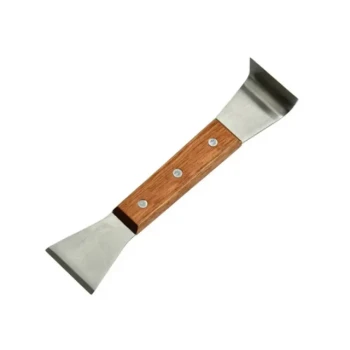
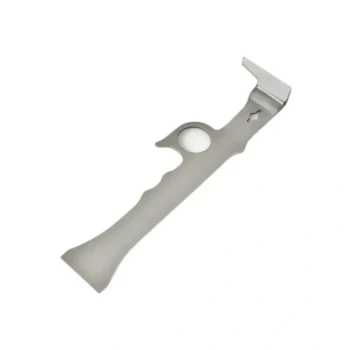
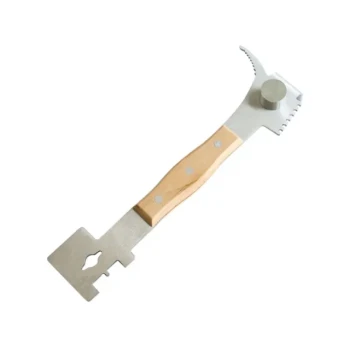
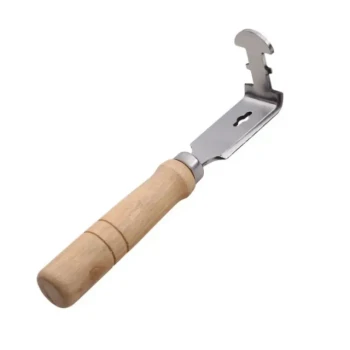
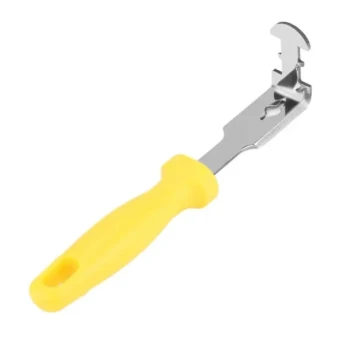
An industrial-grade hive tool functions as a precision instrument to generate consistent mechanical stimuli by tapping the beehive lid at a controlled frequency and force. This repetitive action simulates the disturbance caused by external predators or human interference, effectively provoking the colony’s natural defensive instincts for observation.
By leveraging the robust construction of an industrial-grade tool, researchers ensure that impact energy remains uniform across all trials. This creates a reliable baseline for analysis, isolating bee behavior as the variable rather than the intensity of the disturbance.
The Mechanics of Standardized Stimulation
Generating Consistent Impact Energy
The primary function of utilizing an industrial-grade tool is to eliminate variability in the physical stimulus. Because these tools are constructed to be robust and rigid, they do not deform or yield significantly upon impact.
This structural integrity ensures that when the operator taps the lid, the transfer of energy is uniform. This allows for a direct comparison between different trials without the equipment introducing noise into the data.
Mimicking Ecological Threats
The utilization of the tool is designed to replicate specific biological stressors. By tapping the lid, the tool simulates the physical vibrations associated with a predator attempting to breach the hive or a human beekeeper intervening.
This triggers the colony's innate defensive mechanisms. The goal is to induce a response that is authentic to the bees' natural instincts while keeping the trigger artificial and controlled.
Establishing Frequency and Force
Standardization relies on two specific parameters: constant frequency and constant force. The tool is not used randomly; it is applied rhythmically.
This distinct pattern differentiates the stimulus from random environmental noise (like wind). It ensures that every colony tested experiences the exact same "threat level" during the experiment.
The Context of Experimental Control
Integration with Standardized Housing
The effectiveness of the hive tool relies on the environment it strikes. As noted in supplementary findings, the tool is most effective when used on standardized beehives with removable lids and uniform dimensions.
If the hive lid varies in thickness or material, the sound and vibration produced by the tool would fluctuate. Therefore, the tool and the hive structure work as a system to ensure the physical stimuli are comparable across all test subjects.
Reproducibility of Results
The ultimate goal of using this specific method is reproducibility. By using a standard tool on a standard surface, researchers create a protocol that can be repeated by different scientists in different locations.
This rigorous control allows for the accurate evaluation of colony strength and aggression levels. It removes the guesswork regarding whether a colony was more aggressive because they are genetically defensive or simply because they were hit harder.
Understanding the Trade-offs
Mechanical vs. Biological Stimuli
While an industrial hive tool provides excellent mechanical consistency, it is strictly a physical stimulus. It does not replicate chemical cues (such as breath or pheromones) that a live predator would present.
Researchers must acknowledge that they are measuring the response to vibration and impact, which is only one component of a full defensive reaction.
Operator Precision
Although the tool itself is standardized, its manual utilization still involves a human element. The operator must remain disciplined to maintain the "constant frequency" mentioned in the protocol.
Fatigue or distraction can alter the rhythm of the tapping. Consequently, the reliability of the tool is partially dependent on the consistency of the handler.
Implementing Rigor in Behavioral Studies
To maximize the value of your data when studying honeybee defensiveness, consider the following applications:
- If your primary focus is establishing a baseline: Ensure the hive tool is robust enough to deliver non-deforming impacts, keeping energy transfer identical across all trials.
- If your primary focus is comparative analysis: Verify that the hive lids being tapped are structurally identical to ensure the standardized tool produces the same vibration in every colony.
True experimental integrity is achieved when you control the input so precisely that the only variable remaining is the behavior of the bees themselves.
Summary Table:
| Parameter | Specification for Experiments | Benefit to Researcher |
|---|---|---|
| Tool Type | Industrial-Grade Rigid Construction | Eliminates energy loss and tool deformation |
| Stimulus Method | Controlled Rhythmic Tapping | Distinguishes threat from environmental noise |
| Key Variables | Constant Force & Frequency | Ensures a reliable baseline across all trials |
| Requirement | Standardized Beehive Housing | Maintains uniform vibration and sound resonance |
| Outcome | Reproducible Aggression Data | Isolates bee genetics as the primary variable |
Elevate Your Apiary Operations with HONESTBEE
At HONESTBEE, we understand that whether you are conducting rigorous behavioral research or managing a commercial honey production line, precision and durability are non-negotiable. We cater to commercial apiaries and global distributors by providing a comprehensive wholesale offering of the industry’s most reliable tools.
From industrial-grade hive tools that ensure consistency in the field to advanced hive-making and honey-filling machinery, our portfolio is designed to maximize your efficiency. We also supply a wide array of essential consumables and honey-themed cultural merchandise to support every facet of your business.
Ready to scale your beekeeping business with professional-grade equipment?
Contact HONESTBEE Today to explore our wholesale solutions and discover how our expertise can drive your success.
References
- Patrice Kasangaki, Robert Kajobe. <i>Apis mellifera adansonii</i> Is the Most Defensive Honeybee in Uganda. DOI: 10.1155/2018/4079587
This article is also based on technical information from HonestBee Knowledge Base .
Related Products
- Professional Multi-Function Stainless Steel Hive Tool
- Professional Stainless Steel Pry-Bar Hive Tool
- Professional Stainless Steel J-Hook Hive Tool
- Professional Dual-End Stainless Steel Hive Tool for Beekeeping
- Professional Grade Foldable Beehive Handles
People Also Ask
- Why are professional hive tools considered indispensable? Master Beekeeping Maintenance with Precision Leverage
- What is the role of professional hive tools in routine apiary maintenance? Expert Tips for Hive Health and Longevity
- What are the benefits of a multi-functional hive tool? Streamline Your Apiary Workflow with One Tool
- What advantages do multi-functional hive tools offer? Maximize Your Apiary Efficiency and Workflow
- What are the common construction features of hive tools? Key Insights for Superior Beekeeping Efficiency