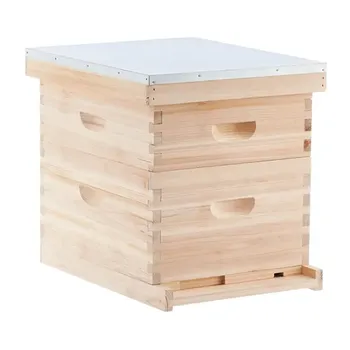
For greenhouse pollination, configure small-frame hives as compact, transportable pollination units—not miniature honey-production colonies. A practical commercial setup uses two to three reduced-size frames in a small wooden or insulated hive body, with secure entrance controls and reliable temperature management. The colony should remain strong enough to maintain brood rearing and repeated foraging flights without drawing heavily on full-sized honey-producing colonies.
The key is matching hive size to the greenhouse service model while preserving colony vitality. Small frames improve transport and space efficiency, but they must be paired with a healthy, populous, young-queen colony, adequate food reserves, controlled ventilation, and a shelter that buffers greenhouse temperature extremes.
Configure the Hive Around the Pollination Job
Use a compact two- or three-frame body
Commercial beekeepers should prepare small-capacity wooden or insulated hive bodies that accept standardized reduced-size frames. A two- to three-frame format is appropriate where the greenhouse has limited service space and the hive must remain inside from winter preparation through the late-spring pollination period, commonly April to May.
The body should be rigid, lightweight, and easy to handle during delivery, placement, inspection, and collection. Standardized dimensions across the product range make replacement parts, frames, foundations, and accessories easier to source.
Treat the unit as a pollination hive
The objective is consistent bee activity over the crop, not maximum honey storage. The compact hive should therefore prioritize living bee coverage, brood continuity, queen performance, and rapid adaptation to the greenhouse environment.
A small hive must not simply be a weak colony placed in a smaller box. Its reduced physical footprint should support logistics while its biological condition remains suitable for sustained pollination.
Select a young, productive queen
A young, mated, prolific queen supports stable brood production and helps maintain colony momentum during the service period. This is particularly important because greenhouse pollination depends on repeated worker activity rather than a short period of peak population.
Colonies showing poor brood pattern, queen failure, disease, or pest pressure should not be deployed, regardless of the quality of the hive hardware.
Build Sufficient Colony Strength Into the Small Format
Use unsealed brood to stimulate foraging
A strong proportion of unsealed brood encourages pollen collection, which directly supports pollination activity. The available guidance identifies unsealed brood as an important stimulus for maintaining active pollen-foraging behavior.
Because a two- or three-frame unit has less physical capacity than a standard hive, the beekeeper should evaluate brood and bee coverage proportionally rather than relying only on frame count.
Preserve food reserves
The compact unit must contain adequate honey and pollen reserves for the period when greenhouse forage is limited or inconsistent. Supplemental feeding equipment should be available where crop conditions do not provide sufficient nutritional support.
Feeding should be planned as part of the service package, not treated as an emergency response after colony activity declines.
Avoid transferring full-size specifications without adjustment
Standard commercial recommendations often describe colonies occupying eight to ten frames, or even larger colonies with approximately twelve frames covered by bees and multiple brood frames. Those specifications are useful benchmarks for colony vitality, but they cannot be inserted literally into a two- or three-frame hive.
The correct interpretation is to preserve the same biological priorities—dense bee coverage, active brood, a productive queen, food reserves, and expansion capacity—within the smaller standardized format.
Add Environmental Protection for Greenhouse Conditions
Use a dedicated shelter or buffer enclosure
Greenhouses can become excessively hot during the day and cold at night. A small shelter covered with polyethylene film and insect netting can isolate the hive from the harshest fluctuations while allowing controlled movement between the hive and crop.
This buffer system helps stabilize brood-rearing conditions and reduces the risk that temperature stress will interrupt pollination performance.
Provide a controlled connection tunnel
A connection tunnel between the hive shelter and the greenhouse crop area gives bees a defined flight route. It also reduces uncontrolled openings that can make hive placement, inspection, and greenhouse management more difficult.
The tunnel should be secure, weather-resistant, and compatible with the hive entrance hardware supplied for the compact unit.
Include orientation features
Indoor environments may provide weaker navigation cues because greenhouse structures can limit normal outdoor visual signals, including ultraviolet references. Hives intended for greenhouse use should therefore include clear orientation structures around the entrance and tunnel.
These features help bees establish a repeatable route between the colony and the target crop.
Manage ventilation and placement
Insulation alone is not sufficient. The hive and shelter must also provide ventilation, protection from direct heat buildup, and a stable position away from high-traffic greenhouse operations.
The placement plan should be established before delivery so that every unit can be installed quickly and consistently.
Standardize the Hardware for Commercial Service
Use interchangeable frames and hive components
A commercial pollination program benefits from standardized:
- Small hive bodies
- Reduced-size frames
- Foundation sheets
- Entrance controls
- Feeders
- Shelter and tunnel components
- Replacement covers and insulation parts
Interchangeability reduces downtime when equipment is damaged, lost, or contaminated. It also allows distributors and resellers to offer a complete solution rather than isolated hive components.
Build a service-ready product portfolio
For B2B buyers, the most useful offering is a coordinated package covering the complete operating cycle:
- Colony housing and small frames
- Secure entrance and orientation hardware
- Feeding equipment
- Temperature-buffer shelters
- Nets, film, and connection tunnels
- Spare frames and replacement parts
- Inspection and maintenance accessories
This one-stop approach is especially valuable when greenhouse operators require rapid replenishment or when multiple sites must be equipped at once.
Plan logistics around rapid deployment
Compact hives are valuable partly because they are easier to transport and position than full-sized honey-production colonies. Packaging should protect frames, entrances, insulation, and feeding systems during shipment.
Suppliers should maintain clear specifications, fast response times, and efficient order fulfillment so beekeepers can replace or expand units without delaying a crop-pollination contract.
Match Hive Deployment to Crop and Site Requirements
Calculate units for the greenhouse operation
Hive quantity should be determined from the crop, greenhouse area, crop density, expected bee activity, and the strength of each colony. A reference planning benchmark cites approximately 110 standardized hives per 20 acres, but this should be treated as a starting point for planning rather than a universal rule for every greenhouse crop.
Small-frame units may differ biologically from standard hives, so the final number should be validated through colony-strength checks and observed pollination performance.
Position units for coverage, not convenience alone
Units should be distributed so bees can reach the target crop efficiently. Concentrating all hives in one convenient location may create uneven activity, particularly in large or compartmentalized greenhouse structures.
Placement should also preserve access for inspection, feeding, ventilation checks, and removal after the service period.
Monitor pollination output
The purpose of the hive configuration is improved fruit set and more uniform crop quality. Beekeepers and greenhouse managers should monitor bee flight activity, colony condition, brood continuity, and crop response throughout the contract.
If activity declines, investigate temperature, nutrition, queen condition, disease, ventilation, and access to the crop before adding more colonies.
Understanding the Trade-offs
Smaller hives improve handling but reduce reserve capacity
Two- and three-frame units are easier to move and install, but they hold fewer bees, brood frames, and food reserves than standard hive bodies. They therefore require closer monitoring and more disciplined feeding and replacement planning.
The smaller format is a logistics advantage, not a substitute for colony strength.
Insulation can create heat-management problems
Insulated bodies and shelters help reduce temperature swings, but poorly ventilated enclosures can trap heat. Greenhouse placement must balance protection from cold with adequate airflow and shading.
Compact units may need more frequent service
A small colony has less nutritional and population buffer when crop conditions change. Commercial service schedules should include regular checks rather than assuming that the unit will remain self-sufficient throughout the greenhouse cycle.
Standard-frame colonies may be more appropriate in some contracts
Where space is available and the crop requires a larger, longer-duration pollination force, a standard eight- to ten-frame or larger colony may be more suitable. The small-frame approach is strongest when transport efficiency, limited greenhouse space, and controlled service deployment are the primary requirements.
How to Apply This to Your Project
Choose the configuration according to both the greenhouse environment and the colony’s biological requirements.
- If your primary focus is transport efficiency: Use standardized two- to three-frame wooden or insulated hive bodies with secure entrances, reduced-size frames, and protective packaging for rapid installation.
- If your primary focus is maximum pollination activity: Deploy only healthy colonies with young queens, active unsealed brood, dense bee coverage, and adequate honey and pollen reserves.
- If your primary focus is greenhouse climate control: Add a polyethylene-and-net shelter, controlled ventilation, and a secure connection tunnel between the hive and crop area.
- If your primary focus is equipment procurement: Source hive bodies, frames, feeders, entrance controls, shelters, tunnels, and replacement parts as one standardized product system.
- If your primary focus is service reliability: Establish pre-delivery strength checks, planned feeding, routine inspections, rapid replacement procedures, and clear deployment quantities for each greenhouse site.
A successful small-frame greenhouse hive is compact in hardware but strong, well-fed, well-protected, and professionally managed as a complete pollination service unit.
Summary Table:
| Configuration Element | Key Requirement |
|---|---|
| Hive Body Size | Two- to three-frame, compact, lightweight |
| Frames | Reduced-size, standardized, interchangeable |
| Queen | Young, mated, prolific |
| Brood | High proportion unsealed brood |
| Food Reserves | Adequate honey and pollen, supplemental feeding |
| Shelter | Insulated, ventilated, with polyethylene film and netting |
| Entrance | Secure, with orientation features and connection tunnel |
| Monitoring | Regular checks on activity, brood, queen, and nutrition |
Partner with HONESTBEE for a complete greenhouse pollination solution. We offer a full range of compact hive bodies, reduced-size frames, feeding systems, shelters, and accessories—all standardized for rapid deployment and reliable performance. Our one-stop sourcing, rapid response, and dedicated support ensure your pollination contracts run smoothly. Contact us today to optimize your greenhouse pollination service and boost crop yields! Get in touch
Related Products
- Multi-Function Plier-Style Frame Grip Hive Tool
- Wooden Bee Hive Frames for Beekeeping and Wholesale
- HONESTBEE Classic Pry Bar Hive Tool with High Visibility Finish for Beekeeping
- HONESTBEE Professional Mini J-Hook Hive Tool for Beekeeping
- 5 Frame Wooden Nuc Box for Beekeeping
People Also Ask
- What are the benefits of a multi-functional hive tool? Streamline Your Apiary Workflow with One Tool
- What advantages do multi-functional hive tools offer? Maximize Your Apiary Efficiency and Workflow
- What tools are used in beekeeping? A Complete Guide to Essential Beekeeping Equipment
- What is the importance of using the right tools in honey production? Boost Quality, Yield & Profitability
- What are the five essential items required for fundamental beekeeping maintenance? Gear Up for Success