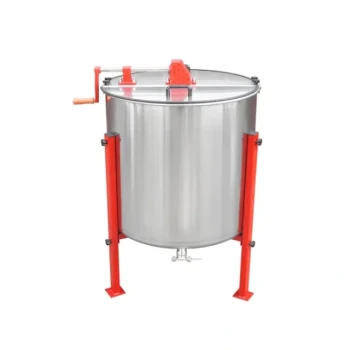
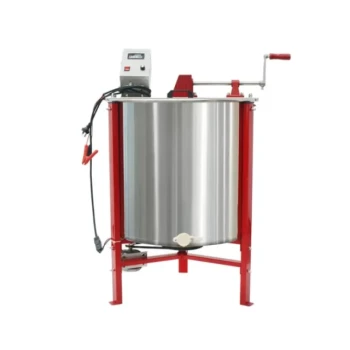
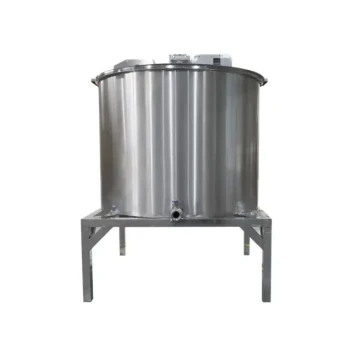
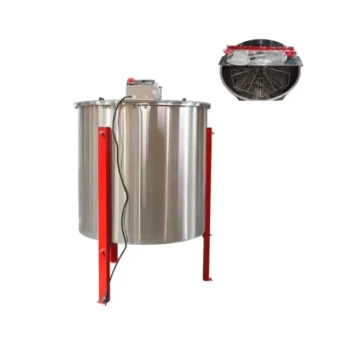
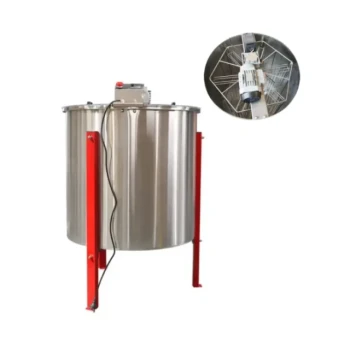
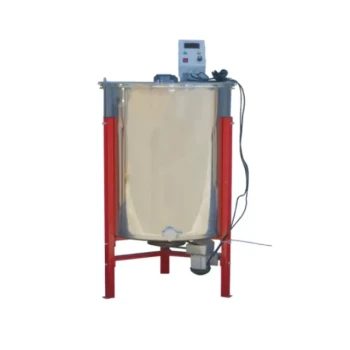
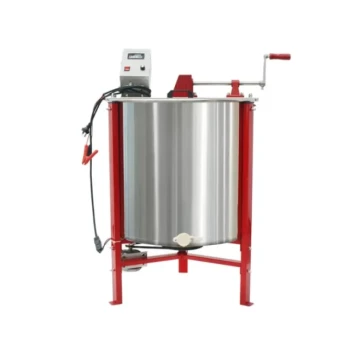
A radial honey extractor is defined by its ability to process hive frames like the spokes of a wheel, allowing centrifugal force to pull honey from both sides of the comb simultaneously. Unlike tangential models, this configuration eliminates the need to stop the machine and flip the frames mid-cycle, significantly reducing the time and labor required for harvest.
The defining characteristic of a radial extractor is its ability to process both sides of a frame in a single, uninterrupted cycle. This "spoke" design maximizes efficiency, making it the standard choice for scaling operations that need to process larger numbers of frames quickly.
The Engineering Behind the Efficiency
The Spoke-Like Arrangement
In a radial extractor, frames are loaded vertically into the basket. The key orientation detail is that the top bar faces the outer wall, while the bottom bar points toward the center shaft.
This creates a radial pattern identical to the spokes on a bicycle wheel. This contrasts sharply with tangential extractors, where the face of the comb looks directly at the wall.
Simultaneous Dual-Sided Extraction
Because of the physics of the "spoke" orientation, the spinning motion creates a suction that pulls honey out of the cells.
This force acts on both sides of the comb at the same time. Consequently, the frames are fully emptied in one run, removing the bottleneck of pausing to reverse frames manually.
Capacity and Workflow
Built for Volume
Because frames are racked radially (end-on) rather than tangentially (side-on), more frames can fit inside the drum.
These units typically range in capacity from 6-frame models up to 20-frame models or larger. This high density makes them the preferred design for beekeepers with a significant number of supers to harvest.
Power Configurations
Radial extractors are available in both manual crank and motorized (electric) versions.
Electric models provide a distinct workflow advantage. Because the extraction cycle is longer but hands-free, the operator can use that time to uncap the next batch of frames, creating a continuous production line.
Understanding the Trade-offs
Risk to Delicate Combs
While efficient, the radial method requires significant force to pull honey "up" the slight angle of the honeycomb cells.
Older, brittle, or uneven combs may be more susceptible to damage or "blowout" under this force compared to the gentler, direct force of a tangential extractor.
The Need for Speed Management
You cannot immediately spin a radial extractor at full speed. The heavy honey must be moved gradually.
The process requires starting slowly and gradually increasing RPMs as the frames lighten. Failing to do so can result in frame breakage or foundation collapse.
Making the Right Choice for Your Goal
Whether a radial extractor is the correct tool depends on your specific volume and equipment status.
- If your primary focus is throughput efficiency: Choose a motorized radial extractor to eliminate frame flipping and maximize the number of frames processed per hour.
- If your primary focus is equipment compatibility: Ensure your specific frame sizes (deeps vs. shallows) fit the radial basket, as some smaller units may require specific screens or adaptations for larger frames.
The radial extractor represents the transition from hobbyist extraction to streamlined production, trading a small amount of gentleness for a massive gain in speed and throughput.
Summary Table:
| Feature | Radial Honey Extractor Characteristics |
|---|---|
| Frame Orientation | Spoke-like (radial) arrangement with top bar facing outward |
| Extraction Method | Simultaneous dual-sided extraction via centrifugal force |
| Capacity Range | High-density loading, typically 6 to 20+ frames |
| Power Options | Available in manual crank or motorized (electric) models |
| Main Advantage | Eliminates the need to flip frames, reducing labor and time |
| Best Suitability | Commercial apiaries and scaling beekeeping operations |
Scale Your Honey Production with HONESTBEE
Transitioning from hobbyist extraction to high-volume production requires the right engineering. HONESTBEE specializes in supporting commercial apiaries and distributors with a complete range of professional beekeeping machinery.
Our portfolio features high-capacity honey-filling machines, specialized hive-making equipment, and a full spectrum of durable extraction tools designed to maximize your throughput. Whether you are stocking a distribution center or upgrading your honey processing line, we provide the industrial-grade hardware and consumables you need to succeed.
Ready to optimize your harvest? Contact us today to explore our wholesale offerings and discover how our expertise can streamline your operations.
Related Products
- 24 Frame Honey Extractor Commercial Radial Honey Frame Extraction Machine
- Stainless Steel Manual 8 Frame Radial Honey Extractor Machine for Beehives
- 6 Frame Manual Stainless Steel Honey Extractor Beekeeping Equipment
- HONESTBEE 8 Frame Electric and Manual Three Use Honey Extractor
- Electric 4 Frame Tangential Honey Extractor
People Also Ask
- How does a radial honey extractor leverage the natural structure of a honeycomb? Optimize Your Apiary's Efficiency
- How do modern honey extraction machines improve harvest efficiency? Boost Your Yield with Radial Technology
- Why must the head of the honey comb be placed near the center axis? Protect Your Comb During Radial Extraction
- Why is the width of iron rings varied for radial honey extractor tilt? Optimize Your Harvest with Precise Engineering
- What are the operational differences between radial and tangential honey extractors? Maximize Your Harvest Efficiency