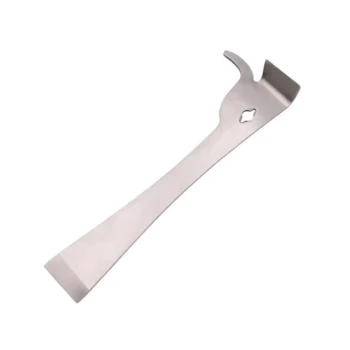
Hive tools feature distinct end geometries engineered to assist with specific aspects of hive maintenance. The three primary shapes are the flat blade for prying and pushing, the bent-over blade for leveraging and scraping, and the hook for snagging and lifting frames. While specialized variations like serrated edges exist for cleaning, most standard tools combine two of these fundamental shapes to maximize utility.
Success in the apiary requires matching the tool's mechanical advantage to the task at hand. While flat blades offer general versatility, specific geometries like hooks and bent blades are essential for applying controlled force to components glued tight by propolis.
The Functions of Primary End Shapes
The Flat Blade
This is the most universal shape found on hive tools. Its thin profile allows it to slide between hive boxes to break propolis seals. It is primarily used for prying components apart, lifting heavy supers, and pushing frames into position.
The Bent-Over Blade
This shape features a 90-degree angle, transforming the tool into a powerful lever. The geometry allows you to apply strong, controlled force to separate stuck boxes without damaging the wood. Additionally, the wide edge is highly effective for scraping propolis off flat surfaces.
The Frame Hook
Often referred to as a "J-hook," this end is designed specifically for frame manipulation. It fits under the end bar of a frame, allowing you to lever it directly upwards. This creates a vertical lift that helps remove a frame without crushing bees or rolling the adjacent comb.
Specialized Variations
The Serrated Edge (Spur)
Some hive tools, known as spur tools, replace a standard edge with a serrated or "spur" design. This aggressive texture is specifically intended for cleaning rather than prying. It excels at scraping away stubborn propolis and removing burr comb that impedes hive management.
Evaluating Tool Geometry and Mechanics
Leverage vs. Portability
The physical length of the tool dictates the amount of leverage you can generate. Longer tools, reaching up to 15 inches, provide significant mechanical advantage for heavy jobs but are cumbersome to carry. Shorter tools, around 6 inches, are highly portable but require more physical effort from the beekeeper to pry apart stuck components.
Material Durability
Regardless of the shape, the material construction impacts the tool's longevity and edge retention. Stainless steel is the preferred standard as it offers high strength and rust resistance. This ensures the prying edges remain sharp and rigid enough to handle the stress of daily hive work.
Making the Right Choice for Your Goal
To select the right tool configuration, assess your most frequent tasks in the apiary.
- If your primary focus is lifting tight frames: Choose a tool with a hook end to safely lever frames vertically out of the box.
- If your primary focus is cleaning and maintenance: Select a tool with a bent-over blade or serrated spur to effectively scrape surfaces clean of propolis and burr comb.
- If your primary focus is separating heavy boxes: Prioritize a longer tool with a flat blade to maximize leverage when cracking the propolis seal between supers.
The right tool acts as an extension of your hand, allowing you to work the hive with precision rather than brute force.
Summary Table:
| End Shape | Primary Function | Best For | Mechanical Advantage |
|---|---|---|---|
| Flat Blade | Prying & Pushing | Breaking propolis seals & moving frames | High versatility/insertion |
| Bent Blade | Leveraging & Scraping | Separating stuck boxes & cleaning surfaces | Maximum leverage for prying |
| Frame Hook | Vertical Lifting | Removing frames without crushing bees | Controlled vertical force |
| Serrated Edge | Aggressive Cleaning | Removing stubborn burr comb & propolis | High friction for scraping |
Elevate Your Beekeeping Operations with HONESTBEE
At HONESTBEE, we understand that professional beekeepers and distributors require high-performance gear that withstands the rigors of the apiary. As a premier wholesale provider, we supply commercial apiaries and global distributors with a full spectrum of industry-leading solutions—from precision-engineered hive tools and specialized hardware to advanced hive-making and honey-filling machinery.
Whether you are looking to source essential consumables or unique honey-themed cultural merchandise, HONESTBEE delivers the quality and scale your business demands.
Ready to scale your wholesale supply? Contact us today to discover how our comprehensive equipment portfolio can drive your success!
Related Products
- Professional Multi-Function Stainless Steel Hive Tool
- Professional Stainless Steel Pry-Bar Hive Tool
- HONESTBEE Professional Long Handled Hive Tool with Precision Cutting Blade
- HONESTBEE Premium Italian Style Hive Tool with Hardwood Handle
- Ergonomic Plastic Frame Spacer Tool for Rapid Hive Management Beekeeping
People Also Ask
- Why are professional hive tools considered indispensable? Master Beekeeping Maintenance with Precision Leverage
- What is the role of professional hive tools in routine apiary maintenance? Expert Tips for Hive Health and Longevity
- What are the benefits of a multi-functional hive tool? Streamline Your Apiary Workflow with One Tool
- What advantages do multi-functional hive tools offer? Maximize Your Apiary Efficiency and Workflow
- What are the common construction features of hive tools? Key Insights for Superior Beekeeping Efficiency