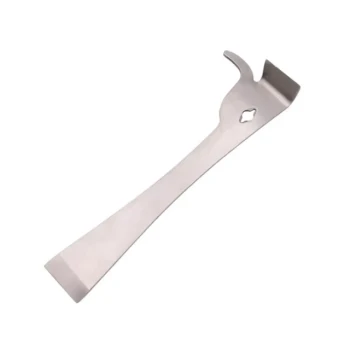
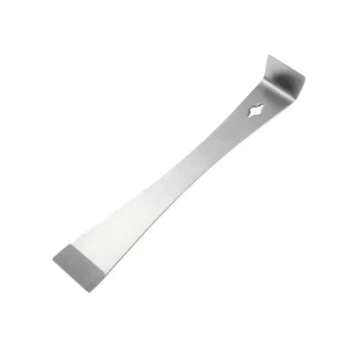
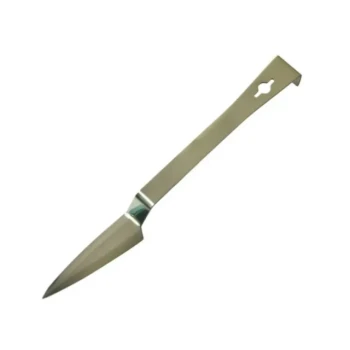
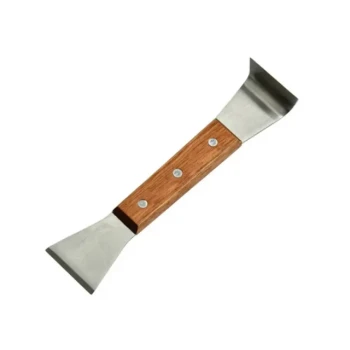
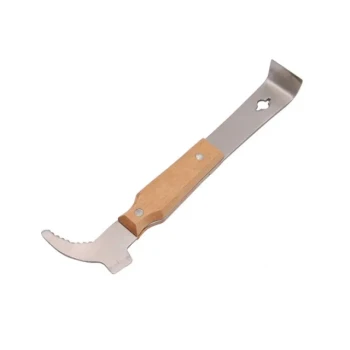
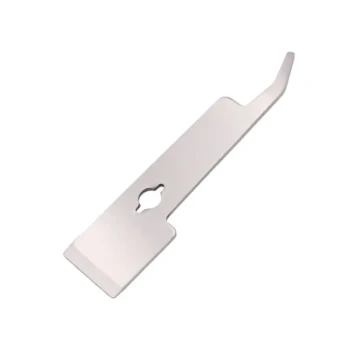
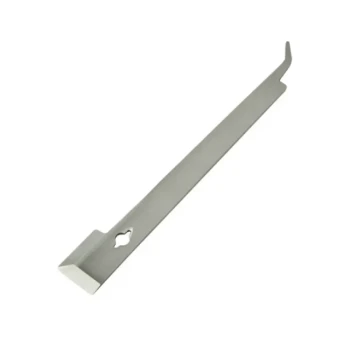
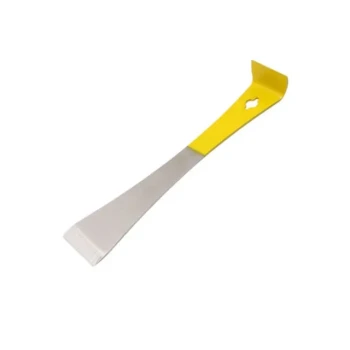
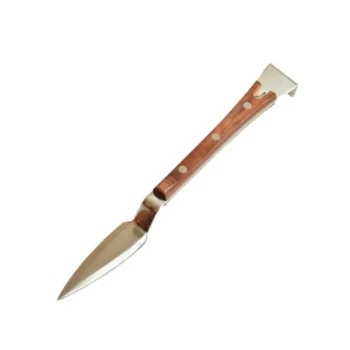
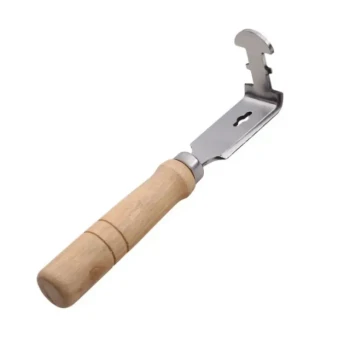
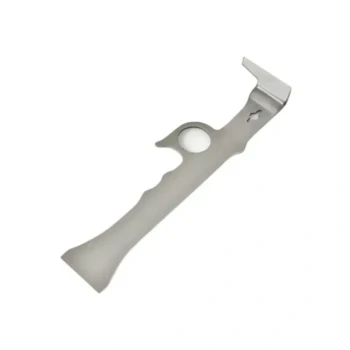
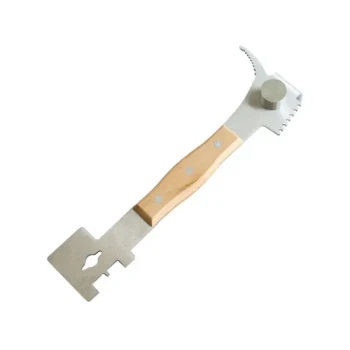
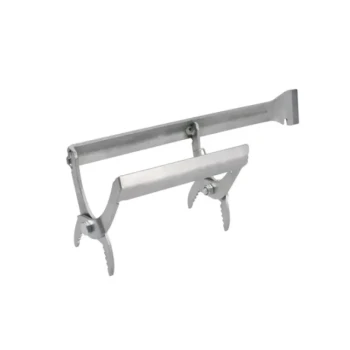
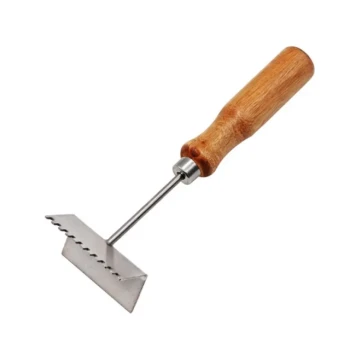
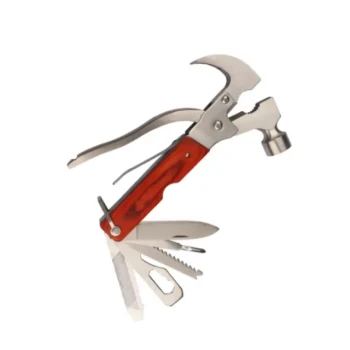
A professional hive tool is a compact, high-strength steel lever designed for hive disassembly, frame handling, and equipment cleaning. Typically measuring 20–25 cm, it combines a broad, thin scraping and prying end with a right-angle bent end for lifting frames and separating propolized hive components. Its tempered-steel construction allows it to withstand repeated leverage, scraping, and impact during routine apiary work.
A professional hive tool should provide three capabilities in one durable implement: prying, lifting, and scraping. The most important specifications are strong tempered steel, a thin flat working edge, a functional bent end, and dimensions that provide leverage without becoming cumbersome inside the hive.
What Defines a Professional Hive Tool?
Tempered-steel construction
The tool is generally manufactured from tempered steel, giving it the strength and resilience required for heavy mechanical loads.
This construction is important because hive components may be tightly bonded by propolis, wax, and debris. A professional tool must resist bending, chipping, and deformation during repeated use.
Compact flat-bar profile
A standard hive tool is a flat metal rod approximately 20–25 cm long. This length provides practical leverage while remaining easy to control around frames, covers, and hive bodies.
Its relatively slim profile allows the tool to fit into narrow joints between hive boxes and frames without requiring excessive force.
Broad, thin scraping end
One end is broad, flat, and thin, with a chisel-like edge. This geometry supports both scraping and prying operations.
The edge is used to remove excess propolis, burr comb, wax, and debris from hive equipment and frame components.
Bent lifting and leverage end
The opposite end is bent at approximately a right angle, with the bend positioned roughly 1 cm from the edge.
This shape creates a mechanical hook and leverage point for separating tightly sealed hive chambers, loosening frames, and lifting frames smoothly during inspection.
Nail-pulling opening
Many standard designs include a small opening of approximately 3–4 mm for pulling nails.
The opening adds maintenance functionality without requiring a separate nail-removal tool, which is useful when repairing or adjusting wooden hive components.
How the Tool Functions in the Hive
Separating propolized hive boxes
Bees use propolis to seal gaps between hive bodies, supers, covers, and other components. Over time, these joints can become difficult to open by hand.
The flat end is inserted into the joint and used as a controlled lever to separate the components without violent movement.
Loosening and lifting frames
Frames can become attached to one another or to the hive body through wax and propolis. The bent end provides a secure point for loosening and lifting them.
Controlled leverage helps reduce sudden movement, which is important for minimizing disturbance to the colony and avoiding unnecessary frame or comb damage.
Scraping wax and propolis
The flat edge removes unwanted buildup from:
- Frame top bars
- Box runners
- Hive floors
- Covers and ledges
- Frame rests
- Other contact surfaces
Regular scraping helps preserve proper equipment fit and reduces the accumulation of material that can interfere with inspections or frame placement.
Cleaning hive equipment
The tool can remove old comb, debris, and excess honey or beeswax from hive parts and frames.
This supports equipment maintenance and helps keep components functional between inspections, harvests, and colony transfers.
Supporting minor hive maintenance
The nail-pulling opening can assist with removing nails, while the flat body can help drive loose nails back into wooden equipment.
It can also help open bee packages, nucs, or jammed smoker components when used carefully and without damaging the equipment.
Why Tool Geometry Matters
Leverage without excessive force
The tool works according to a simple lever principle: its rigid body transfers hand force into a concentrated separating force.
The bent end is especially effective where frames or boxes are bonded by propolis, allowing the beekeeper to apply gradual pressure rather than pulling forcefully by hand.
Controlled frame handling
A tool that is too thick may not enter narrow gaps, while one that is too flexible may bend under load.
The combination of a thin profile and tempered-steel strength provides access and leverage while allowing the beekeeper to work with controlled movements.
Reduced equipment damage
A correctly shaped edge can separate components and remove buildup without excessive impact. This is preferable to striking or twisting hive parts, which can damage wood, frames, or comb.
The tool should be used as a precision lever and scraper, not as a substitute for uncontrolled force.
Applications Across Beekeeping Operations
Routine inspections
During inspections, the hive tool is used to open covers, separate supers, loosen frames, and lift frames for examination.
Its compact size makes it practical for repeated handling around live colonies.
Honey harvesting and extraction
The tool helps remove frames, clean wax and propolis from frame surfaces, and maintain proper contact between frames and hive equipment.
It is particularly useful when buildup makes frames difficult to remove or reposition.
Hive repair and preparation
The tool supports basic maintenance by scraping contact surfaces, removing old material, handling nails, and cleaning frame rests.
This makes it useful not only in the apiary but also during equipment preparation and repair.
Nuc and package handling
Beekeepers may use the flat end to open bee packages or nuc boxes and to loosen components sealed with propolis.
These applications require careful handling to avoid damaging the container or unnecessarily disturbing the bees.
Smoker and accessory maintenance
The tool can help open a jammed smoker and manipulate compact or stuck components.
However, it should not be used in a way that exposes the operator to excessive heat or damages the smoker body.
Understanding the Trade-offs
Standard tools versus specialized designs
The standard hive tool is popular because it combines the core functions most beekeepers need in one simple form.
Specialized tools may offer alternative hook shapes, wider blades, or additional features, but these can increase cost, weight, or complexity without improving every task.
Sharpness versus safety
A thin, sharp scraping edge improves performance against propolis and wax. At the same time, it requires careful handling during storage, transport, and use around bees and wooden equipment.
For professional supply, edge finishing and protective packaging are important quality considerations.
Compactness versus leverage
A 20–25 cm tool is compact and easy to carry, but it provides less leverage than a substantially longer bar.
The standard size is a practical compromise: sufficient for normal hive work while remaining manageable in confined hive spaces.
Feature count versus reliability
Additional openings or multipurpose features can increase utility, but they also add potential points for poor finishing, sharp burrs, or structural weakness.
For distributors and resellers, a dependable core design with consistent manufacturing quality is generally more valuable than unnecessary features.
What Buyers and Resellers Should Evaluate
Material and durability
Confirm that the tool uses tempered steel or an equivalent high-strength construction suitable for repeated mechanical loading.
The working ends should resist bending, edge deformation, and premature wear during scraping and prying.
Dimensional consistency
A standard length of approximately 20–25 cm should be maintained consistently across production batches.
Width, thickness, bend position, and hole size should also be checked because dimensional variation can affect leverage, frame access, and handling comfort.
Edge and surface finishing
The flat end should be sufficiently thin and functional for scraping, but free from dangerous manufacturing burrs.
Smooth finishing, clean bends, and properly formed openings reduce user complaints and improve the product’s professional appearance.
Portfolio and fulfillment suitability
For B2B buyers, the hive tool is often part of a broader beekeeping equipment assortment.
Reliable stock availability, rapid response, consistent specifications, and efficient order fulfillment are therefore as important as the individual tool’s design.
How to Apply This to Your Project
Choose the specification according to the tool’s intended workload and the expectations of the end user.
- If your primary focus is professional beekeeping performance: Prioritize tempered steel, a rigid 20–25 cm body, a thin scraping edge, and a correctly formed right-angle lifting end.
- If your primary focus is wholesale or distribution: Prioritize consistent dimensions, reliable finishing, repeatable quality, packaging suitability, and dependable replenishment.
- If your primary focus is multipurpose hive maintenance: Select a standard design with a scraper, frame-lifting end, and approximately 3–4 mm nail-pulling opening.
- If your primary focus is safe and efficient colony inspections: Favor controlled leverage and smooth edge finishing over excessive sharpness or unnecessary features.
The right professional hive tool is a durable, precisely shaped lever that improves hive access, frame handling, cleaning, and maintenance in one compact implement.
Summary Table:
| Specification | Description |
|---|---|
| Material | Tempered steel for durability and strength |
| Length | 20–25 cm for balance and leverage |
| Scraping end | Broad, thin, chisel-like edge for removing propolis and wax |
| Lifting end | Right-angle bent ~1 cm from edge for prying and lifting frames |
| Nail-pulling opening | 3–4 mm hole for removing nails |
| Applications | Separating boxes, lifting frames, scraping, cleaning, minor maintenance |
Upgrade your apiary with HONESTBEE's professional hive tools, crafted for durability and efficiency. As a trusted wholesaler for commercial beekeepers and distributors, we offer competitive pricing, OEM/ODM support, and rapid fulfillment. Contact us today to secure reliable supply and enhance your beekeeping operations. Get in touch to discuss your bulk needs!
Related Products
- Professional Multi-Function Stainless Steel Hive Tool
- Professional Stainless Steel Pry-Bar Hive Tool
- HONESTBEE Professional Long Handled Hive Tool with Precision Cutting Blade
- Professional Dual-End Stainless Steel Hive Tool for Beekeeping
- HONESTBEE Professional Multi-Functional Hive Tool with Ergonomic Wood Handle
People Also Ask
- Why are professional hive tools considered indispensable? Master Beekeeping Maintenance with Precision Leverage
- What is the role of professional hive tools in routine apiary maintenance? Expert Tips for Hive Health and Longevity
- What are the benefits of a multi-functional hive tool? Streamline Your Apiary Workflow with One Tool
- What advantages do multi-functional hive tools offer? Maximize Your Apiary Efficiency and Workflow
- What are the common construction features of hive tools? Key Insights for Superior Beekeeping Efficiency