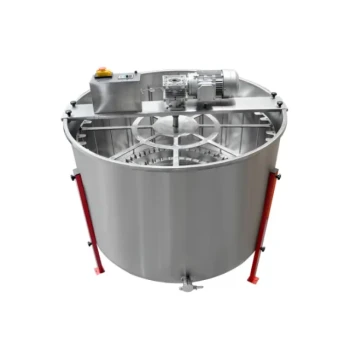
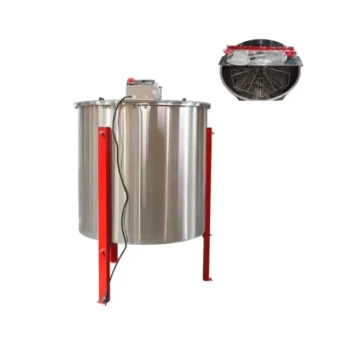
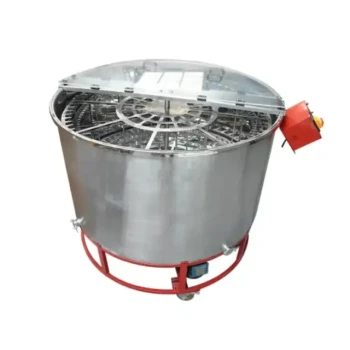
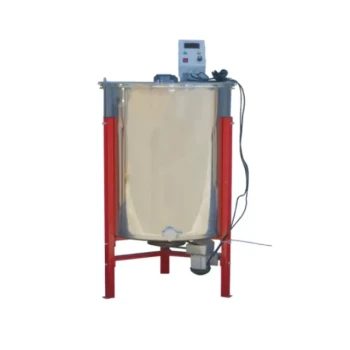
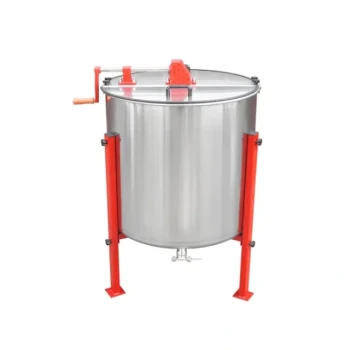
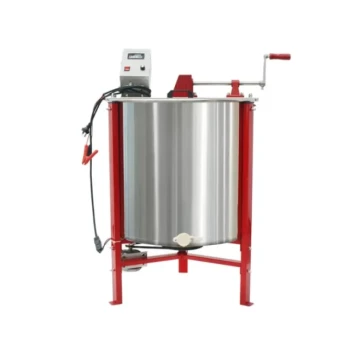
A commercial honey extractor is an industrial-grade machine engineered specifically for large-scale beekeeping operations managing 200 or more colonies. Unlike standard equipment, these units are designed to handle massive quantities of honey, prioritizing high-volume throughput and workflow efficiency over low initial cost.
The defining characteristic of a commercial extractor is its ability to scale production. By automating the spinning process and utilizing high-capacity designs, these machines allow operators to process honey continuously without the bottlenecks found in smaller setups.
The Mechanics of Commercial Efficiency
Motorized Operation for Multitasking
Commercial extractors rely on powerful electric motors rather than manual hand cranks. This provides the consistent speed and torque necessary to spin heavy loads of honey-laden frames.
The primary operational advantage here is workflow optimization. Once the frames are loaded and the machine is running, the operator is free to begin uncapping the next batch of frames, significantly reducing overall harvest time.
The Radial Design Advantage
Most high-efficiency commercial units utilize a radial design, where frames are positioned like the spokes of a wheel. This orientation is critical for volume processing because it allows honey to be extracted from both sides of the frame simultaneously.
This eliminates the need to pause the machine, pull out the frames, and flip them over. By removing this manual step, a commercial operation can cycle through batches much faster than with tangential (non-radial) designs.
Preserving the Hive's Resources
Harnessing Centrifugal Force
At its core, the extractor functions by generating centrifugal force. The spinning motion flicks the liquid honey out of the cells, where it hits the extractor walls and drains into collection buckets.
Protecting the Honeycomb
A vital aspect of this mechanical process is that it leaves the wax comb intact. Because the comb is not destroyed during harvest, beekeepers can return the frames to the hive, allowing bees to refill them immediately rather than wasting energy building new wax.
Understanding the Trade-offs
The Cost of Entry
The most significant barrier to commercial extraction is the financial investment. These are large, specialized machines that cost significantly more than hobbyist equipment, necessitating a serious business commitment.
Infrastructure Requirements
These machines are defined as "large" and "industrial-grade," meaning they require dedicated space. You cannot easily stow a commercial extractor in a closet; it requires a processing facility or honey house designed to accommodate its footprint and power needs.
Making the Right Choice for Your Goal
To determine if a commercial-grade extractor fits your operation, evaluate your current scale and future growth.
- If your primary focus is managing 200+ colonies: You require a commercial unit to handle the volume and maintain profitability through labor efficiency.
- If your primary focus is workflow speed: Look for an electric radial model that allows you to uncap frames while the previous batch is spinning.
- If your primary focus is budget or small-scale hobbying: A commercial unit is likely overkill; the high investment will not offer a return on investment for small colony counts.
Scale your equipment to match your production needs to ensure your apiary remains both efficient and profitable.
Summary Table:
| Feature | Commercial Honey Extractor | Hobbyist Extractor |
|---|---|---|
| Capacity | 200+ Colonies / High Volume | Small Batch / 1-10 Colonies |
| Design Type | Primarily Radial (Both sides at once) | Often Tangential (Manual flipping) |
| Operation | Powerful Electric Motor | Manual Hand Crank or Small Motor |
| Efficiency | Simultaneous Uncapping & Spinning | Linear Processing (One task at a time) |
| Infrastructure | Requires Dedicated Honey House | Portable / Storage Friendly |
Scale Your Honey Production with HONESTBEE
Are you ready to transition from manual labor to industrial-grade efficiency? HONESTBEE specializes in supporting commercial apiaries and distributors with high-performance beekeeping machinery designed for growth.
Our comprehensive wholesale range includes:
- High-Capacity Radial Extractors: Maximize throughput with motorized automation.
- Industrial Machinery: From hive-making to precision honey-filling machines.
- Full-Spectrum Supplies: All essential beekeeping tools and industry consumables.
Don't let equipment bottlenecks limit your harvest. Partner with HONESTBEE for the hardware and cultural merchandise your business needs to thrive. Contact us today to receive a wholesale quote and expert consultation!
Related Products
- 32 Frame Commercial Electric Honey Extractor for Beekeeping and Honey Production
- Commercial Electric 12 Frame Honey Extractor Spinner Motorized Honey Extractor
- 40 Frame Commercial Electric Honey Extractor for Beekeeping
- 24 Frame Honey Extractor Commercial Radial Honey Frame Extraction Machine
- 8-Frame Electric Self-Reversing Honey Extractor Spinner for Commercial Honey Extraction Equipment
People Also Ask
- What are commercial honey extractors used for? Boost Your Apiary's Efficiency & Profitability
- What is a commercial honey extractor? The Essential High-Volume Solution for Large Apiaries
- Who are commercial honey extractors designed for? Scaling Your Industrial Beekeeping Success
- How is honey extracted commercially? Maximize Your Apiary's Efficiency and Honey Yield
- What are commercial honey extractors and for what scale of beekeeping are they intended? Scale Your 200+ Colony Apiary