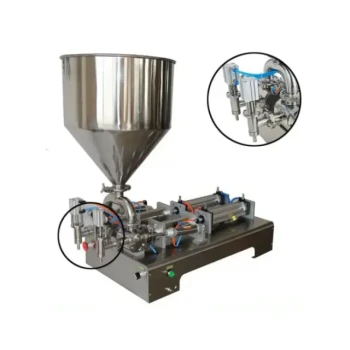
A piston honey filling machine is a specialized packaging device engineered to handle high-viscosity liquids with exceptional volumetric precision. It operates by using the mechanical forward and backward motion of a piston to draw a pre-set amount of honey from a hopper and dispense it directly into packaging containers. This method allows for consistent filling in both small artisanal setups and large-scale industrial lines.
Core Takeaway: The defining feature of this machine is volumetric control. Unlike gravity fillers that rely on flow time, a piston filler physically measures the honey inside a cylinder before dispensing it, ensuring that every jar contains the exact same amount regardless of minor changes in the honey's thickness.
The Operational Mechanism
To understand how a piston filler works, you must look at the cycle of the piston itself. The process transforms a continuous supply of honey into discrete, measured doses.
The Intake Phase
The process begins with honey stored in a hopper above the machine. As the piston retracts (moves backward), it creates a vacuum within the cylinder.
This negative pressure draws the honey from the hopper through the filling lines and into the cylinder. The volume drawn is determined by the length of the piston's stroke, which is pre-calibrated by the operator.
The Dispensing Phase
Once the cylinder is full and the packaging is positioned under the filling nozzle, the piston reverses direction. It moves forward, mechanically pushing the honey out of the cylinder.
Because the honey is forced out by physical pressure rather than gravity, the machine can easily handle the product's natural resistance and stickiness.
Calibration and Speed
The speed of the piston is strictly calibrated to match the packaging line. This ensures that the fill volume is accurate and that the timing aligns with the arrival of empty jars.
Once filled, the package moves immediately to sealing and labeling stations to complete the cycle.
Why This Method Suits Honey
Honey presents unique challenges due to its viscosity and tendency to string or drip. The piston mechanism addresses these physical properties directly.
Handling High Viscosity
Honey is dense and resists flow. A piston applies direct force, making it superior to gravity fillers for thick products.
Some machines also incorporate heating mechanisms to gently warm the honey. This reduces viscosity temporarily, facilitating an even smoother flow without altering the honey's quality.
Hygiene and Maintenance
Sticky products require rigorous cleaning. Many piston fillers are designed for easy disassembly.
This allows operators to strip down the cylinder and nozzle components for thorough washing, preventing crystallization or bacterial buildup between batches.
Understanding the Trade-offs
While piston fillers are the industry standard for precision, they are not the only solution. It is important to recognize where they fit in the broader landscape of filling technology.
Production Speed Limits
Piston fillers are precise, but they have physical speed limits due to the mechanical stroke required for every fill.
For extremely high-speed, mass-production environments, pump-based systems may offer faster continuous throughput, though often at a higher initial equipment cost.
Complexity of Cleaning
While designed for disassembly, the mechanical nature of pistons means there are more moving parts (seals, O-rings, cylinders) compared to a simple gravity filler.
This results in a slightly longer changeover time between different honey varieties compared to simpler systems.
Making the Right Choice for Your Goal
Selecting the right machine depends on balancing your need for precision against your production volume.
- If your primary focus is high precision with thick honey: Choose a Piston Filling Machine, as it physically measures volume to ensure consistent weight in every jar.
- If your primary focus is low budget and lower viscosity products: Consider a Gravity Filling Machine, but be aware that it may struggle with thicker, raw honey.
- If your primary focus is maximum speed for mass production: Investigate Pump-Based Systems, which offer rapid, continuous filling for fully automated lines.
Ultimately, the piston filler remains the most reliable "workhorse" for honey production because it prioritizes product consistency over raw speed.
Summary Table:
| Feature | Piston Filling Machine Details |
|---|---|
| Core Mechanism | Mechanical piston stroke creating vacuum & physical pressure |
| Key Benefit | Exceptional volumetric precision regardless of viscosity |
| Suitability | Ideal for high-viscosity, raw, or thick honey |
| Components | Hopper, Cylinder, Piston, and Nozzle (often with heating elements) |
| Maintenance | Requires disassembly for cleaning; ensures high hygiene standards |
Scale Your Honey Production with HONESTBEE
At HONESTBEE, we specialize in empowering commercial apiaries and distributors with the professional tools needed to succeed. Whether you are looking for high-precision piston honey filling machines, advanced hive-making equipment, or a reliable wholesale supply of beekeeping consumables, we have you covered.
Why partner with us?
- Full Spectrum Solutions: From specialized hardware to honey-themed cultural merchandise.
- Industry Expertise: Tailored machinery designed to handle the unique viscosity of honey.
- Wholesale Value: Comprehensive offerings that support your growth and operational efficiency.
Ready to enhance your packaging precision and streamline your workflow? Contact us today to discover how our equipment and expertise can transform your business!
Related Products
- Precision Durable Efficient HONESTBEE Rotary Honey Filling Machine
- Pneumatic Double Nozzle Honey Filling Bottling Packaging Machine
- Fully Automatic Honey Filling Packaging Machine for Processing Line
- Commercial Rotary Honey Filling Machine for Production
- Precision Automated Packaging Turntable Honey Spoon Filling Sealing Packing Machine
People Also Ask
- What quality control role does professional honey filling equipment perform? Ensure Consistency and Product Stability
- How do honey filling machines work? Achieve Precision & Speed for Your Apiary
- How do honey filling and processing machines aid native bee product conservation? Boost Value with HONESTBEE Technology
- What are the common types of bottling machines used for honey? Choosing the Right Solution for Your Apiary
- How do high-precision honey filling machines ensure quality? Optimize Your Commercial Production with HONESTBEE