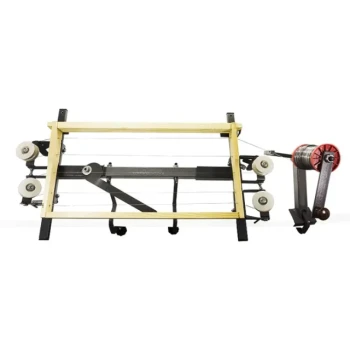
A beehive frame is the structural skeleton used to hold and support the beeswax honeycomb within a hive. Suspended vertically inside the hive boxes, these rectangular structures allow bees to perform life-sustaining functions—such as raising young and storing honey—within a defined boundary. Crucially, frames allow beekeepers to remove, inspect, and reorganize the honeycomb without destroying the colony's work.
The frame is the interface between the bee’s instinct to build and the beekeeper’s need to manage. By containing the comb within a mobile rectangle, frames convert a chaotic natural nest into an accessible, modular system.
The Structural Role of the Frame
Supporting the Colony's Infrastructure
Functioning much like the studs in a house, frames provide the essential rigid support for the hive's interior. Bees naturally build wax comb to store pollen, honey, and eggs.
Without a frame, this comb would be attached directly to the hive walls or ceiling, making it fragile and stationary. The frame bears the weight of these heavy resources, ensuring stability within the hive box.
Anatomy of a Frame
A standard frame is a four-sided rectangle, typically made of wood or plastic. It consists of a top bar, two side bars, and a bottom bar.
The top bar features protruding ends (lugs) that rest on a rabbet (ledge) within the hive body, allowing the frame to hang freely. The side bars determine the depth of the comb and maintain the correct "bee space" between frames to allow bees to move freely.
Guiding Comb Construction
The Role of Foundation
As highlighted in the primary reference, frames are often used to hold a sheet of foundation. This is an insert, made of plastic or beeswax, that features a hexagonal imprint.
This imprint acts as a blueprint, guiding the bees to build straight, uniform honeycomb centered within the frame. By encouraging bees to build systematically, foundation maximizes the usable space within the hive.
Foundationless Beekeeping
Frames can also be used without a pre-set sheet, a practice known as foundationless beekeeping. In this setup, the frame serves only as the perimeter boundary.
Bees are left to build the comb naturally within the open space of the frame. While this allows for natural cell sizing, it relies entirely on the bees' instinct to fill the void between the frame's sides.
Facilitating Hive Management
Non-Destructive Inspection
The single most significant function of the frame is mobility. Because the comb is built inside the frame rather than attached to the box walls, a beekeeper can lift distinct sections of the hive out for inspection.
This allows for the monitoring of the queen, the checking of brood health, and the assessment of food stores without tearing apart the colony's home.
Modularity and Resource Management
Frames allow for the reorganization of the hive's resources. A beekeeper can move a frame full of honey from a strong hive to a weak one, or shift frames to improve airflow.
This modularity also simplifies harvest. Frames filled with capped honey can be removed, extracted, and returned to the hive to be refilled, saving the bees the energy cost of rebuilding the wax.
Understanding the Trade-offs
Cross-Comb Issues
While frames are designed to organize the hive, bees do not always respect the boundaries. If a frame is not hung correctly, or if foundationless frames are used without a guide, bees may build cross-comb.
Cross-comb occurs when bees connect the wax across two or more frames, effectively gluing them together. This negates the primary benefit of the frame, making removal difficult and increasing the risk of crushing bees during inspection.
Foundation Materials
Choosing what goes inside the frame involves compromise. Plastic foundation is durable and easy to install, but some bees are hesitant to draw wax on it.
Wax foundation is more natural and accepted readily by bees, but it is fragile. It often requires the installation of horizontal reinforcement wires through the side bars to prevent the comb from sagging or collapsing under the weight of honey.
Making the Right Choice for Your Goal
How you utilize frames depends on your philosophy and management goals.
- If your primary focus is ease of management: Utilize frames with plastic or wired wax foundation to ensure bees build straight, sturdy, and easily inspecting combs.
- If your primary focus is natural wax production: Consider foundationless frames, but ensure the hive is level and monitor early construction closely to prevent cross-comb.
Ultimately, the frame is the essential tool that transforms a hollow box into a functioning, manageable apiary.
Summary Table:
| Feature | Primary Function | Key Benefit |
|---|---|---|
| Structural Support | Acts as a skeleton for wax comb | Prevents comb collapse and adds stability |
| Mobility | Allows individual frame removal | Facilitates inspections without damaging the colony |
| Bee Space | Maintains precise gaps between combs | Prevents bees from gluing parts together with propolis |
| Foundation Guide | Provides a blueprint for cell building | Ensures straight, uniform comb for easier extraction |
| Modularity | Enables swapping between hive boxes | Simplifies resource management and honey harvesting |
Scale Your Apiary Operations with HONESTBEE
At HONESTBEE, we understand that high-quality frames are the backbone of a productive commercial apiary. We provide professional-grade beekeeping tools, hive-making machinery, and a full spectrum of consumables designed for distributors and large-scale beekeepers.
Whether you need precision-engineered hardware or honey-filling equipment to streamline your production, our comprehensive wholesale offering is built to enhance your efficiency and yield.
Ready to upgrade your equipment? Contact us today to discuss your wholesale needs and discover how our expertise can support your business growth.
Related Products
- Wooden Bee Hive Frames for Beekeeping and Wholesale
- Heavy-Duty Stainless Steel Clip-On Frame Perch
- Assembled Wooden Bee Frames with Plastic Foundation for Durability and Convenience by HONESTBEE
- HONESTBEE Wired and Assembled Wooden Bee Frames Foundation for a Thriving Hive
- Professional Galvanized Steel Frame Rest for Beehives
People Also Ask
- How do wooden and plastic hive frames compare in terms of durability? Wood vs. Plastic Longevity & Repairability
- How does balancing the number of frames impact hive productivity? Optimize Your Apiary's Biological Output
- What are the main considerations when choosing between wooden and plastic bee hive frames? Optimize Your Apiary's Efficiency
- How should beehive frames be maintained to prolong their lifespan? 5 Pro Tips for Durable Beekeeping Equipment
- What are frames and combs used for in beekeeping? The Foundation of Modern Hive Management