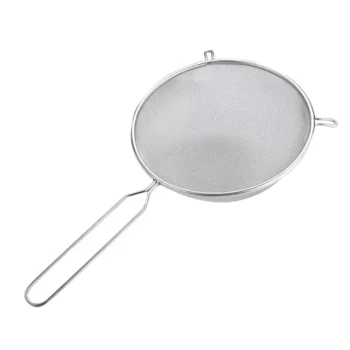
Fine Nylon Mesh acts as the critical primary filtration medium in the gravity separation process for stingless bee honey. Placed securely over large collection containers, it utilizes natural gravity to separate liquid honey from solid contaminants, specifically capturing large cerumen (wax) fragments and other impurities to prepare the raw product for subsequent refinement stages.
The mesh serves as the first line of defense in the extraction process, achieving an initial separation of solids from liquids. By filtering out bulk residues like cerumen, it ensures the honey is sufficiently clarified for further processing without the need for aggressive mechanical intervention.
The Role of Filtration in Gravity Separation
Primary Impurity Capture
The fundamental function of the Fine Nylon Mesh is to act as a physical barrier against contaminants. As raw honey is poured or drips onto the mesh, the fabric intercepts solid particles.
This is particularly effective for removing large cerumen fragments (wax) and other substantial debris. These are common byproducts of the harvesting process that must be removed to ensure product quality.
Facilitating Gravity-Fed Dripping
The mesh is specifically designed to work in conjunction with gravity. It is placed over large containers to allow for a passive, "gravity-fed" dripping process.
Unlike pressure filtration, which forces honey through a medium, this method allows the liquid to flow naturally through the weave of the nylon. This gentle approach helps maintain the integrity of the liquid while separating it from solid mass.
Preparing the Product for Refinement
Initial Separation Phase
It is important to view the use of Fine Nylon Mesh as an initial separation step rather than the final stage of processing. Its goal is to create a baseline level of clarity.
By removing the bulk of the solid residues early, the mesh prevents downstream equipment or finer filters from becoming immediately clogged.
Establishing the Liquid Base
Once the honey passes through the mesh, it is considered "liquid honey" distinct from the raw, wax-heavy harvest. This separation is the prerequisite for any further refinement.
The resulting liquid in the collection container is cleaner and more uniform, making it ready for precise yield monitoring or secondary filtration if required.
Understanding the Trade-offs
Filtration Speed vs. Force
Gravity separation using Fine Nylon Mesh is a passive process. While it is gentle on the honey, it is inherently slower than active pumping or pressing methods.
If the mesh becomes oversaturated with large cerumen fragments, the flow rate can decrease significantly. This requires monitoring to ensure the process remains efficient.
Particle Size Limitations
The mesh is optimized for "large" fragments and initial separation. It is not designed to sterilize the honey or remove microscopic particles.
Relying solely on this stage for a final, polished product may result in visible sediment remaining in the honey. It is most effective when treated as a preparatory step for further refinement.
Making the Right Choice for Your Goal
To maximize the effectiveness of your honey processing setup, consider how the mesh fits into your specific workflow.
- If your primary focus is bulk contaminant removal: Utilize the Fine Nylon Mesh immediately after harvesting to capture large cerumen fragments before they break down further.
- If your primary focus is process efficiency: Ensure the mesh is sized correctly for your container to prevent bottlenecks during the gravity-fed dripping phase.
The effective use of Fine Nylon Mesh is the foundational step in transforming raw harvest material into refined, high-quality stingless bee honey.
Summary Table:
| Feature | Function in Gravity Separation |
|---|---|
| Primary Role | Acts as the first line of defense to capture large cerumen (wax) and debris |
| Mechanism | Passive gravity-fed dripping; avoids aggressive mechanical force |
| Goal | Achieve initial liquid clarification and prepare honey for refinement |
| Key Benefit | Prevents downstream equipment clogging by removing bulk solids early |
| Limitation | Passive flow is slower than pressure filtration; captures only large particles |
Elevate Your Honey Production with HONESTBEE
At HONESTBEE, we specialize in empowering commercial apiaries and distributors with the high-performance tools needed to excel in a competitive market. Whether you are scaling up your stingless bee honey production or outfitting a large-scale facility, our comprehensive wholesale offering has you covered.
From fine nylon filtration mesh and specialized beekeeping tools to industrial-grade honey-filling machines and hive-making equipment, we provide the full spectrum of hardware and consumables. Beyond the machinery, we also offer unique honey-themed cultural merchandise to help you build a stronger brand presence.
Ready to streamline your extraction process and maximize your yield?
Contact HONESTBEE Today to discuss your bulk equipment needs and discover how our specialized industry solutions can drive your business growth.
References
- Bajaree Chuttong, Michael Burgett. Meliponiculture. DOI: 10.1080/0005772x.2014.11417595
This article is also based on technical information from HonestBee Knowledge Base .
Related Products
- Nylon Honey Strainer Square Filter Cloth for Honey Filters
- Conical Nylon Honey Strainer Filter Bag for Beekeeping and Honey Filtration
- Heavy-Duty Nylon Beehive Hive Strap with Stainless Steel Cinch Buckle
- Professional Stainless Steel Honey Filter with Support Handle
- Stainless Steel Triangle Support Honey Strainer and Filters
People Also Ask
- What is the significance of using professional filter cloths or sieves in honey processing? Ensure Purity and Quality
- What is the simple straining method for processing honey? A Cost-Effective Guide to Pure Extraction
- What cloth for straining honey? The Best Materials for Clean, High-Quality Honey
- What size mesh to strain honey? A Guide to the Standard Double-Sieve Method
- Why is specialized filter cloth preferred over the traditional squeezing method for wild honey? Achieve Higher Purity