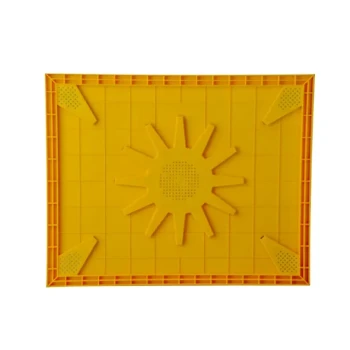
The floorboard, also known technically as the bottom board, serves as the fundamental structural base of a beehive. It is engineered to support the entire weight of the colony's supers and frames while providing the single, controlled point of entry and exit for the bees.
While often viewed merely as a stand, the floorboard is actually a critical instrument for hive management. It anchors the physical structure of the hive while simultaneously acting as the primary control point for colony defense, ventilation, and temperature regulation.
The Structural Foundation
Supporting the Hive Load
The primary mechanical function of the floorboard is load-bearing. As the bees store food reserves and raise young, the hive becomes significantly heavy.
The floorboard must be robust enough to support this full, fluctuating weight without warping or shifting.
Moisture Control and Positioning
Beyond holding weight, the floorboard acts as a barrier against ground-level environmental factors.
To ensure proper moisture control, the bottom board must always be elevated off the ground. Direct contact with the soil can lead to dampness wicking into the hive, compromising the colony's health.
Managing the Colony Entrance
Regulating Traffic and Temperature
The floorboard incorporates the specific hardware required to manage the hive entrance. This entrance generally features two distinct settings to accommodate seasonal changes.
During warmer months, the entrance is set to a wide position to allow for maximum traffic flow and ventilation. Conversely, in colder conditions, the entrance is reduced to minimize heat loss and prevent drafts.
Facilitating Colony Defense
By limiting access to a single point, the floorboard significantly aids the colony's security measures.
A single, controlled entrance allows the bees to focus their defensive efforts in one location. This makes it much easier for guard bees to repel intruders and protect the food stores within.
Common Pitfalls to Avoid
Neglecting Entrance Adjustments
A common error is failing to adjust the entrance reducer on the floorboard as seasons change.
Leaving the entrance wide open during cold snaps places unnecessary stress on the colony as they struggle to maintain internal heat. Similarly, a restricted entrance during a nectar flow can cause congestion and overheating.
Improper Ground Placement
Placing the floorboard directly on the earth is a critical mistake.
Without elevation, the floorboard cannot effectively mitigate moisture, leading to mold growth and wood rot that threatens the structural integrity of the entire stack.
Making the Right Choice for Your Hive
To maximize the effectiveness of your floorboard, you must align its configuration with current environmental conditions.
- If your primary focus is seasonal temperature control: Use the reduced entrance setting during winter to conserve heat and the wide setting in summer for ventilation.
- If your primary focus is colony defense: Utilize the reduced entrance size to create a "bottleneck" that is easier for a smaller number of bees to guard.
- If your primary focus is equipment longevity: Ensure the floorboard is placed on a stand or blocks to prevent moisture absorption from the soil.
A properly managed floorboard provides the stability and protection required for a thriving, productive colony.
Summary Table:
| Function | Key Benefit | Maintenance Tip |
|---|---|---|
| Load Bearing | Supports the weight of supers & frames | Use robust materials to prevent warping |
| Moisture Control | Prevents dampness and wood rot | Always elevate off the ground with a stand |
| Traffic Control | Regulates bee entry and exit | Use entrance reducers during nectar flow |
| Climate Regulation | Manages internal airflow and heat | Open wide for summer; restrict for winter |
| Colony Defense | Creates a defensible bottleneck | Narrow the entrance to help guard bees |
Scale Your Apiary Operations with HONESTBEE
As a commercial apiary or distributor, the durability and precision of your hive components are paramount. HONESTBEE provides the industry's most comprehensive range of wholesale beekeeping tools, machinery, and equipment—from heavy-duty floorboards to automated honey-filling systems.
Why partner with us?
- Full Spectrum Supply: Everything from hive hardware to specialized machinery.
- Built for Scale: Reliable equipment designed to withstand the rigors of commercial honey production.
- Wholesale Advantage: Competitive pricing on essential industry consumables and cultural merchandise.
Ready to enhance your productivity and secure your colonies? Contact our expert team today to discuss your wholesale requirements!
Related Products
- Langstroth Solid Bottom Board for Beekeeping
- Solid Bottom Board Australian Pine Wood Langstroth Bottom Board for Wholesale
- HONESTBEE Wooden Bee Escape Board with Triangle Mesh Design for Beekeeping
- Long Langstroth Style Horizontal Top Bar Hive for Wholesale
- Wooden Bee Hive Frames for Beekeeping and Wholesale
People Also Ask
- What are the functions of solid bottom boards for a beehive? Essential Thermal Protection and Winter Survival Tips
- What is the purpose of a solid bottom board for bee hives? Enhance Hive Health and Winter Survival
- How does climate influence the choice between a solid and screened bottom board? Optimize Your Hive for Local Weather
- What is the primary function of a bottom board in a modern modified beehive system? Essential Foundation Guide
- What are the characteristics of a solid bottom board for a beehive? Boost Colony Health and Thermal Insulation