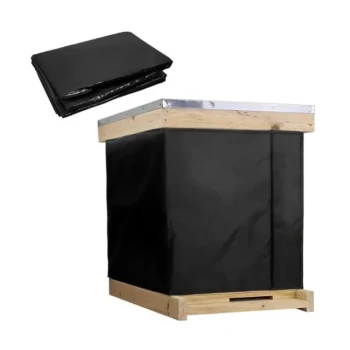
Installing a high R-value Foam Insulation Board is a critical defensive measure for colony survival. It acts as a primary barrier against conductive heat loss, trapping the rising warmth generated by the bee cluster. By maintaining the temperature of the inner cover, it prevents the formation of cold condensation that would otherwise drip back onto the bees.
The necessity of top insulation extends beyond simple warmth; it is fundamentally about moisture control. By preventing the top cover from becoming a cold condensing surface, you eliminate the "cold rain" that is a leading cause of winter bee mortality.
The Mechanics of Heat Retention
Combatting Conductive Heat Loss
Heat naturally moves from warmer areas to cooler areas. In a beehive, the warmth generated by the colony attempts to escape through the hive body materials.
High R-value foam provides significant resistance to this conductive flow. It acts as a thermal break, drastically slowing the rate at which energy leaves the top of the hive.
Managing Rising Warm Air
Physics dictates that warm air produced by the bee cluster rises. Without intervention, this valuable heat accumulates at the top of the hive and dissipates rapidly through the thin wooden cover.
Top insulation captures this rising heat. It keeps the thermal energy within the hive envelope where the bees can utilize it, rather than losing it to the outside environment.
The Critical Danger of Moisture
The Condensation Dynamic
When warm, moist air from the bees' respiration hits a cold surface, it condenses into liquid water. In an uninsulated hive, the inner cover becomes the coldest surface.
This creates a dangerous cycle where moisture collects directly above the cluster. The high R-value board keeps the inner surface warm, preventing the temperature from dropping below the dew point.
Preventing "Cold Rain"
If condensation forms on the inner cover, gravity eventually takes over. Freezing cold water drips down directly onto the clustering bees.
This "cold rain" is often fatal. While bees can withstand cold temperatures, they cannot survive being wet and cold simultaneously. The insulation board eliminates this drip hazard, significantly improving overwintering survival rates.
Common Pitfalls to Avoid
Insufficient R-Value
Not all foam is created equal. Using thin or low-density foam may fail to insulate the lid sufficiently to prevent the dew point from forming.
You must ensure the R-value is high enough for your specific climate to effectively stop conductive heat transfer.
Ignoring the "Chimney Effect"
Heat rises vertically. Insulating the sides of a hive while neglecting the top is an inefficient strategy.
Because the heat pressure is highest at the top, a lack of top insulation renders side insulation largely ineffective. The system must address the top first.
Making the Right Choice for Your Colony
To maximize the effectiveness of your hive setup, align your insulation strategy with the specific threats your bees face.
- If your primary focus is preventing colony loss: Prioritize top insulation to eliminate the "wet bee" scenario, as moisture is a greater killer than cold alone.
- If your primary focus is energy conservation: Ensure the foam board has the highest possible R-value to reduce the metabolic energy bees must consume to generate heat.
A properly insulated top cover transforms the hive from a condensation trap into a stable, dry environment essential for winter survival.
Summary Table:
| Feature | Purpose | Impact on Colony |
|---|---|---|
| High R-Value Foam | Blocks conductive heat loss | Retains metabolic heat within the cluster |
| Thermal Barrier | Keeps inner cover warm | Prevents moisture from reaching the dew point |
| Moisture Control | Eliminates "Cold Rain" | Prevents bees from getting wet and freezing |
| Vertical Insulation | Counters "Chimney Effect" | Maximizes efficiency of all other hive insulation |
Secure Your Apiary’s Success with HONESTBEE Professional Equipment
Don't let winter moisture threaten your productivity. At HONESTBEE, we specialize in empowering commercial apiaries and distributors with the tools needed for large-scale success. From high-efficiency hive components and insulation solutions to advanced hive-making and honey-filling machinery, our comprehensive wholesale portfolio is designed to optimize your operations.
Whether you are scaling your honey production or stocking essential consumables for your distribution network, HONESTBEE provides the quality and expertise you deserve.
Ready to elevate your beekeeping business? Contact us today to explore our full spectrum of hardware and specialized machinery!
References
- Ashley L. St. Clair, Adam G. Dolezal. Honey bee hive covers reduce food consumption and colony mortality during overwintering. DOI: 10.1371/journal.pone.0266219
This article is also based on technical information from HonestBee Knowledge Base .
Related Products
- Professional Insulated Plastic Bee Hives
- Australian Pine Wood Langstroth Screen Bottom Board for Wholesale
- Professional Insulated Winter Hive Wrap for Beekeeping
- Styrofoam Mini Mating Nuc Box with Frames Feeder Styrofoam Bee Hives 3 Frame Nuc Box
- Langstroth Screen Bottom Board for Beekeeping Wholesale
People Also Ask
- What are the advantages of plastic bee hives? Boost Efficiency & Durability for Your Apiary
- Are plastic bee hives any good? Unlock Durability & Efficiency for Your Apiary
- How do plastic bee hives compare to wooden hives in handling? Reduce Strain & Boost Efficiency
- Are plastic bee hives good? Durable, Low-Maintenance Hives for Modern Apiaries
- What are the disadvantages of plastic beehives? Key Operational and Environmental Risks Exposed