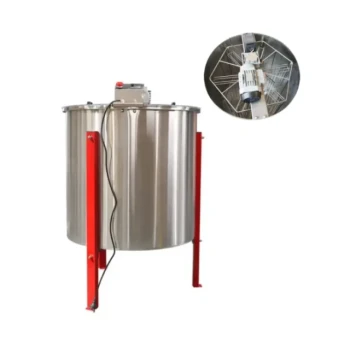
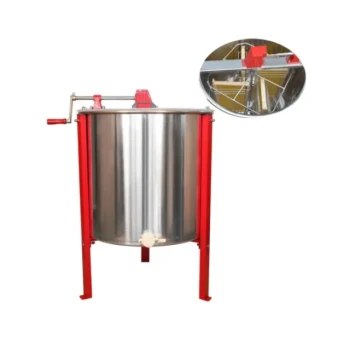
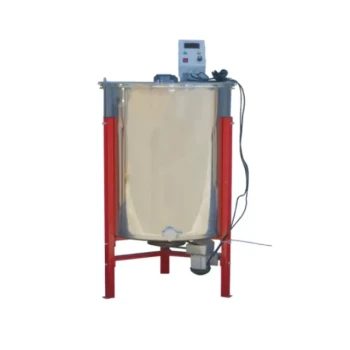
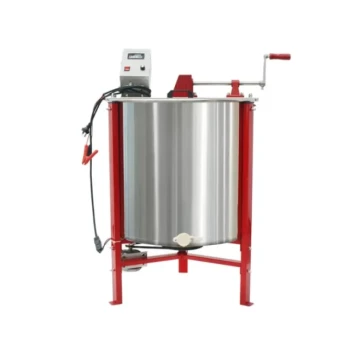
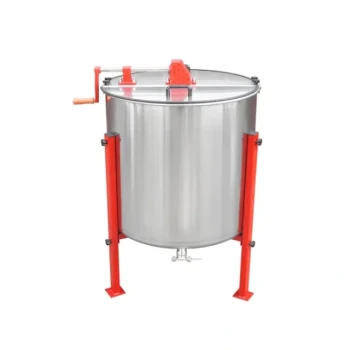
The primary function of a honey extractor is to mechanically separate liquid honey from the honeycomb frame using centrifugal force. By spinning the frames at high speed, the device pulls the honey out while leaving the delicate wax comb structure intact, allowing for immediate reuse within the hive.
The mechanical advantage of an extractor lies in its ability to harvest the product without destroying the production infrastructure. By preserving the wax comb, you eliminate the need for bees to rebuild it, significantly shortening production cycles and increasing total honey yield.
The Mechanics of Extraction
Harnessing Centrifugal Force
The core mechanism of any extractor—whether manual or electric—relies on a spinning basket or drum that holds the hive frames.
A motor or hand crank provides the necessary torque to rotate these frames at high speeds. This generates centrifugal force, which pulls the liquid honey out of the comb cells and projects it against the inner walls of the tank, where it drains into a collection tray.
Structural Preservation
Unlike "crush-and-strain" methods, which destroy the comb to release the honey, an extractor is non-destructive.
Because the comb is supported within the basket during rotation, the wax lattice remains undamaged. This mechanical benefit is critical for maintaining a sustainable and efficient apiary workflow.
The Biological and Economic Impact
Energy Conservation for the Colony
Bees consume a significant amount of honey to produce a small amount of beeswax.
When you return intact wet frames to the hive, the bees do not need to expend energy or resources rebuilding the comb. They can immediately begin cleaning the cells and refilling them with nectar.
Shortened Production Cycles
By removing the construction phase from the bees' workflow, you accelerate the hive's productivity.
Bees can focus entirely on foraging and ripening nectar. This efficiency directly translates to a higher volume of honey harvested per season, making the extractor a vital tool for economic scaling.
Quality and Purity
Extracting honey via centrifugal force results in a cleaner final product.
Because the wax is not crushed into the honey, the extracted liquid contains significantly less debris (such as wax particles or propolis). This simplifies the downstream filtration process and improves the visual quality of the harvest.
Understanding the Trade-offs
Equipment Cost vs. Scale
While extractors increase yield, they represent a significant upfront investment compared to simple straining tools.
For very small hobbyists, the cost of a stainless steel drum and motor mechanism may outweigh the value of the extra honey produced in a single season.
Maintenance and Storage
Extractors are bulky pieces of machinery that require dedicated storage space and rigorous cleaning.
Honey is acidic and hygroscopic; failure to clean the moving parts and the drum thoroughly can lead to corrosion or fermentation of residues, potentially ruining future harvests.
Making the Right Choice for Your Goal
To determine how an extractor fits into your operation, consider your specific objectives:
- If your primary focus is maximizing yield: Prioritize an electric extractor to process frames quickly, returning them to the hive during the peak nectar flow to capitalize on the bees' foraging energy.
- If your primary focus is economy and small-scale management: A manual extractor offers the biological benefits of comb preservation without the higher cost and complexity of a motorized system.
- If your primary focus is product purity: Use an extractor to minimize wax debris, ensuring a clearer final product with less aggressive filtration required.
Ultimately, the honey extractor is not just a harvesting tool; it is a conservation device that protects your hive's most labor-intensive asset—the comb itself.
Summary Table:
| Feature | Mechanical/Biological Benefit | Impact on Apiary Efficiency |
|---|---|---|
| Centrifugal Force | Separates honey without crushing wax | Preserves honeycomb for immediate reuse |
| Comb Preservation | Bees skip the energy-intensive rebuilding phase | Shortens production cycles and increases yield |
| Mechanical Torque | High-speed rotation (Manual or Electric) | Enables rapid processing of multiple frames |
| Purity Control | Minimizes wax debris and propolis mix | Simplifies filtration and improves product clarity |
Maximize Your Honey Production with HONESTBEE
At HONESTBEE, we understand that for commercial apiaries and distributors, efficiency is the foundation of profitability. Our professional-grade honey extractors are engineered to preserve your hive's most valuable asset—the wax comb—allowing your bees to focus on production rather than reconstruction.
Whether you need precision hive-making machinery, high-capacity honey-filling systems, or a steady supply of essential beekeeping tools and consumables, we provide the comprehensive wholesale solutions your business requires. Contact us today to discover how our specialized hardware and industry expertise can scale your operations and enhance your harvest quality.
Related Products
- HONESTBEE 72 Frame Industrial Electric Honey Extractor for Beekeeping
- Commercial Electric 12 Frame Honey Extractor Spinner Motorized Honey Extractor
- HONESTBEE 6 Frame Self Reversing Electric Honey Extractor for Beekeeping
- HONESTBEE 3-Frame Manual Acrylic Honey Extractor
- Stainless Steel Manual 8 Frame Radial Honey Extractor Machine for Beehives
People Also Ask
- What is the importance of balancing honeycomb frames within a honey extractor? Ensure Stability and Protect Machinery
- How is honey separated from the frames after they are uncapped? Efficient Extraction Methods for High Yields
- What are the main benefits of using a honey extractor? Maximize Yields and Protect Your Honeycomb
- What are the recommended methods for removing honey from the honeycomb? Top Extraction Techniques for Maximum Efficiency
- How do manual honey extractors compare to electric honey extractors? Choosing the Right Tool for Your Apiary Growth