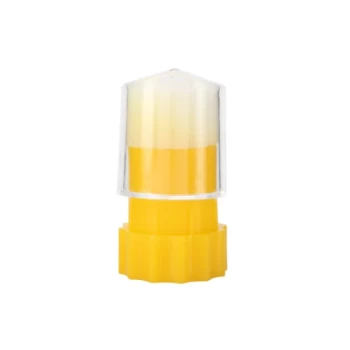
Specialized marking pens serve to identify the precise location of newly laid eggs. Rather than marking the fragile insect itself, these pens are used to label positions on transparent hive covers or cell rims, establishing a precise timeline for development.
The central value of this technique is sample uniformity. By physically mapping egg locations, researchers can calculate exact larval age, ensuring that all specimens collected for analysis are at an identical developmental stage—a requirement for accurate time-dependent physiological studies.
The Mechanics of Age Tracking
Marking the Environment, Not the Organism
Unlike adult bees, honeybee larvae are soft-bodied and fragile. You cannot apply pigment directly to them without risking injury or altering their development.
Instead, researchers use specialized marking pens on the hive infrastructure. By marking the transparent cover or the rim of the cell where an egg has just been laid, a physical map of the colony's reproductive timeline is created.
Establishing a Temporal Baseline
The mark acts as a timestamp. Once a position is labeled, the clock starts for that specific cell.
This allows researchers to return after a set period—such as exactly five days—and retrieve a larva that they know, with certainty, is of that specific age.
Why Uniformity is Critical
Eliminating Developmental Variables
In scientific analysis, a difference of even 24 hours in larval age can skew results significantly. Larvae grow rapidly, and their metabolic rates change quickly.
If a researcher inadvertently mixes four-day-old larvae with five-day-old larvae, the data becomes "noisy" and unreliable. Positional marking eliminates this guesswork.
Application in Substance Accumulation
This precision is particularly vital when studying how substances accumulate in biological tissue over time.
For example, when analyzing the accumulation of lithium in larval tissues, the rate of uptake is time-dependent. Validating that every sample in the test group is at the exact same point in its lifecycle is the only way to prove a correlation between exposure time and substance concentration.
Distinguishing Methods: A Critical Clarification
Positional Marking vs. Thoracic Marking
It is crucial not to confuse larval age tracking with adult identification methods.
While thoracic markers (paints, pens, or tags) are applied directly to the bodies of adult workers or queens to track site fidelity, survival, or social networks, this approach is impossible for larvae.
The Role of Non-Toxic Tools
While the pens used for larvae mark the cell, the tools used for adults (like marking brushes or extraction spatulas) interact with the insect.
When reading research methodology, ensure you distinguish between environmental marking (tracking age via cell position) and individual marking (tracking behavior via body paint).
Making the Right Choice for Your Research
If you are designing a protocol for honeybee study, select your marking method based on the developmental stage of the subject.
- If your primary focus is tracking larval physiology: Rely on positional marking on hive covers to guarantee age uniformity without disturbing the developing brood.
- If your primary focus is adult behavior or survival: Utilize thoracic marking tools (paints or tags) applied directly to the bee to track movement and longevity.
True data integrity begins with the precise validation of your subject's age.
Summary Table:
| Feature | Positional Marking (Larvae) | Thoracic Marking (Adults) |
|---|---|---|
| Target | Hive covers or cell rims | Body of the bee (thorax) |
| Primary Goal | Establish precise age/timestamp | Track behavior, survival, or ID |
| Subject Status | Fragile, soft-bodied | Mobile, hardened exoskeleton |
| Key Benefit | Sample uniformity for studies | Individual identification |
| Tool Type | Non-toxic specialized pens | Marking brushes, paints, or tags |
Elevate Your Apiary Operations with HONESTBEE
Precision is the foundation of successful beekeeping, whether in the lab or the field. HONESTBEE empowers commercial apiaries and distributors with a complete range of professional-grade tools. From specialized marking equipment for research to advanced hive-making and honey-filling machinery, we provide the hardware you need to scale your business.
Our value to you:
- Wholesale Excellence: Competitive pricing on full-spectrum beekeeping supplies.
- Industrial Solutions: High-efficiency machinery for honey production and hive manufacturing.
- Comprehensive Portfolio: Everything from essential consumables to honey-themed cultural merchandise.
Ready to optimize your production and supply chain? Contact HONESTBEE today to discuss our wholesale offerings and industrial equipment solutions.
References
- Janez Prešern, Martin Šala. Lithium contamination of honeybee products and its accumulation in brood as a consequence of anti-varroa treatment. DOI: 10.1016/j.foodchem.2020.127334
This article is also based on technical information from HonestBee Knowledge Base .
Related Products
- Queen Bee Marking Pen POSCA Queen Marking Pens for Beekeeping Bee Markers
- Queen Bee Marking Pen UNI Medium Point for Queen and Bee Marking
- Plastic Long Marker Device for Catching and Marking Bees Queen Bee Marking Tube and Cage
- Plastic Beekeeping Honey Bee Larvae Grafting Tools for Queen Rearing and Chinese Grafting
- Professional Large-Format Hive Number Set for Beekeeping
People Also Ask
- What role do specialized marking pens and color-coding systems play in honeybee tracking? Enhance Research Precision
- Why are specialized marking pens used for stingless bee queens? Essential Tools for Large-Scale Breeding Success
- How should a new paint pen be primed before marking a queen bee? Essential Tips for Safe & Clear Markings
- How should a queen bee marking pen tip be properly primed? Master the Art of Safe Queen Marking
- What specifications are required for a high-quality queen bee marking pen? Ensure Safety and Precision for Your Colony