The process of raising queen bees relies on a sequence of specialized environments designed to meet the changing needs of the developing larvae. This progression moves queen cells from a "starter hive" for initial intense feeding, to a "finishing hive" for cell completion, and finally to a "mating nuc" for emergence and reproduction.
The quality of a raised queen depends on maximizing care at specific developmental stages. By rotating larvae through starter hives, finishing hives, and mating nucs, beekeepers ensure optimal nutrition, proper cell construction, and efficient resource management.
Phase 1: The Starter Hive
Initiating Development
The process begins by placing young larvae into a starter hive. This environment is specifically populated with a high density of young nurse bees.
The Royal Jelly Diet
The primary function of the starter hive is intense nutrition. The nurse bees feed the larvae an exclusive diet of royal jelly. This rich nutritional input is the biological trigger that differentiates a queen bee from a standard worker bee.
Phase 2: The Finishing Hive
Completing the Rearing Cycle
After the initial feeding stage, the developing queens are moved to a finishing hive. Here, a different set of nurse bees takes over the care of the larvae.
Sealing the Cells
The colony in the finishing hive is responsible for the final stage of larval growth. Their specific task is to complete the rearing process and seal the queen cells with wax, protecting the pupae as they undergo metamorphosis.
Phase 3: The Mating Nucleus (Nuc)
Separation for Emergence
Once the queen cells are sealed, they must be separated. Individual cells are moved into distinct, smaller hives known as mating nucs. This separation is vital to prevent the first emerging queen from eliminating her rivals.
The Mating Flights
The new queen emerges within the safety of the mating nuc. This small colony serves as her home base as she matures and eventually leaves for her mating flights to become a reproductive queen.
Strategic Advantages of Mating Nucs
Conserving Hive Resources
Using small nucleus hives for the final stage offers significant efficiency benefits. They require fewer donated brood combs than full-sized hives. This leaves more resources available for honey production hives or allows the beekeeper to create a higher volume of mating nucs.
Reducing Resource Competition
Smaller colonies naturally have lower resource demands. In apiaries with a large number of hives, using small nucs reduces the competition for local nectar and pollen. This ensures that the surrounding environment can support the population without being stripped of forage.
Optimizing Your Queen Rearing Strategy
To implement this process effectively, you must balance biological needs with resource management.
- If your primary focus is Queen Quality: Ensure your starter hive is overpopulated with young nurse bees to guarantee maximum royal jelly production during the critical early hours.
- If your primary focus is Apiary Efficiency: Utilize the smallest viable mating nucs to conserve brood combs and reduce forage pressure on your production colonies.
By strictly adhering to this three-stage rotation, you provide the specialized care required for high-quality queens while maintaining the overall health of your apiary.
Summary Table:
| Stage | Specialized Hive | Primary Goal | Key Activity |
|---|---|---|---|
| Phase 1 | Starter Hive | Intense Nutrition | Feeding larvae royal jelly to trigger queen differentiation. |
| Phase 2 | Finishing Hive | Cell Completion | Final larval care and sealing the queen cells with wax. |
| Phase 3 | Mating Nuc | Emergence & Mating | Protecting emerging queens and providing a base for mating flights. |
Elevate Your Queen Rearing Operation with HONESTBEE
To produce superior queens, you need specialized tools that balance biological needs with operational efficiency. HONESTBEE supports commercial apiaries and distributors by supplying a comprehensive range of professional beekeeping machinery and equipment.
Whether you need precision hive-making machines for your mating nucs, specialized hardware, or essential industry consumables, we provide the wholesale solutions required to scale your production.
Ready to upgrade your apiary’s performance? Contact HONESTBEE Today to discover how our premium equipment and cultural merchandise can add value to your business.
Related Products
- Portable Bee Mating Hive Boxes Mini Mating Nucs 8 Frames for Queen Rearing
- Professional Multi-Functional Queen Bee Cage
- Premium Nicot Style Queen Rearing Kit with Hair Roller Bee Cages
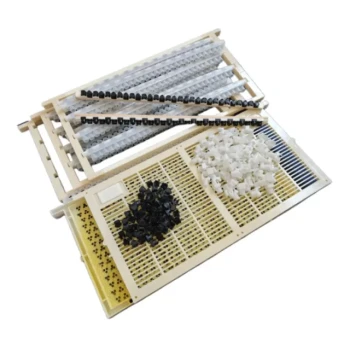
- Jenter Queen Rearing Kit Complete Set for Bee Breeding
- JZBZ Langstroth Queen Rearing Frame for Beekeeping
People Also Ask
- How do specialized queen-rearing frames and mating boxes boost off-season bee production? Optimize Your Apiary's Output
- What are the approximate weights of different types of 8-frame beehive boxes? Lift Smarter for Your Apiary
- What role does the structural configuration of beekeeping mating boxes play? Optimize Queen Mating Success
- What is an 8 frame box and why is it popular? A Lighter, More Ergonomic Hive Solution
- What role do portable mating nucs play in geographic isolation breeding? Secure Genetic Purity in Remote Locations