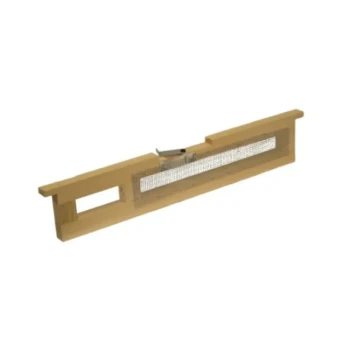
Standardized bee housing is the operational backbone of modern commercial apiculture. It transforms beekeeping from a variable craft into a scalable industry by providing a controlled environment for brood rearing and honey storage. In large-scale operations, precisely designed hive components ensure part interchangeability, which significantly improves the efficiency of hive inspections, honey extraction, and migratory transport.
Core Takeaway Standardized housing converts the biological variability of a bee colony into a manageable, modular industrial asset. By ensuring component interchangeability and environmental control, these systems allow apiaries to scale operations linearly, mechanize transport, and stabilize annual production yields.
Driving Operational Efficiency
The Power of Interchangeability
The primary value of standardized housing lies in component interchangeability. In a commercial setting, frames, boxes, and covers must fit every hive in the operation without modification.
This uniformity drastically reduces the time required for routine inspections. Beekeepers can swap components between colonies to balance resources or manage population issues instantly.
Facilitating Migratory Beekeeping
Commercial apiculture often requires moving thousands of hives to follow nectar flows or fulfill pollination contracts. Standardized specifications ensure compatibility with loading equipment and transport vehicles.
This structural uniformity allows for secure stacking and mechanized handling, reducing labor costs and physical strain. It ensures that hives remain stable and secure during long-distance transit.
Streamlining Honey Extraction
Standardized internal structures are essential for industrial-scale honey harvesting. They allow for the use of automated extraction machinery that requires uniform frame dimensions.
This compatibility accelerates the harvest process, maximizing throughput during critical production windows.
Scaling Production Capacity
Modular Expansion for Yield Maximization
Standardized systems utilize a multi-layered structure, often adding "supers" (additional boxes) on top of the brood chamber. This allows beekeepers to flexibly expand storage space in direct response to nectar flow.
By adapting the hive volume to the colony's productivity, operators can maximize the honey yield per hive. This modularity prevents space constraints from limiting production during peak seasons.
Linear Scalability
The total number of standardized hives defines the base production capacity of an apiary. Research indicates a clear linear relationship between the scale of the colony (number of hives) and total honey yield.
This predictability allows business owners to model growth accurately. It transforms honey production into a calculated equation of hardware investment versus output.
Protecting Biological Assets
Environmental Control and Thermoregulation
Standardized equipment provides a stable physical environment that aids the colony in thermoregulation. This protection helps bees resist external climatic stress, such as extreme heat or cold.
By reducing the energy bees spend on maintaining hive temperature, more energy is directed toward foraging and honey production.
Disease and Pest Management
A controlled hive environment is the first line of defense against biological threats. Standardized designs facilitate easier monitoring and treatment of pests and diseases.
Furthermore, these secure structures effectively prevent absconding (colony abandonment), safeguarding the apiary's biological capital.
Understanding the Trade-offs
Balancing Investment and Output
While standardization enables scaling, it represents a significant upfront infrastructure investment. Operators must precisely manage the quantity of hives to balance the cost of hardware assets against expected economic returns.
Over-investing in equipment that cannot be fully utilized by the available bee population leads to diminished returns on capital.
Spatial Arrangement Challenges
Standardized housing facilitates high-density apiaries, but this creates logistical challenges regarding forage. Beekeepers must optimize the spatial arrangement of hives to reduce foraging path overlaps.
Poor placement of otherwise efficient hives can lead to competition for resources. This requires careful planning to ensure pollination efficiency and maintain the minimum pollen consumption required for colony survival.
Making the Right Choice for Your Goal
To leverage standardized housing effectively, align your management strategy with your specific operational focus:
- If your primary focus is rapid scaling: Prioritize total component interchangeability to ensure that adding new hives does not increase management complexity or labor time per unit.
- If your primary focus is migratory pollination: Focus on housing specifications that are fully compatible with mechanized loading systems and transport logistics to minimize downtime.
- If your primary focus is maximizing yield per hive: Utilize the modular design to aggressively manage space during nectar flows, ensuring storage capacity never caps production.
Standardization is not merely about convenience; it is the strategic tool that allows you to control the variables of nature and build a predictable, profitable enterprise.
Summary Table:
| Benefit Category | Key Feature | Operational Impact |
|---|---|---|
| Operational Efficiency | Component Interchangeability | Faster inspections and seamless resource swapping between colonies. |
| Scalability | Modular Expansion (Supers) | Linear growth and maximized honey yield based on real-time nectar flow. |
| Logistical Advantage | Standardized Dimensions | Simplified mechanized transport and more efficient migratory pollination. |
| Colony Protection | Environmental Control | Improved thermoregulation and easier monitoring for pest management. |
Scale Your Apiary Operations with HONESTBEE
Transitioning to standardized systems is the most effective way to turn biological variability into industrial success. HONESTBEE caters specifically to commercial apiaries and distributors with a comprehensive wholesale offering designed for growth.
We provide the full spectrum of beekeeping tools, machinery, and equipment, including specialized hardware like hive-making and honey-filling machines. Our portfolio also covers essential industry consumables and honey-themed cultural merchandise to support every facet of your business.
Maximize your yield and streamline your logistics today.
Contact our team at HONESTBEE to get a wholesale quote
References
- Matt Benge, Amy T. Vu. Challenges and barriers to conducting commercial beekeeping education programs in Florida. DOI: 10.37433/aad.v4i4.379
This article is also based on technical information from HonestBee Knowledge Base .
Related Products
- Professional Insulated Plastic Bee Hives
- Wholesales Dadant Size Wooden Bee Hives for Beekeeping
- HONESTBEE Wired and Assembled Wooden Bee Frames Foundation for a Thriving Hive
- Wooden Bee Hive Frames for Beekeeping and Wholesale
- Assembled Wooden Bee Frames with Beeswax Foundation Ready to Use by HONESTBEE
People Also Ask
- What are the advantages of plastic bee hives? Boost Efficiency & Durability for Your Apiary
- Are plastic bee hives any good? Unlock Durability & Efficiency for Your Apiary
- How do plastic bee hives compare to wooden hives in handling? Reduce Strain & Boost Efficiency
- Are plastic bee hives good? Durable, Low-Maintenance Hives for Modern Apiaries
- What are the disadvantages of plastic beehives? Key Operational and Environmental Risks Exposed