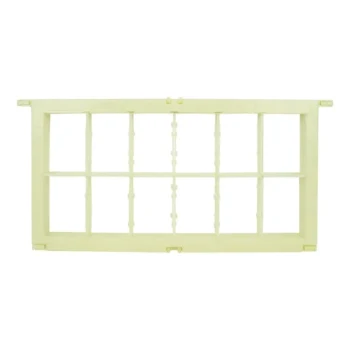
The implementation of standardized beehive frames and beeswax substrates serves as the fundamental control mechanism for scientific honey bee health monitoring. By utilizing components manufactured by precise machinery, researchers ensure that colonies across different monitoring sites function within an identical physical infrastructure. This consistency is the prerequisite for accurately calculating critical biological metrics—such as hive area, food stores, and brood rates—while ensuring that chemical residue analysis remains reliable and comparable.
Core Insight: In the complex ecosystem of a beehive, physical variability introduces data "noise." Standardization acts as a calibration tool, ensuring that observed changes in colony health are attributable to environmental stressors or genetics, rather than inconsistencies in the hive's architecture.
Eliminating Variables in Biological Monitoring
Establishing a Consistent Baseline
To accurately monitor health, researchers must verify that different colonies start from a similar baseline. Standardized frames and foundations allow scientists to unify colony scales by maintaining a fixed number of larval or honey-pollen combs. This eliminates interference caused by initial differences in colony structure, ensuring high comparability between experimental groups.
Precision in Quantitative Measurement
Valid data relies on uniform units of measure. Standardized frames provide a consistent metric for evaluating colony strength, such as counting the "number of frames covered by bees" or measuring the total area of sealed brood. Without this physical standardization, calculating the density of the population or the volume of food stores becomes an estimation rather than a precise measurement.
Isolating Environmental Stressors
When hive structures are identical, researchers can rule out physical housing differences as a cause for colony decline. This isolation ensures that observed stress patterns can be attributed primarily to external factors, such as foraging landscape quality, climate impacts, or parasitic infections. It allows for a direct correlation between environmental input and biological output.
Enhancing Chemical Residue Analysis
The Lipophilic Nature of Beeswax
Beeswax is not merely a structural element; it acts as a chemical sponge that absorbs lipophilic (fat-soluble) compounds. This property makes it the primary carrier for retaining pesticides and other environmental contaminants found within the hive.
Uniformity for Accurate Sampling
For residue analysis to be valid, the substrate being tested must be physically consistent. The uniform structure of standardized beeswax foundations ensures that the surface area and density are constant across samples. This allows researchers to confidently state that chemical levels detected in one location are comparable to those in another, free from biases caused by variations in wax thickness or texture.
Understanding the Trade-offs
The Reuse Dilemma
Standardized frames are designed to withstand centrifugal extraction, allowing colonies to reuse old combs and shortening the production cycle. However, because wax is lipophilic, reusing standardized combs indefinitely can lead to a cumulative buildup of pesticides or pathogens.
Maintenance of the Standard
The benefit of standardization is lost if the equipment degrades or varies between manufacturers. Strict adherence to dimensional precision is required; even minor deviations in "bee space" (the gap between frames) can induce bees to build irregular "burr comb," which disrupts the standardized metrics and complicates observation.
Making the Right Choice for Your Goal
When designing your monitoring program or management strategy, align your equipment choices with your primary objective.
- If your primary focus is Ecotoxicology and Research: Prioritize high-precision, new wax foundations to ensure zero background contamination and perfect structural uniformity for residue analysis.
- If your primary focus is Breeding and Genetics: Use standardized hive dimensions to eliminate environmental housing bias, ensuring that high yields or disease resistance are due to genetics, not superior equipment.
- If your primary focus is Production Efficiency: Leverage the durability of standardized frames to maximize comb reuse and minimize the energy bees spend on wax secretion.
Standardization transforms the beehive from a variable biological habitat into a controlled scientific instrument.
Summary Table:
| Factor | Role in Standardization | Monitoring Benefit |
|---|---|---|
| Physical Baseline | Uniform frame dimensions and hive area | Ensures high comparability between experimental groups |
| Data Precision | Consistent metric for brood and food stores | Enables accurate quantitative measurement of colony strength |
| Stress Isolation | Identical physical housing structure | Rules out architectural bias in environmental stress studies |
| Chemical Analysis | Uniform lipophilic beeswax substrates | Ensures consistent surface area for reliable pesticide sampling |
| Structural Control | Adherence to precise 'bee space' | Prevents irregular burr comb that disrupts data collection |
Elevate Your Apiary Standards with HONESTBEE
Precise monitoring starts with precision-engineered equipment. HONESTBEE specializes in supporting commercial apiaries and distributors with the high-quality infrastructure required for scientific health monitoring and efficient honey production.
As a comprehensive wholesale provider, we supply the full spectrum of beekeeping tools—from specialized hive-making and honey-filling machinery to durable, standardized hardware and industry consumables. Whether you are conducting ecotoxicology research or scaling production, our portfolio ensures your colonies function within a controlled, high-performance environment.
Ready to upgrade your inventory? Contact us today to explore our wholesale solutions and discover how HONESTBEE brings unmatched value to your professional beekeeping operations.
References
- Noa Simon‐Delso, Louis Hautier. Honeybee Colony Disorder in Crop Areas: The Role of Pesticides and Viruses. DOI: 10.1371/journal.pone.0103073
This article is also based on technical information from HonestBee Knowledge Base .
Related Products
- Assembled Wooden Bee Frames with Beeswax Foundation Ready to Use by HONESTBEE
- Professional Galvanized Steel Frame Rest for Beehives
- Assembled Wooden Bee Frames with Plastic Foundation for Durability and Convenience by HONESTBEE
- Wooden Bee Hive Frames for Beekeeping and Wholesale
- HONESTBEE Wired and Assembled Wooden Bee Frames Foundation for a Thriving Hive
People Also Ask
- Under what circumstances should bee frames be destroyed? Protect Your Apiary from American Foulbrood
- How should frames be rearranged as a bee colony grows? Master Hive Expansion and Nest Management
- Do bee frames need foundation? Choose the Right Approach for Your Apiary
- Can beekeepers switch between wooden and plastic frames? Optimize Your Hive's Performance
- How do you re-wax bee frames? A Simple Guide to Faster Comb Building