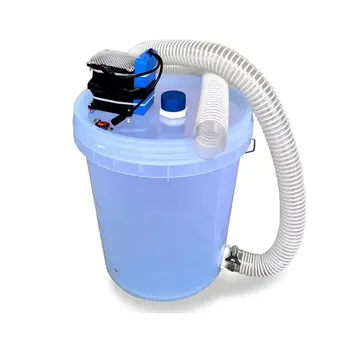
The vacuum pump serves as the core power source for the entire dehydration process. By actively maintaining the system pressure at specific levels, such as -700 mmHg, it fundamentally alters the thermodynamics of water removal. This pressure reduction lowers the boiling point of water, facilitating evaporation at the surface while simultaneously inducing a boiling effect within the internal moisture of the bee pollen granules.
The technical value of proper vacuum selection lies in its ability to trigger internal moisture boiling alongside surface evaporation. This dual action ensures uniform dehydration, which is critical for preserving the structure, color, and aroma of temperature-sensitive bee pollen.
The Mechanism of Low-Pressure Dehydration
Altering the Boiling Point
The primary function of the vacuum pump is to create an environment where water boils at a temperature significantly lower than 100°C.
By sustaining a pressure of roughly -700 mmHg, the system allows moisture to change state from liquid to gas with minimal thermal energy.
This protects the bee pollen from high heat, which is notoriously damaging to its nutritional profile.
Inducing Internal Moisture Movement
Standard drying often relies strictly on surface evaporation, which draws moisture out slowly via capillary action.
A properly rated vacuum pump creates a pressure differential that induces a boiling effect inside the granule itself.
This effectively pushes internal moisture outward, preventing moisture from becoming trapped deep within the pollen structure.
Ensuring Process Uniformity
Inconsistent pressure leads to inconsistent drying, resulting in a product with wet centers and over-dried exteriors.
A stable vacuum ensures that the dehydration forces are applied evenly across the batch.
This uniformity is the key technical driver behind consistent structure, color, and aroma in the final product.
Understanding the Trade-offs
The Risk of Surface Crusting
While the vacuum pump drives moisture release, it must be balanced against the material's physical limitations.
If the drying rate at the surface exceeds the rate of internal moisture migration, the surface may crust over.
This crust seals moisture inside, defeating the purpose of the vacuum and leading to incomplete drying or spoilage.
Balancing Heat Conduction and Pressure
The vacuum enhances evaporation, but the energy for that evaporation comes from heat conduction through the material layers.
If the vacuum is strong but the material layer is too thick, heat cannot penetrate effectively to the center.
This results in a mismatch where the bottom layers may overheat (degrading Vitamin C) while the top layers remain under-dried.
Making the Right Choice for Your Goal
To optimize your bee pollen drying system, you must align your vacuum settings with your specific quality targets.
- If your primary focus is Sensory Quality (Color/Aroma): Prioritize a pump capable of holding a stable -700 mmHg to maximize internal boiling at the lowest possible temperatures.
- If your primary focus is Structural Consistency: Ensure your pressure settings are tuned to prevent rapid surface drying, allowing internal moisture to escape before the outer shell hardens.
True technical mastery involves synchronizing your vacuum pressure with material thickness to achieve a uniform, bioactive product.
Summary Table:
| Technical Factor | Functional Role | Impact on Bee Pollen Quality |
|---|---|---|
| Vacuum Pressure | Lowers boiling point to ~-700 mmHg | Prevents heat damage to proteins & vitamins |
| Internal Boiling | Forces moisture from core to surface | Ensures uniform dehydration & structural integrity |
| Process Stability | Regulates evaporation rate | Preserves natural color, aroma, and bioactivity |
| Thermal Balance | Synchronizes heat with pressure | Prevents surface crusting and internal moisture trapping |
Elevate Your Bee Product Quality with HONESTBEE
At HONESTBEE, we understand that precision is the difference between a premium product and a lost harvest. As a dedicated partner to commercial apiaries and distributors, we provide more than just equipment; we offer the technical expertise required to master complex processes like vacuum dehydration.
Whether you need specialized honey-filling machines, hive-making equipment, or a full suite of beekeeping tools and machinery, our wholesale solutions are designed for industrial-scale success. We empower our clients to achieve superior sensory and bioactive results through high-performance hardware and essential industry consumables.
Ready to optimize your apiary’s output?
Contact our expert team today to explore our comprehensive machinery portfolio and wholesale offerings.
References
- Bui Quoc Khoa, Patricia Tam. Optimization of The Vacuum Drying process for Bee Pollen Using the R method. DOI: 10.54660/ijmcr.2024.3.6.51-56
This article is also based on technical information from HonestBee Knowledge Base .
Related Products
- Portable Electric Bee Vacuum with Lithium Battery and 20L Collection Bucket
- High Quality Honey Dehumidifier Dryer Thickening Machine for Beekeeping
- Removable Plastic Pollen Trap With Ventilated Tray for Bees Pollen Collector
- Plastic Bee Pollen Trap Strips Comb Catcher Collector
- Heavy-Duty Ergonomic Grip Galvanized Pollen Shovel
People Also Ask
- What are the advantages of using portable bee vacuums for sampling honey bees? Optimize Nosema Detection Efficiency
- Who is qualified to use a bee vacuum? Essential Safety and Experience Requirements for Effective Bee Relocation
- What potential problems can occur when using a bee vacuum? Prevent Colony Mortality and Ensure Safe Bee Removal
- What are the benefits of using a bee vacuum? Safely Remove & Preserve Honey Bee Colonies
- Why do people use bee vacuums? A Humane Solution for Live Bee Removal