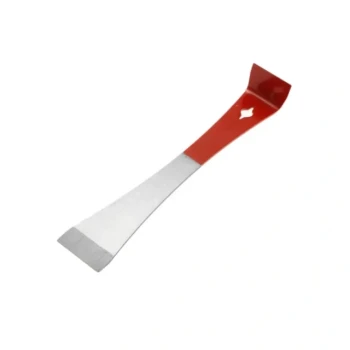
The technical value of a stainless steel grafting tool lies in its ability to facilitate the non-destructive transfer of fragile honey bee larvae. By utilizing a precision-curved tip, this instrument allows researchers to move larvae from natural honeycomb cells into 96-well experimental plates without compromising their delicate body walls. This mechanical precision is the foundational step for establishing valid artificial rearing and toxicity protocols.
The grafting tool is not merely a transfer device; it is a critical control measure in toxicity testing. By minimizing mechanical injury during transplantation, it ensures that observed mortality or developmental issues are caused by the test substance—such as PlyPl23—rather than physical trauma from the handling process.
Precision Geometry and Larval Handling
The Function of the Curved Tip
The primary technical feature of this tool is its precision-curved tip. This design is engineered to slide under the larva, cradling its shape rather than pinching or piercing it.
This geometry allows the user to lift the larva gently from the bottom of the honeycomb cell. It supports the larva's weight across a larger surface area, reducing localized pressure points.
Compatibility with Micro-Assays
The tool is specifically sized to navigate the confined spaces of 96-well experimental plates.
This capability is essential for modern laboratory setups, allowing for high-throughput screening where space is limited and placement accuracy is paramount.
Preserving Biological Integrity
Preventing Physical Trauma
Honey bee larvae, particularly those around 2 days old, possess extremely fragile body walls.
The stainless steel tool is designed to prevent the rupture or bruising of this exterior membrane. Even microscopic damage to the body wall can lead to infection or fluid loss, compromising the organism's viability.
Ensuring High Survival Rates
For any artificial rearing experiment to be valid, the baseline survival rate of the control group must be high.
By using a tool that minimizes physical mechanical damage, researchers ensure that larvae survive the transfer process itself. This establishes a reliable baseline for subsequent observations of growth and development.
Ensuring Validity in Toxicity Testing
Isolating the Test Variable
In toxicity assays, such as testing the safety of PlyPl23, the goal is to measure the biological effect of a specific substance.
If larvae are damaged during transfer, it introduces a confounding variable. The grafting tool eliminates "handling stress" as a cause of death, ensuring that experimental results accurately reflect the toxicity of the substance, not the clumsiness of the transfer.
Consistent Developmental Baselines
Reliable research requires consistent development across all test subjects.
Larvae that are physically stressed during transfer may exhibit stunted growth or delayed development unrelated to the chemical being tested. The grafting tool standardizes the physical state of the larvae at the start of the experiment.
Operational Considerations and Limitations
Dependence on Operator Skill
While the stainless steel tool offers precision, it is a manual instrument. Its effectiveness is ultimately tied to the dexterity and steadiness of the researcher.
A "precision tip" cannot compensate for aggressive handling or unsteady hands. Proper training in the scooping technique is required to realize the tool's technical value.
Throughput Speed vs. Care
There is an inherent trade-off between the speed of transfer and the safety of the larvae.
Rushing the process with a steel tool can still result in mechanical injury. The tool is designed for accuracy over speed, and prioritizing the latter can negate the benefits of the design.
Aligning Equipment with Research Goals
The choice to use a high-precision stainless steel grafting tool is a choice to prioritize data integrity over convenience.
- If your primary focus is Toxicity Testing (e.g., PlyPl23): You must use this tool to ensure that any mortality recorded is statistically attributable to the chemical, not physical injury.
- If your primary focus is Mass Artificial Rearing: You should prioritize the tool to maximize the percentage of larvae that successfully reach pupation and adulthood.
Ultimately, the stainless steel grafting tool transforms the high-risk variable of manual handling into a standardized, reliable process essential for credible in vivo data.
Summary Table:
| Feature | Technical Value | Research Benefit |
|---|---|---|
| Precision-Curved Tip | Enables non-destructive cradling of larvae | Minimizes physical trauma and body wall rupture |
| Sized for Micro-Assays | Compatible with 96-well experimental plates | Supports high-throughput screening and accuracy |
| Stainless Steel Build | Rigid and sterilizable material | Eliminates handling stress as a confounding variable |
| Mechanical Reliability | Standardizes the transfer process | Ensures consistent developmental baselines for testing |
Elevate Your Bee Research with HONESTBEE Precision Tools
At HONESTBEE, we understand that the integrity of your data depends on the quality of your equipment. As a leading supplier for commercial apiaries and global distributors, we provide a comprehensive range of beekeeping tools, specialized machinery, and essential consumables designed for precision and durability.
Whether you are scaling up artificial rearing or conducting sensitive toxicity assays, our professional-grade stainless steel grafting tools and hardware solutions ensure your operations meet the highest industry standards.
Partner with HONESTBEE to secure high-performance equipment for your apiary or distribution network.
Contact Our Wholesale Experts Today
References
- Ana Oliveira, Joana Azeredo. The First Paenibacillus larvae Bacteriophage Endolysin (PlyPl23) with High Potential to Control American Foulbrood. DOI: 10.1371/journal.pone.0132095
This article is also based on technical information from HonestBee Knowledge Base .
Related Products
- Stainless Steel Queen Grafting Tool for Beekeeping and Bee Queen Grafting
- HONESTBEE Advanced Ergonomic Stainless Steel Hive Tool for Beekeeping
- Professional Stainless Steel J-Hook Hive Tool
- Precision Stainless Steel Frame Cleaner for Hive Grooves and Corners
- Retractable Chinese Queen Rearing Grafting Tools Equipment
People Also Ask
- What is grafting in queen rearing? Take Control of Your Apiary's Genetics
- What are the benefits of using a queen grafting tool for queen rearing? Master Precision for Superior Bee Genetics
- What are the steps involved in using a queen grafting tool? A Guide to Successful Queen Rearing
- What is the step-by-step process for using a queen grafting tool? Master Larva Transfer for Better Queen Rearing
- What is the primary function of a queen grafting tool? Master Precise Larval Transfer for High Queen Acceptance