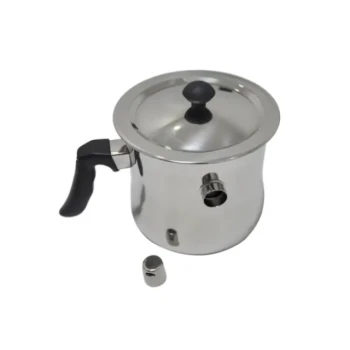
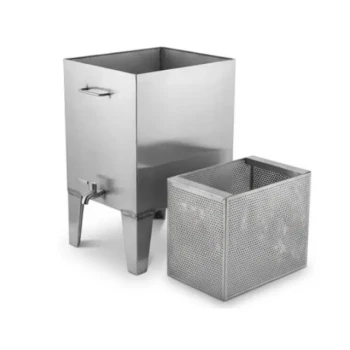
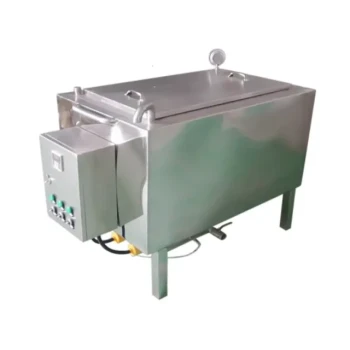
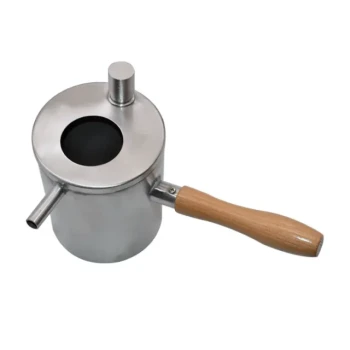
To maintain the texture and quality of beeswax, avoiding water contamination is paramount. You must ensure that water from your double boiler does not splash or mix into the melting wax, as this will degrade the final consistency of the rendered product. Additionally, wrapping honeycomb chunks in cheesecloth during the melting process allows you to manage the material effectively and filter out impurities that affect texture.
The integrity of beeswax relies on isolation and gentle heat. While a water bath is necessary to regulate temperature, the wax itself must remain dry and be filtered through material like cheesecloth to preserve its natural structure.
Preserving Quality Through Environmental Control
The Danger of Moisture
The most significant threat to the texture of your beeswax is water contamination. While a double boiler system is the standard method for melting, the water in the bottom pan must be kept at a light simmer, not a rolling boil.
If the water is too turbulent, droplets can splash into the wax container. Even a small amount of water mixing with the liquifying wax can ruin the texture, leading to an inconsistent or "mushy" final product.
Temperature and Aesthetics
Beeswax has a melting point of approximately 147°F (64°C). Exceeding this temperature significantly does not speed up the process; it degrades the product.
Overheating the wax causes two specific quality issues: it darkens the color and diminishes the natural honey aroma. To retain the bright yellow hue and pleasant scent that defines high-quality beeswax, maintain the lowest heat setting necessary to keep the water simmering.
Filtration for Smoothness
Raw honeycomb contains impurities that will ruin the smoothness of your wax block. Wrapping the chunks in cheesecloth or placing them inside a nylon stocking during the melting phase is essential.
This acts as a filter, trapping propolis, bee parts, and other debris while allowing the pure wax to seep out. For the highest quality finish, this may require a cycle of melting, cooling, and re-melting with fresh filters until the wax is visually clear.
Common Pitfalls to Avoid
The Risk of Direct Heat
Never melt beeswax directly over an open flame or burner. Without the buffer of a water bath (double boiler), the wax can easily exceed its flashpoint of 400°F, leading to ignition.
Beyond the safety hazard, direct heat creates "hot spots" that scorch the wax, permanently altering its chemical structure and quality before the entire block has melted.
The Microwave Method
Avoid using a microwave to melt beeswax. Microwaves heat unevenly, which creates localized pockets of extreme heat that can ruin the wax's quality and pose a fire risk.
Furthermore, beeswax is difficult to clean from microwave surfaces. The double boiler method, ideally using an electric burner or slow cooker, offers the consistent, controlled heat required for a quality result.
Making the Right Choice for Your Goal
To achieve the best results based on your specific needs, consider the following approach:
- If your primary focus is cosmetic quality: Prioritize temperature control; keep the heat low to preserve the light color and natural scent, and filter multiple times.
- If your primary focus is processing raw comb: Focus on the filtration method; use cheesecloth or stockings to separate debris early, but ensure the "dirty water" from the boiling process never touches the rendered wax.
Treat beeswax not as a simple ingredient, but as a delicate compound that requires patience and isolation to maintain its superior properties.
Summary Table:
| Key Factor | Recommended Practice | Benefit |
|---|---|---|
| Temperature | Maintain ~147°F (64°C) | Prevents darkening and preserves natural honey aroma |
| Heating Method | Double boiler / Water bath | Ensures uniform heat and prevents scorching or fire risks |
| Moisture Control | Avoid water splashing into wax | Prevents "mushy" texture and maintains structural integrity |
| Filtration | Use cheesecloth or nylon | Removes impurities like propolis and debris for a smooth finish |
| Safety | No direct flames or microwaves | Prevents flashpoint ignition and localized overheating |
Elevate Your Wax Processing with HONESTBEE
To achieve professional-grade results, you need equipment designed for precision. HONESTBEE supports commercial apiaries and distributors with high-performance beekeeping tools and industrial machinery. Whether you require specialized honey-filling machines, professional hive-making hardware, or essential industry consumables, our wholesale portfolio is built to scale your operations.
Ready to enhance your production quality and efficiency? Contact us today to explore our full spectrum of equipment and see how HONESTBEE can deliver unparalleled value to your beekeeping business.
Related Products
- Beeswax Melter for Candle Making Honey Bee Wax Melter
- Steam Beeswax Melter Wax Warmer for Wax Processing
- Electric Commercial Beeswax Melter for Factory Use
- Solar Beeswax Melter Easy Solar Wax Melter for Beeswax
- Professional Stainless Steel Wax Melter for Beekeeping and Crafts
People Also Ask
- What is the best way to melt beeswax? Safely Preserve Quality with Indirect Heat
- What is the best way to melt beeswax? Use a Solar Wax Melter for Simple, Pure Results
- What types of beeswax melters are available for beekeepers? Choose the Right One for Your Operation
- What safety precautions should be taken when melting beeswax? A Guide to Flammable Wax Handling
- What types of beeswax melters are available for different scales of beekeeping? Solar vs. Electric Melters Compared