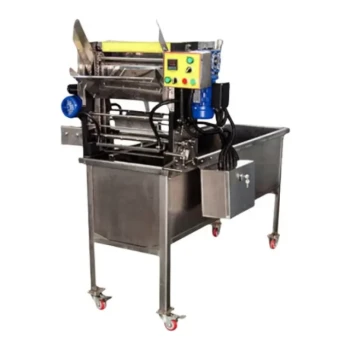
Automated honey filling lines serve as the critical infrastructure for transforming raw honey into a commercially viable, trusted consumer product. These systems integrate precision metering, vacuum sealing, and automated labeling to directly mitigate safety risks like secondary contamination while establishing the consistency required to compete in premium markets.
By standardizing the encapsulation process, automated lines do more than increase speed; they provide the physical foundation for brand credit. They ensure the airtight, hygienic packaging necessary to extend shelf life and satisfy a market increasingly vigilant about food safety and fraud.
Elevating Food Safety and Hygiene
Minimizing Secondary Contamination
The primary safety advantage of automation is the removal of human error and contact. Manual filling exposes honey to potential pathogens and environmental impurities.
Automated lines utilize sterile, closed-loop environments that isolate the product. This significantly reduces the risk of secondary contamination during the transfer from tank to jar.
Ensuring Airtight Preservation
Honey is hygroscopic, meaning it absorbs moisture from the air, which can lead to fermentation and spoilage.
Automated vacuum sealing functions create a hermetic seal that manual capping cannot replicate. This airtight barrier prevents atmospheric moisture entry, preserving the honey's physicochemical stability and extending its shelf life.
Professional Encapsulation
No-drip filling nozzles and precise mechanical capping ensure the bottle neck remains clean.
This prevents sticky residue that attracts bacteria or insects. A clean, professionally sealed package serves as a visual guarantee of hygiene to the consumer.
Driving Market Competitiveness
Precision Metering and Cost Control
Competitiveness relies on margin control, and honey is a high-value raw material.
High-precision piston or weighing systems ensure every jar meets strict net content specifications. This eliminates the "overfilling" common in manual operations, directly reducing raw material waste and maximizing yield per batch.
Building Brand Credit
In a market wary of adulterated products, the packaging quality acts as a proxy for product quality.
The high-standard encapsulation provided by these lines reflects a premium image. It signals to consumers that the brand invests in safety and quality control, thereby building the "brand credit" necessary to command higher prices.
Accessing Formal Retail Channels
Large-scale retailers, such as supermarkets, demand rigorous standardization and supply chain consistency.
Automated equipment produces the uniform, legally compliant packaging required to enter these formal channels. It allows local producers to scale operations and move from roadside selling to international export markets.
Understanding the Operational Trade-offs
Technical Maintenance Requirements
While automation reduces manual labor costs, it shifts the operational requirement to technical maintenance.
Operators must be trained to handle calibration and mechanical troubleshooting. A breakdown in a fully automated line can halt production entirely, unlike a manual line where labor is flexible.
Initial Capital Investment
The transition to automated lines represents a significant upfront capital expenditure.
For smaller beekeeping enterprises, the ROI depends heavily on volume. Automation is a tool for scaling; without sufficient raw supply, the cost-per-unit benefits of these machines cannot be fully realized.
Making the Right Choice for Your Production Goals
To maximize the value of an automated filling line, align the technology with your specific business objective:
- If your primary focus is Brand Trust: Prioritize systems with advanced vacuum sealing and labeling capabilities to ensure a premium, tamper-evident appearance.
- If your primary focus is Cost Efficiency: Focus on high-precision volumetric metering systems to eliminate product giveaways and raw material waste.
- If your primary focus is Market Expansion: Select equipment that offers rapid changeover capabilities to handle the various jar sizes and labeling standards required by different retailers.
Ultimately, automated filling is not just about packaging speed; it is the essential mechanism for converting raw agricultural output into a standardized, safe, and competitive commercial asset.
Summary Table:
| Key Feature | Role in Safety & Competitiveness | Business Impact |
|---|---|---|
| Precision Metering | Eliminates overfilling and raw material waste | Increases profit margins and cost control |
| Vacuum Sealing | Creates airtight, hermetic barriers against moisture | Extends shelf life and prevents fermentation |
| Closed-Loop Design | Minimizes human contact and secondary contamination | Ensures compliance with global food safety standards |
| Automated Labeling | Produces uniform, professional, and compliant packaging | Facilitates entry into premium retail and export markets |
| No-Drip Nozzles | Maintains clean bottle necks and hygienic presentation | Enhances brand credit and consumer trust |
Transform Your Apiary into a Premium Brand with HONESTBEE
Elevate your honey production from raw agricultural output to a world-class commercial asset. HONESTBEE provides commercial apiaries and distributors with the cutting-edge machinery needed to dominate the market. From high-precision honey-filling machines and automated production lines to specialized hive-making equipment and honey-themed merchandise, we offer a comprehensive wholesale portfolio tailored to your growth.
Partner with HONESTBEE to:
- Reduce Waste: Achieve unmatched accuracy with precision metering systems.
- Guarantee Safety: Protect your product with sterile, automated encapsulation.
- Scale Globally: Meet the rigorous standards of international retailers with consistent, high-quality packaging.
Ready to maximize your yield and build lasting brand credit? Contact our expert team today to find the perfect equipment solution for your operation!
References
- Christopher R. Gustafson, Antoine Champetier. Could Information About Honey Fraud Increase Consumers’ Valuation of Domestic Honey in the Face of Rising Honey Imports in the U.S. and EU?. DOI: 10.32873/unl.dc.yiitpr.08
This article is also based on technical information from HonestBee Knowledge Base .
Related Products
- Fully Automatic Honey Filling Packaging Machine for Processing Line
- Automatic Honey Filling and Filtering Machine for Beekeeping Bottle Filling
- Precision Durable Efficient HONESTBEE Rotary Honey Filling Machine
- Precision Automated Packaging Turntable Honey Spoon Filling Sealing Packing Machine
- Semi Automatic Small Honey Bottle Filling Machine Honey Filler
People Also Ask
- Why are fully automatic honey filling and packaging lines essential? Boost Your Honey's Market Value and Quality
- What is a fully-automatic honey filler? Streamline Your Production with High-Precision Automation
- How do automated honey filling and packaging machines affect profitability? Boost Margins with HONESTBEE Technology
- How do automated honey filling and packaging machines contribute to the market value of honey products? Maximize Your ROI
- How do industrial-grade automated honey filling and packaging machines mitigate the risk of physical contamination?