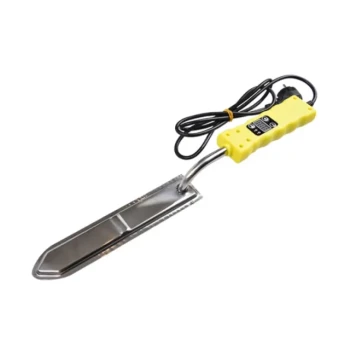
Digital thermocouple thermometers serve as the critical control mechanism for maintaining the precise environmental conditions required during propolis processing. They function by continuously monitoring both the cooling equipment and the general workshop atmosphere to ensure temperatures remain strictly within a narrow technical range, specifically around 19.82°C.
Propolis is thermally sensitive material that shifts from brittle to sticky with even minor temperature increases. The core value of digital monitoring is preventing this phase change, ensuring the material remains solid enough for effective mechanical separation.
The Physics of Propolis Processing
Combating Thermal Sensitivity
Propolis is an extremely heat-sensitive substance. Its physical properties change rapidly when exposed to thermal fluctuations, making the ambient environment a critical variable in the production line.
Digital thermocouple thermometers provide the necessary precision to track these changes in real-time. They are used to strictly monitor the cooling environment to ensure it does not deviate from the optimal set point.
Preventing Re-Adhesion
The primary operational risk during the cooling and cleaning stages is the propolis softening. If the material warms up, it becomes sticky again.
This stickiness causes the propolis to adhere to machinery or resist separation. By maintaining a target temperature of 19.82°C (± 1.92°C), operators ensure the propolis remains in a state suitable for the stripping process.
Achieving Process Consistency
Multi-Point Temperature Monitoring
Relying on a single data point is often insufficient for industrial processing. Digital thermocouples are utilized for multi-point monitoring throughout the workspace.
This technique ensures that the entire processing chain—not just one isolated area—remains within the technical temperature limits. This comprehensive coverage guarantees that mechanical separation efficiency is maintained from start to finish.
Operational Considerations and Trade-offs
The Burden of Precision
The window for optimal processing is incredibly narrow. With a tolerance of only ± 1.92°C, there is very little room for equipment error or environmental drift.
This requires thermometers that are highly calibrated and responsive. Using lower-grade equipment can lead to undetected temperature spikes that ruin a batch by allowing it to soften unexpectedly.
Infrastructure Dependency
While the thermometers provide the data, they cannot cool the room. The strict monitoring requirements imply that the underlying cooling infrastructure must be robust enough to react immediately to the data provided.
If the cooling system cannot maintain the 19.82°C target despite the alerts from the thermometers, the monitoring becomes ineffective.
Optimizing Your Processing Setup
To ensure high-yield propolis processing, align your temperature control strategy with your specific operational goals:
- If your primary focus is mechanical efficiency: strictly maintain the environment at 19.82°C to maximize brittleness and ensure clean stripping.
- If your primary focus is process consistency: implement multi-point monitoring to detect and eliminate thermal pockets that could cause localized softening.
Precise thermal management is the difference between a clean mechanical separation and a stalled, sticky production line.
Summary Table:
| Stage | Target Temperature | Role of Thermocouple | Impact on Propolis |
|---|---|---|---|
| Cooling | 19.82°C (± 1.92°C) | Continuous real-time monitoring | Maintains brittleness for processing |
| Cleaning | 19.82°C (± 1.92°C) | Multi-point environmental tracking | Prevents re-adhesion to machinery |
| Mechanical Stripping | Stable Room Temp | Detecting thermal pockets | Ensures clean, efficient separation |
Maximize Your Propolis Yield with HONESTBEE Solutions
At HONESTBEE, we understand that precision is the backbone of a successful commercial apiary. As a premier provider for beekeeping distributors and large-scale operations, we supply the professional-grade tools and machinery needed to master thermal-sensitive processes. From specialized honey-filling machines to robust hive-making equipment and essential consumables, our portfolio is designed to enhance your production efficiency.
Ready to upgrade your processing line? Contact us today to explore our comprehensive wholesale offerings and see how our expertise can drive your business forward.
References
- Roman Dvykaliuk. Testing of the collecting propolis device on the bee farms in different regions of Ukraine. DOI: 10.24263/2225-2924-2023-29-2-9
This article is also based on technical information from HonestBee Knowledge Base .
Related Products
- Digital Honey Refractometer for Precision Measurement of Optimal Honey Quality
- Professional Electric Honey Uncapping Knife with Heated Digital Temperature Control for Beekeeping
- HONESTBEE Adjustable Voltage Wire Embedder with Digital Display
People Also Ask
- What role do high-precision refractometers play in determining the maturity and quality of honey? Ensure Honey Purity.
- Do the color and viscosity of honey affect its refractometer reading? Mastering Moisture Measurement Accuracy
- What is a honey refractometer? The Essential Tool for Perfect Honey Quality
- How do refractometers ensure technical precision when measuring honey moisture? Secure Quality and Prevent Fermentation
- How is the reading taken from a honey refractometer? A Guide to Accurate Moisture Measurement