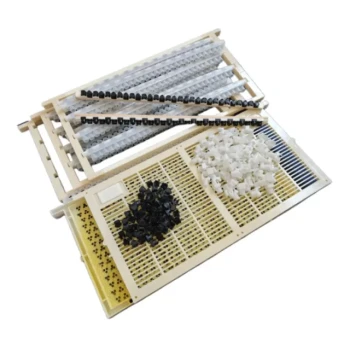
Integrated non-grafting queen rearing systems serve as a mechanical solution to the most delicate bottleneck in beekeeping: the transfer of larvae. By confining the queen to a specialized plastic comb with removable bottoms, these systems compel her to lay eggs directly into artificial cell bases, which can then be transferred to rearing colonies without ever touching the larvae.
Core Takeaway The fundamental value of non-grafting systems is the democratization of queen production. They replace the high manual dexterity and visual acuity required for traditional grafting with a standardized mechanical process, significantly reducing larval injury and allowing operations to scale breeding programs without hiring master grafters.
The Mechanics of Non-Grafting Systems
The Principle of Confinement
The system relies on a specialized cassette or frame containing a plastic comb structure.
The queen is confined within this space using a cover or excluder material. This restriction forces her to lay eggs in the specific locations provided by the beekeeper, rather than scattering them randomly across a wax comb.
The Removable Bottom Mechanism
Unlike natural comb, the "cells" in this system utilize removable bottoms.
Once the queen has laid eggs in the artificial cups, the beekeeper does not need to use a grafting needle to lift the larvae. Instead, the back of the device is detached, and the individual cups—now containing eggs or young larvae—are unplugged and moved directly to cell bars.
Preservation of Larval Health
The most significant biological advantage is the protection of the developing bee.
Manual grafting carries a high risk of physically injuring the microscopic larvae or drying out the royal jelly. By moving the cup rather than the insect, the larvae remain untouched and undisturbed in their original bed of jelly.
Operational Impact
Lowering the Technical Barrier
Traditional queen rearing requires a steady hand, excellent eyesight, and years of practice to master.
Non-grafting systems eliminate this skill gap entirely. They allow novice beekeepers or general farm labor to produce queens with a success rate that was previously reserved for specialists.
Scaling Production
For larger operations, these systems standardize the workflow.
By removing the variable of human error in larval transfer, the operation becomes more predictable. This consistency is vital for maintaining colony strength and shortening production cycles, which directly influences economic return.
Understanding the Trade-offs
Equipment Management
While you avoid the need for manual skill, you exchange it for equipment complexity.
These systems require cleaning, assembly, and careful management of the plastic components. The beekeeper must manage the "hardware" of the cups and frames rather than the "software" of the grafting technique.
Timing Precision
Success depends heavily on strict scheduling.
Because the queen is confined, the beekeeper must adhere to a precise timeline to release her and move the eggs. Failing to move the cups at the exact right developmental stage can result in the colony rejecting the cells or the queen becoming stressed from prolonged confinement.
Making the Right Choice for Your Goal
To determine if a non-grafting system is the right investment for your apiary, consider your specific operational focus:
- If your primary focus is genetic independence: These systems allow you to raise daughters from your best queens without investing years in learning to graft manually.
- If your primary focus is large-scale consistency: The system minimizes physical damage to larvae, ensuring a higher percentage of viable queen cells during mass production pushes.
- If your primary focus is minimizing labor costs: You can utilize staff with lower technical training to handle the transfer process, reserving your expert staff for colony assessments and selection.
The ultimate role of the non-grafting system is to ensure that the difficulty of larval transfer never limits the genetic potential of your apiary.
Summary Table:
| Feature | Traditional Grafting | Non-Grafting Systems |
|---|---|---|
| Skill Level | High dexterity & vision required | Standardized mechanical process |
| Larval Handling | Physical transfer via needle | No direct contact with larvae |
| Risk of Injury | High (damage or dehydration) | Minimal (preserved in original jelly) |
| Scalability | Limited by specialist availability | Easy to scale with general labor |
| Equipment | Minimal (grafting tool) | Specialized cassette and cup system |
Scale Your Queen Production with HONESTBEE
Are you looking to eliminate the bottleneck of manual grafting and achieve consistent, high-volume queen rearing? HONESTBEE provides commercial apiaries and distributors with professional-grade non-grafting systems and the full spectrum of beekeeping machinery.
From advanced hive-making equipment and precision honey-filling machines to a complete range of wholesale beekeeping tools and essential consumables, we empower your operation to grow efficiently. Let us help you maximize your genetic potential and reduce labor costs with our comprehensive wholesale solutions.
Contact HONESTBEE Today for a Wholesale Quote
References
- Ralph Büchler, J. Wilde. Standard methods for rearing and selection of<i>Apis mellifera</i>queens. DOI: 10.3896/ibra.1.52.1.07
This article is also based on technical information from HonestBee Knowledge Base .
Related Products
- No Grafting Queen Rearing Kit: System for Royal Jelly Production and Queen Rearing
- Jenter Queen Rearing Kit Complete Set for Bee Breeding
- Nicot Queen Rearing Kit for Beekeeping and Grafting in Nicot System
- Stainless Steel Beekeeping Queen Grafting Tool for Honey Bee Rearing
- Premium Nicot Style Queen Rearing Kit with Hair Roller Bee Cages
People Also Ask
- What is the primary function of a queen rearing kit? Eliminate Manual Grafting for Superior Bee Breeding
- How do specialized queen rearing kits and queen management tools improve the success rate of bee colony expansion?
- What are some alternative methods to grafting for queen cell production? Discover Graft-Free Queen Rearing Systems
- Are queen rearing systems generally suitable for all honeybee species? Master Efficient Breeding Methods
- Are queen rearing systems suitable for all beekeepers? Modern Tools for Every Experience Level