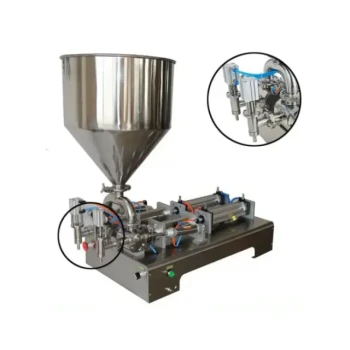
Industrial honey-filling and packaging machinery acts as the critical bridge between raw agricultural production and high-value international trade. These systems transform raw honey into commercial-grade products by utilizing high-precision quantitative filling and strict hygienic sealing. By ensuring finished goods meet rigorous international food safety standards, this machinery allows producers to access premium retail markets and high-value industrial trade channels that are otherwise inaccessible to manual operations.
Core Takeaway: Industrial packaging is not merely about containment; it is a value-add process that converts a raw commodity into a standardized, high-end consumer good. By guaranteeing hygiene, precision, and shelf stability, this technology can potentially double the market price of honey compared to its unprocessed form.
Achieving Global Compliance and Standardization
Precision Through Quantitative Filling
To compete internationally, honey producers must eliminate the weight deviations inherent in manual processing. Industrial machinery utilizes high-precision quantitative filling to ensure exact volume control for every unit.
This consistency allows local producers to meet strict international standards regarding volume accuracy. It ensures trade credibility and prevents the financial losses associated with over-filling or the reputational damage of under-filling.
Meeting Strict Hygiene Standards
Accessing markets like the European Union requires adherence to stringent food safety regulations. Industrial lines integrate automated sealing and processing that significantly reduce human contact.
By minimizing the risk of secondary contamination, these machines ensure the product remains pure from the vat to the bottle. This level of hygiene is a prerequisite for entering high-value export channels.
Preserving Quality and Extending Shelf Life
Creating a Physical Barrier
High-quality packaging provided by industrial machinery acts as a robust physical barrier. This protects the honey from environmental factors that could degrade its quality over time.
Effective sealing extends the shelf life of the product, making it viable for long-distance shipping and extended retail display. This stability is essential for maintaining the natural physical and chemical properties of the honey during export.
Stability via Automation
Industrial processing lines often integrate filtration and temperature control with the filling process. This integration maintains the stability of the honey's quality across large production volumes.
Automated agitation and filling prevent separation or crystallization issues during the packaging phase. This ensures the customer receives a product that looks and tastes consistent with the producer's master sample.
Elevating Brand Value and Market Positioning
Transitioning to High-End Consumer Goods
Machinery enables the shift from selling primary agricultural goods (often sold in bulk) to high-end consumer products. Research indicates that professionally packaged honey can command a market price more than double that of raw, unprocessed honey.
Professional Presentation and Traceability
Advanced machinery supports diverse packaging designs and precise labeling. This allows for the application of certification marks and coding required for traceability, which increases consumer trust.
For unique varieties, such as Caucasian Gray Bee honey, high-performance packaging conveys a premium brand image. It transforms a generic jar into a recognizable, trusted commodity that competes effectively with imported brands.
Understanding the Trade-offs
The Cost of Consistency
While manual filling allows for flexibility, it lacks the rigor required for export. Adopting industrial machinery requires a shift toward rigid standardization.
Producers must accept that the "artisan" variability of manual packing is replaced by strict uniformity. This is necessary to meet global standards, but it requires a commitment to maintaining complex automated systems to ensure the "precision" and "hygiene" advantages are not lost to mechanical failure.
Making the Right Choice for Your Goal
To maximize the value of your honey production, align your equipment choice with your specific market targets:
- If your primary focus is International Export: Prioritize machinery with high-precision quantitative filling and automated sealing to meet strict EU-level hygiene and volume standards.
- If your primary focus is Brand Premium: Focus on equipment that supports diverse packaging designs and professional coding to convey a high-end image and justify a higher price point.
Industrial packaging transforms honey from a simple commodity into a trusted, high-value global product.
Summary Table:
| Feature | Impact on Market Value | Benefit for International Trade |
|---|---|---|
| Quantitative Filling | Eliminates weight deviations | Ensures trade credibility and volume compliance |
| Automated Sealing | Prevents secondary contamination | Meets stringent EU/Global food safety standards |
| Standardized Packaging | Enables premium brand positioning | Commands prices 2x higher than bulk honey |
| Integrated Processing | Extends product shelf life | Facilitates long-distance shipping and retail stability |
| Professional Labeling | Enhances traceability | Builds consumer trust and brand recognition |
Scale Your Honey Business to Global Markets with HONESTBEE
Transform your raw production into a premium international brand. HONESTBEE provides commercial apiaries and distributors with the cutting-edge machinery needed to dominate the global honey market. From high-precision honey-filling machines and automated packaging lines to specialized hive-making hardware, our comprehensive wholesale solutions are designed for efficiency and compliance.
Why partner with HONESTBEE?
- Export-Ready Quality: Our equipment ensures your products meet the strictest international hygiene and volume standards.
- End-to-End Solutions: We supply the full spectrum of beekeeping tools, industrial machinery, and essential consumables.
- Value-Driven Growth: We help you transition from selling bulk commodities to high-margin, branded consumer goods.
Ready to elevate your production? Contact our experts today to find the perfect machinery for your operations.
References
- Georgi Aleksiev. HONEY TRADE IN BULGARIA AND ITS IMPACT ON THE APPICULTURAL SECTOR. DOI: 10.15547/tjs.2019.s.01.073
This article is also based on technical information from HonestBee Knowledge Base .
Related Products
- Precision Automated Packaging Turntable Honey Spoon Filling Sealing Packing Machine
- Double Nozzle Small Honey Filling Machine Honey Sachet Packing Packaging Equipment
- Fully Automatic Honey Filling Packaging Machine for Processing Line
- Small Honey Filling Machine Sachet Packing Equipment Single Nozzle
- Economy Small Honey Filling Machine Honey Bottle Filler Packaging Machine
People Also Ask
- Why is the use of professional filling and sealing packaging machinery necessary for the production of high-value honey?
- What role do automated filling and packaging machines play in the honey supply chain? Scale Your Retail Distribution
- What are the benefits of automated honey filling and packaging? Scale Your Apiary with Industrial Precision
- What role do professional automated filling and packaging machines play in honey processing? Boost Efficiency & Value
- How do automated honey filling and packaging machines contribute to the market value of honey products? Maximize Your ROI