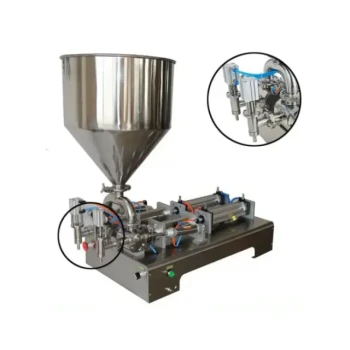
Industrial honey-filling machines primarily address the critical bottlenecks of process inefficiency and sanitary non-compliance inherent in manual packaging. By integrating automated metering and filling systems, these machines allow producers in high-yield regions—such as those rich in buckwheat and mustard—to rapidly package large volumes of honey while adhering to standardized sanitary requirements for commercial distribution.
Core Takeaway: Industrial filling technology bridges the gap between raw agricultural extraction and the commercial supply chain. It converts variable, high-viscosity raw materials into standardized commodities by solving issues related to throughput speed, volume precision, and strict export-grade hygiene.
Overcoming Throughput and Efficiency Barriers
Handling Peak Production Windows
High-potential floral regions produce massive volumes of honey in short seasonal windows. Manual packaging cannot keep pace with this influx, creating production bottlenecks.
Industrial machines provide the necessary high throughput to process these large batches immediately. This speed ensures that beekeeping operations can quickly transform pollination by-products into market-ready goods without storage delays.
Precision Quantitative Control
Manual filling often leads to inconsistent product weights and volume errors. This inconsistency undermines brand reliability and commercial viability.
Automated systems utilize high-precision quantitative controls to ensure every unit contains the exact intended volume. This guarantees product consistency across thousands of units, a requirement for entry into large-scale retail chains.
Solving Physical Property Challenges
Managing Viscosity and Crystallization
Honey is a technically difficult liquid to handle due to its high viscosity and tendency to crystallize. Standard liquid fillers often fail or clog when processing thick, raw honey.
Advanced industrial fillers address this through constant temperature flow control. By maintaining specific thermal conditions, the machine keeps the honey fluid enough for rapid movement without degrading its quality.
Eliminating Material Loss and Bubbles
Improper filling techniques can introduce air bubbles or cause dripping, which ruins the product's aesthetic appeal and shelf value.
Industrial designs minimize material loss through anti-drip nozzles and controlled flow rates. This prevents the formation of air bubbles, ensuring the final product looks clear and professional, particularly for high-end gift products.
Ensuring Hygiene and Market Compliance
Mitigating Contamination Risks
Manual handling is the primary vector for secondary contamination in food processing. Every human interaction increases the risk of introducing bacteria or foreign particles.
Automated filling removes the human element from the open-container stage. Sealed machine designs prevent environmental pollutants and potential antibiotic cross-contamination, which is critical for maintaining organic certification.
Meeting Export Standards
International markets enforce stringent requirements regarding food safety and packaging integrity.
Industrial-grade machinery ensures compliance with these rigorous standards through automated sealing and hygienic processing zones. This capability allows producers to pivot from local sales to high-value international export markets.
Operational Considerations and Trade-offs
Scalability vs. Complexity
Not all "industrial" machines suit every operation. A compact automatic filler may handle 360 bottles per hour (500g size), suitable for boutique operations.
Conversely, large processing plants require inline machines with multiple nozzles (2 to 4) to achieve 3 to 6 tons per day. Producers must balance their current yield with the floor space and capital investment required for these larger, more complex systems.
Flexibility Limitations
While efficient, high-speed inline machines are often optimized for specific bottle shapes or liquid viscosities.
Switching between different container formats (e.g., jars vs. sachets) or honey types may require significant retooling or downtime. Operators must assess whether their product line variety aligns with the machine's specialization.
Making the Right Choice for Your Goal
To select the appropriate filling technology, evaluate your production targets against the machine's capabilities:
- If your primary focus is entering international export markets: Prioritize machines with sealed designs and constant temperature controls to ensure organic compliance and shelf stability.
- If your primary focus is rapid processing of seasonal gluts: Invest in multi-nozzle inline systems capable of processing 3 to 6 tons per day to prevent bottlenecks during harvest peaks.
- If your primary focus is boutique or gift-grade honey: Look for precision machines with anti-drip and bubble-prevention features to maximize the visual appeal of the product.
Standardization is the key technical bridge that turns a raw harvest into a globally tradeable asset.
Summary Table:
| Technical Challenge | Industrial Machine Solution | Impact on Production |
|---|---|---|
| High Viscosity | Constant temperature flow control | Maintains fluidity and prevents clogging |
| Inconsistent Volume | High-precision quantitative metering | Ensures brand reliability and retail compliance |
| Contamination Risk | Sealed automated systems | Meets international food safety and export standards |
| Production Bottlenecks | Multi-nozzle inline filling | Processes 3-6 tons/day during peak harvest |
| Aesthetic Defects | Anti-drip nozzles & flow control | Eliminates air bubbles and product wastage |
Scale Your Honey Production with HONESTBEE Professional Equipment
Transitioning from raw harvest to a global commodity requires more than just honey—it requires precision engineering. HONESTBEE specializes in empowering commercial apiaries and distributors with high-performance honey-filling machines, hive-making hardware, and essential beekeeping tools.
Whether you are processing 3 to 6 tons a day or seeking to penetrate high-value export markets with organic-certified hygiene, our comprehensive wholesale offerings are designed to maximize your throughput and product quality.
Ready to upgrade your facility? Contact us today to discuss how our specialized machinery can streamline your operation and drive your business growth.
References
- Shiva Rijal, Yubak Dhoj. BEE FLORAL CALENDAR OF CULTIVATED AND WILD PLANTS AVAILABLE IN DIFFERENT AGROECOSYTEMS OF CHITWAN, NEPAL. DOI: 10.29121/granthaalayah.v6.i11.2018.1121
This article is also based on technical information from HonestBee Knowledge Base .
Related Products
- Commercial Rotary Honey Filling Machine for Production
- Precision Durable Efficient HONESTBEE Rotary Honey Filling Machine
- Fully Automatic Honey Filling Packaging Machine for Processing Line
- Automatic Honey Filling and Filtering Machine for Beekeeping Bottle Filling
- Economy Small Honey Filling Machine Honey Bottle Filler Packaging Machine
People Also Ask
- What role do commercial honey filling machines play in honey distribution? Scaling Efficiency and Quality Control
- What technical support do commercial-grade filling machines provide? Convert Honey NTFPs into Marketable Commodities
- What is the significance of specialized honey filling equipment? Scaling from Beekeeping to Commercial Success
- Why is professional honey filling machinery critical for honey production? Scale Your Apiary's Profit & Efficiency
- Why is high-capacity honey filling machinery necessary for Giant Honey Bees? Solve the Apis dorsata Volume Crisis