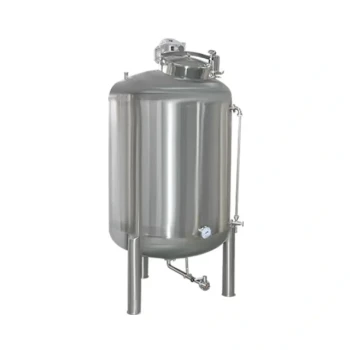
Large settling tanks are the primary method for natural honey purification, utilizing gravity rather than mechanical force to separate impurities. When honey is held in these tanks at a controlled temperature of 25 to 30 degrees Celsius, distinct layers form based on density. Low-density debris and air bubbles rise to the top, heavy particles sink to the bottom, and pure, high-quality honey remains in the center.
The Core Insight Settling tanks provide a critical balance between purification and preservation. By relying on gravity and time rather than aggressive filtration, producers can achieve the visual clarity and batch consistency required for the market without degrading the honey’s nutritional profile.
The Mechanics of Natural Purification
Density-Based Separation
The fundamental principle of a settling tank is gravity-based separation. Honey is a viscous fluid, but when given enough time, materials with different densities will separate naturally.
Rising Impurities
Low-density elements, such as wax particles, pollen debris, and trapped air bubbles, naturally migrate to the surface. This creates a "scum" layer that can be easily skimmed off, significantly improving the honey's visual transparency.
Sedimentation of Heavy Particles
Conversely, heavier impurities that may have passed through initial strainers settle at the very bottom of the tank. The tap for bottling is typically located above this sediment line, ensuring only clean honey is drawn for packaging.
The Critical Role of Time
This is not an instant process. The honey must remain undisturbed for at least 48 hours to allow this stratification to occur effectively. This duration ensures that even extremely fine impurities have time to migrate out of the main body of the honey.
Thermal Control and Preservation
The Optimal Temperature Range
For gravity settling to work efficiently, the viscosity of the honey must be managed. The tanks are operated in a controlled environment between 25 and 30 degrees Celsius.
Preserving Nutritional Integrity
This specific temperature range is warm enough to facilitate the movement of impurities but cool enough to prevent heat damage. Excessive heat can destroy enzymes and degrade the nutritional components of honey; settling tanks avoid this risk entirely.
Temperature Stabilization
Beyond purification, the tanks allow the honey to equilibrate with the ambient temperature. This thermal balancing ensures stable physical properties, preventing issues during the bottling process.
Achieving Commercial Consistency
Homogenization of Batches
In large-scale operations, honey from different hives or harvest days can vary significantly. Large tanks allow producers to mix these various batches thoroughly.
Unifying Physical Characteristics
This mixing process, known as homogenization, unifies the product's key attributes. It ensures that the color, moisture content, and flavor remain consistent across the entire production run.
Meeting Market Standards
Consistency is a strict requirement for large distributors and export markets. Large settling tanks are the critical equipment that ensures every jar of honey on a shelf looks and tastes the same.
Understanding the Trade-offs
The Cost of Time
The primary trade-off of using settling tanks is the production bottleneck. Requiring honey to sit for 48+ hours slows down throughput compared to aggressive pressure filtration systems.
Space Requirements
To maintain production flow while honey settles, facilities need significant floor space to house multiple large tanks. This increases the capital investment and facility size required for operation.
Temperature Sensitivity
Strict adherence to the 25–30°C range is mandatory. If the temperature drops too low, the honey becomes too thick for impurities to move; if it rises too high, the nutritional quality is compromised.
Making the Right Choice for Your Goal
Whether you are designing a processing facility or evaluating production methods, the use of settling tanks depends on your specific quality targets.
- If your primary focus is Nutritional Quality: Prioritize gravity settling to remove impurities without subjecting the honey to high heat or high-pressure filtration that degrades enzymes.
- If your primary focus is Product Standardization: Utilize large tanks to homogenize moisture levels and color across large batches to meet strict retail or export consistency requirements.
Ultimately, large settling tanks represent a commitment to quality over speed, ensuring a clean, consistent product that retains its natural value.
Summary Table:
| Feature | Benefit | Detail |
|---|---|---|
| Gravity Separation | Natural Purification | Removes wax and air bubbles (top) and heavy sediment (bottom). |
| Thermal Control | Preserves Enzymes | Maintains 25-30°C to reduce viscosity without heat damage. |
| Homogenization | Market Consistency | Unifies color, moisture, and flavor across large production batches. |
| Time-Based Flow | High Clarity | Requires 48+ hours to ensure even fine impurities are removed. |
Elevate Your Honey Production with HONESTBEE
At HONESTBEE, we understand that large-scale honey processing requires a balance between speed and quality. As a dedicated partner to commercial apiaries and distributors, we offer a comprehensive wholesale range of beekeeping tools, machinery, and essential consumables.
Whether you need precision honey-filling machines, specialized hardware for hive-making, or professional-grade settling equipment to ensure your product meets global export standards, we have the expertise to support your growth.
Ready to optimize your honey processing line? Contact HONESTBEE Today to explore our full spectrum of beekeeping solutions and cultural merchandise.
References
- Abideen Abiodun Alarape, P. E. Arira. Survey of Apicultural Practices in Ibadan, Oyo State, Nigeria. DOI: 10.22161/ijeab.51.11
This article is also based on technical information from HonestBee Knowledge Base .
Related Products
- Stainless Steel Honey Storage and Settling Tank with Double Strainer
- Heavy Duty Stainless Steel Honey Processing Machine Decrystallizing Tank
- Stainless Steel Honey Storage Tank with Lid for Honey
- Professional Honey Storage Tank with Agitation System
- Stainless Steel Uncapping Tank with Stand and Strainer
People Also Ask
- What economic role do honey storage tanks play? Boost Your Revenue Through Strategic Inventory Management
- What roles do industrial honey storage tanks and filtration meshes play in processing? Ensure Purity & Consistency
- What is the purpose of a honey storage tank? Streamline Your Honey Processing for Quality & Efficiency
- What role do settling tanks play in honey production? Achieve Pure, High-Clarity Honey Naturally
- How do high-precision filtering equipment and honey settling tanks contribute to product quality? Enhance Honey Purity