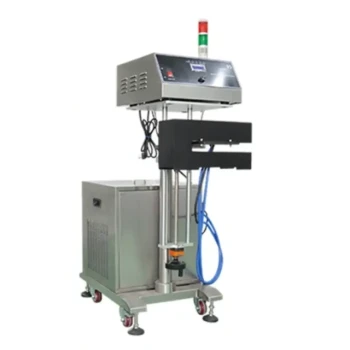
Industrial low-temperature freezing is the critical preparatory step required to overcome the natural viscoelastic properties of raw propolis. Without this thermal treatment, the material’s high viscosity and toughness at room temperature cause it to adhere to mechanical components, rendering standard grinding processes impossible.
The Core Takeaway Propolis is naturally adhesive and tough; attempting to grind it at ambient temperatures inevitably leads to equipment clogging and poor particle consistency. Freezing the material to approximately -20°C forces a phase change into a brittle solid state, enabling the creation of a fine powder that maximizes surface area for the subsequent extraction of active compounds.
The Physical Challenge: Overcoming Viscoelasticity
The Adhesion Problem
At room temperature, raw propolis acts as a viscous, tough resin. It possesses high adhesive properties that make it incompatible with standard milling or pulverization equipment.
Equipment Fouling
If introduced to a grinder without freezing, the friction and mechanical action generate heat. This causes the propolis to smear rather than shatter, leading to immediate mechanical clogging. The material adheres to the blades and internal surfaces, halting production and necessitating difficult cleanup.
The Solution: Thermal Embrittlement
Reaching the Embrittlement Point
The primary function of the industrial freezing equipment is to lower the temperature of the propolis below its embrittlement point.
The Target Temperature
Supplementary data indicates that lowering the temperature to approximately -20°C is the industry standard for this process. At this temperature, the resin undergoes a physical transformation from a viscoelastic state to a fragile, brittle solid.
Enabling Mechanical Pulverization
Once brittle, the propolis no longer resists impact. Instead of stretching or sticking, it fractures cleanly under mechanical force. This allows high-power electric grinders to process the blocks into a uniform fine powder without adhering to the machinery.
The Strategic Goal: Maximizing Extraction Efficiency
Increasing Surface Area
The ultimate goal of grinding is not just size reduction, but the maximization of surface area. A fine, uniform powder exposes significantly more surface area than coarse chunks.
Enhancing Solvent Penetration
This increased surface area is the core prerequisite for the next stage: ethanol extraction. The fine powder allows the solvent to penetrate the matrix thoroughly.
Disrupting Encapsulation
The grinding process disrupts the physical encapsulation structure formed by waxes and resins. This ensures that active components, such as flavonoids and phenolic compounds, are accessible to the solvent, resulting in a higher yield.
Understanding the Trade-offs and Risks
Consequences of Inadequate Freezing
If the temperature is not maintained at or below the specific embrittlement point (approx. -20°C) throughout the process, the material may revert to a sticky state during grinding. This leads to inconsistent particle sizes and potential equipment damage.
The Risk of Chemical Degradation
While the primary need for freezing is mechanical, there is a secondary chemical risk. Propolis contains heat-sensitive active components and volatiles. Without the freezing environment, the heat generated during grinding—or exposure to ambient temperatures—can accelerate oxidation and volatilization, altering the chemical profile of the final product.
Making the Right Choice for Your Goal
To optimize your propolis processing line, consider which outcome drives your immediate operational needs:
- If your primary focus is Mechanical Throughput: Ensure your equipment can maintain a consistent core temperature of -20°C to prevent resin adhesion and equipment downtime.
- If your primary focus is Extract Quality: Utilize the freezing stage not just for grinding, but to stabilize volatile components and prevent oxidation of heat-sensitive phenolics.
Correct thermal pretreatment transforms propolis from a mechanical liability into a high-yield resource.
Summary Table:
| Feature | At Room Temperature | At -20°C (Frozen) |
|---|---|---|
| Material State | Viscoelastic / Tough Resin | Fragile / Brittle Solid |
| Equipment Interaction | Adheres to blades; causes clogging | Fractures cleanly; high-speed processing |
| Grinding Result | Smearing & overheating | Uniform fine powder |
| Surface Area | Low (Coarse chunks) | High (Fine powder) |
| Extraction Yield | Poor solvent penetration | Maximum active compound recovery |
Elevate Your Propolis Processing with HONESTBEE
Maximize your yields and protect your equipment by integrating professional-grade thermal solutions into your production line. At HONESTBEE, we specialize in providing commercial apiaries and distributors with the high-performance tools and machinery needed to scale operations efficiently.
From industrial-grade freezing and grinding equipment to specialized honey-filling machines and essential beekeeping consumables, our comprehensive wholesale portfolio is designed to meet the rigorous demands of the modern bee products industry. Whether you are upgrading your extraction facility or sourcing premium hardware, our team is ready to provide the expertise you need.
Ready to optimize your production? Contact us today to explore our full range of solutions!
References
- Aslı Özkök, Bekir Salih. The Chemical Analysis of Propolis, Which are Produced in Western of Turkey. DOI: 10.15671/hjbc.20164420575
This article is also based on technical information from HonestBee Knowledge Base .
Related Products
- Professional Water Cooled Induction Sealing Machine for Bottles and Containers
- Professional Plastic Honey Dipper for Easy Honey Drizzling
- Economy Small Scale Honey Dryer Dehumidifier Thickening Machine
- Heavy Duty Stainless Steel Honey Processing Machine Decrystallizing Tank
- 0.5T Capacity Honey Dehumidifier Dryer with Vacuum Heating and Thickening Filtering Machine
People Also Ask
- How does tamper-evident sealing equipment benefit the honey trade? Ensure Product Integrity and Market Trust
- What is the function of an induction sealing machine in packaging? Secure Your Brand with Tamper-Evident Seals
- How does an induction sealing machine work? Enhance Honey Packaging with Hermetic Seals & Tamper Evidence
- What is an induction sealing machine and how does it work? Achieve Airtight, Tamper-Evident Seals
- How does the induction sealing process work? Create Tamper-Evident, Airtight Seals for Your Products