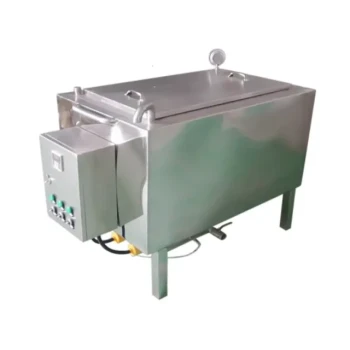
Precise temperature control is the critical safeguard that prevents honey bee feeding syrup from turning toxic during processing. Industrial equipment is required to strictly regulate heat levels, ensuring that the sugar does not chemically degrade into Hydroxymethylfurfural (HMF), a byproduct that is fatal to bee colonies.
Core Insight The primary function of industrial temperature control is not merely to dissolve sugar, but to act as a safety limiter against chemical degradation. By maintaining strict thermal ceilings, processors prevent the formation of HMF, ensuring the syrup supports colony health rather than causing metabolic failure.
The Chemistry of Risk: Hydroxymethylfurfural (HMF)
The Byproduct of Overheating
When sugar solutions are subjected to excessive heat, the chemical structure of the sugar begins to break down.
This degradation produces Hydroxymethylfurfural (HMF). While harmless in trace amounts, HMF concentrations spike rapidly once temperature thresholds are crossed.
Biological Impact on Bees
Honey bees are unable to process high levels of HMF.
Consuming syrup with elevated HMF content leads to severe intestinal metabolic disorders. This toxicity directly results in increased mortality rates within the hive, effectively poisoning the workforce you are trying to nourish.
The Role of Precision Industrial Equipment
Maintaining Critical Temperatures
For specific processes, such as producing inverted sugar syrup, the temperature must be held at a "critical point" of approximately 38°C.
Industrial equipment uses sensors and regulators to lock this temperature in. This specific heat level allows enzymes or acids to effectively hydrolyze sucrose into glucose and fructose without risking thermal degradation.
Uniformity Through Stirring
Temperature control relies heavily on movement. Industrial-grade stirring devices provide regular, intermittent agitation of the mixture.
This ensures the heat is distributed evenly, eliminating "hot spots" where sugar might burn locally. It also guarantees that the sucrose is fully dissolved and hydrolyzed, maximizing the digestibility of the feed.
Common Pitfalls to Avoid
The Danger of Boiling
A common mistake in non-industrial or amateur processing is bringing the syrup to a boil to speed up dissolution.
Syrup must never be boiled. While slight heating assists in dissolving the recommended 1:1 sugar-to-water ratio (common for spring feeding), boiling guarantees the creation of HMF and renders the feed unsafe.
Neglecting the Cooling Phase
Temperature control extends to the post-processing phase.
Even properly heated syrup poses a risk if introduced to the hive while hot. The mixture must be allowed to cool completely before being placed into beekeeping feeders, preventing physical injury to the bees and ensuring proper storage stability.
Ensuring Colony Safety and Nutrition
To maximize the health of your apiary, your processing method must prioritize thermal stability over speed.
- If your primary focus is Safety: Ensure your equipment has a hard thermal limit to prevent the syrup from ever reaching boiling point, eliminating the risk of HMF spikes.
- If your primary focus is Digestibility: maintain the mixture at exactly 38°C with constant stirring to facilitate full enzymatic hydrolysis of sucrose into glucose and fructose.
- If your primary focus is Spring Feeding: Use a 1:1 ratio of granulated sugar to water and allow the solution to cool entirely before filling hive feeders.
Precision in processing is the difference between feeding your bees and poisoning them.
Summary Table:
| Feature | Requirement | Impact on Bee Health |
|---|---|---|
| Temperature Limit | Max 38°C for inversion | Prevents Hydroxymethylfurfural (HMF) toxicity |
| Heat Distribution | Constant/Intermittent Stirring | Eliminates local hot spots and chemical degradation |
| Mixing Ratio | 1:1 Sugar to Water (Spring) | Ensures optimal digestibility and energy intake |
| Cooling Phase | Full cooling before use | Prevents thermal injury and ensures storage stability |
Secure Your Colony’s Nutrition with HONESTBEE Precision Solutions
Don't let improper heating compromise your apiary's productivity. At HONESTBEE, we empower commercial apiaries and distributors with high-performance, temperature-controlled machinery designed to eliminate HMF risks.
Our comprehensive wholesale portfolio includes:
- Advanced Sugar Processing & Honey-Filling Machines with precision thermal sensors.
- Industrial-Grade Stirring Systems for uniform heat distribution.
- A Full Spectrum of Beekeeping Tools and essential industry consumables.
Whether you are scaling up your production or seeking reliable equipment for your distribution network, HONESTBEE delivers the hardware and expertise needed to safeguard bee health.
Contact our experts today to optimize your feeding process!
References
- Tamara Hribernik, Aleš Gregorc. Understanding Honey Bee (Apis mellifera) Colony Losses: A Multifactorial Perspective. DOI: 10.18690/agricsci.22.1-2.4
This article is also based on technical information from HonestBee Knowledge Base .
Related Products
- HONESTBEE Round Hive Top Bee Feeder for Syrup
- High Quality Honey Dehumidifier Dryer Thickening Machine for Beekeeping
- HONESTBEE Commercial Upright Honey Melter
- Professional Thermostatic Conical Honey Melter
- Professional Stainless Steel Honey Filtering Machine with Water Bath Heating for Beekeeping
People Also Ask
- What can the round hive top feeder be used for? A Guide to Efficient, Safe Bee Feeding
- What is the capacity of the round hive top feeder for syrup and pollen? A Guide to Targeted Apiary Support
- What types of hive boxes is the round hive top feeder compatible with? Universal Fit for 8 & 10-Frame Langstroth Hives
- What types of feed can be used with the round hive top feeder? Versatile Feeding for Optimal Apiary Health
- What are the different types of top feeders for bees? Choosing the Best Feeder for Your Apiary