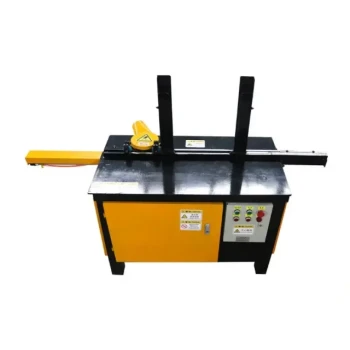
Removable-frame hives are important because they make beekeeping inspectable, reusable, and scalable. Beekeepers can remove individual frames to monitor brood, queen performance, disease, pests, and honey stores without destroying the colony’s comb structure. Hive-making machines support commercial production by manufacturing frames, hive boxes, and related components with consistent dimensions, structural strength, and interchangeability.
The removable-frame design provides the operating system for modern commercial beekeeping, while hive-making machines provide the manufacturing consistency needed to deploy that system at scale.
Why Removable Frames Matter in Commercial Beekeeping
Non-destructive colony management
A removable frame allows the beekeeper to inspect one part of the colony without dismantling or destroying the entire nest. This turns hive management from a destructive process into a controlled, repeatable operation.
Beekeepers can evaluate brood development, queen activity, food stores, and colony strength while preserving the existing comb for continued use.
Reusable comb improves operating efficiency
Honey can be removed from the frames using centrifugal extraction while the wax comb remains intact. The frames can then be returned to the hive, allowing bees to refill existing comb instead of rebuilding it from the beginning.
This saves bees the energy and resources required for wax production and can improve honey-production efficiency over repeated harvest cycles.
Better disease and queen monitoring
Regular frame-by-frame inspection makes it easier to identify disease, pests, abnormal brood patterns, and queen-related problems at an early stage. Commercial operators can therefore make targeted interventions instead of treating or replacing entire colonies unnecessarily.
This level of visibility is especially important when managing large apiaries, where small health problems can spread quickly or affect production across many hives.
Modular hive expansion
Standardized removable frames support the vertical stacking of hive bodies and honey supers. Operators can adjust internal hive capacity as colony populations and seasonal nectar flows change.
The same modular principle supports migratory beekeeping, larger commercial colonies, and organized pollination operations.
Why Standardization Is Essential
Consistent bee space
Hive components must maintain accurate internal dimensions and appropriate bee space. If frames or boxes are incorrectly sized, bees may fill unwanted gaps with excess comb or propolis, making inspections and frame removal more difficult.
Precision manufacturing helps maintain the clearances required for predictable colony management.
Interchangeable components
Commercial beekeepers need to move frames and boxes between colonies, yards, and production cycles. Standardized deep, medium, and shallow frames must fit their corresponding hive bodies and supers reliably.
Interchangeability reduces operational friction and simplifies inventory management, repairs, expansion, and seasonal reconfiguration.
Structural integrity and insulation
Hive boxes and frames must withstand repeated handling, transport, stacking, inspection, and extraction. Well-produced components also contribute to a stable hive environment that protects colonies from challenging weather conditions.
For distributors and wholesalers, consistent construction quality is equally important because customers expect dependable performance across a complete product range.
How Hive-Making Machines Support Production
Repeatable component dimensions
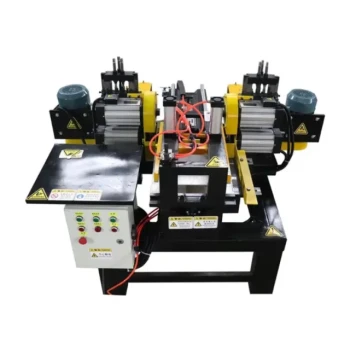
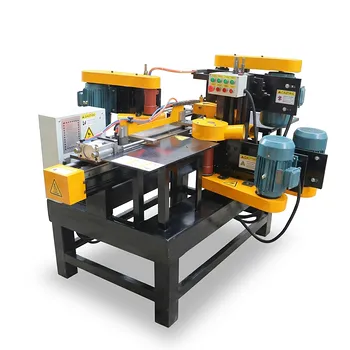
Hive-making machines produce frames, boxes, and other wooden components according to defined specifications. This repeatability helps manufacturers maintain accurate dimensions across large production runs.
The result is a more uniform product that supports proper fit, reliable bee space, and smooth interchangeability between hive components.
Faster large-scale output
Commercial apiaries and distribution businesses may require large quantities of standardized equipment. Manual production can make it difficult to maintain consistent quality while meeting delivery schedules.
Dedicated machinery increases production efficiency and supports faster assembly of hive components, helping suppliers respond to expansion projects and seasonal demand.
Lower infrastructure burden
Professional hive-making and frame-processing equipment can reduce the infrastructure costs associated with scaling production. Instead of relying entirely on slow, inconsistent manual processes, manufacturers can establish a more organized and repeatable production workflow.
This is valuable for producers serving commercial beekeepers, as well as B2B resellers seeking stable supply and predictable fulfillment.
Support for product customization
Standardized machinery does not necessarily mean inflexible products. Production equipment can support custom specifications for different hive formats, local climates, or bee-management practices while maintaining controlled manufacturing quality.
This gives suppliers the ability to offer both common hive components and tailored solutions without abandoning production consistency.
More efficient order fulfillment
For distributors and wholesalers, equipment is only commercially useful when it supports dependable supply. Efficient hive production helps suppliers maintain broader inventories, coordinate complete orders, and reduce delays caused by component shortages.
A capable supplier can therefore provide frames, boxes, supers, and related equipment as part of a more complete sourcing service.
The Commercial Value of a Complete Hive System
Easier inventory management
When components follow standardized dimensions, distributors can organize products by established frame and box sizes. Customers can more easily identify compatible equipment, while suppliers can manage stock with greater confidence.
This also reduces the risk of selling components that do not fit the customer’s existing hive system.
Streamlined honey processing
Uniform removable frames are compatible with mechanized honey extraction workflows. Consistent frame dimensions allow commercial operators to handle, extract, and return combs more efficiently.
The hive design and the processing system therefore work together: removable frames improve colony management, while standardized construction supports downstream equipment and operations.
Better scalability for apiaries
A commercial apiary can expand more predictably when new hives, frames, and supers are compatible with existing equipment. Standardization makes it easier to add colonies, reorganize yards, and replace damaged components.
For resellers, this creates an opportunity to supply a full-spectrum product portfolio rather than isolated wooden parts.
Understanding the Trade-offs
Precision equipment requires investment
Hive-making machines require capital, setup, maintenance, and trained operation. For small producers with limited output, manual production may remain economically reasonable.
The business case becomes stronger when production volume, quality requirements, or delivery expectations justify the investment.
Standardization must match the target market
Not every beekeeping market uses the same frame depth, hive body format, or management method. Producing a technically precise component in the wrong specification still creates an unusable product.
Suppliers should confirm local standards and customer requirements before selecting machinery or building inventory.
Automation does not replace quality control
Machines improve repeatability, but they do not eliminate the need to inspect wood quality, joints, surface finish, dimensions, and final assembly. Poor raw materials or incorrect machine settings can produce large quantities of defective components.
Effective production therefore combines machinery with clear specifications, process controls, and final inspection.
Customization can increase complexity
Offering many sizes or regional variations can help reach more customers, but it also complicates purchasing, production planning, storage, and fulfillment. A focused core range with carefully selected custom options is often easier to manage.
How to Apply This to Your Commercial Operation
The right approach depends on whether your priority is apiary performance, manufacturing capacity, or dependable B2B supply.
- If your primary focus is colony management: Choose a standardized removable-frame system that supports non-destructive inspection, reusable comb, disease monitoring, and modular hive expansion.
- If your primary focus is production efficiency: Use precision hive-making machinery to maintain consistent dimensions, improve throughput, and support repeatable assembly.
- If your primary focus is distribution or resale: Source compatible frames, boxes, supers, and related equipment from suppliers able to provide a broad product portfolio and reliable order fulfillment.
- If your primary focus is market flexibility: Select production equipment and suppliers that can support standard products alongside controlled customization for local climates and beekeeping practices.
- If your primary focus is long-term scalability: Prioritize interchangeability, documented specifications, quality control, and responsive technical support over the lowest initial equipment price.
Removable-frame hives make commercial beekeeping manageable, while precise hive production makes that management scalable.
Summary Table:
| Aspect | Removable-Frame Hive Design | Hive-Making Machines |
|---|---|---|
| Core Function | Enables non-destructive inspection, reuse of comb, and modular expansion | Produces components with consistent dimensions and structural quality |
| Key Benefits | Better disease monitoring, queen management, and operational efficiency | Faster production, lower infrastructure burden, and support for customization |
| Commercial Value | Supports scalable apiary management and downstream processing | Ensures interchangeability, inventory reliability, and timely fulfillment |
| Considerations | Requires standardized frame sizes and bee space | Needs investment, matching market specs, and quality control integration |
Ready to optimize your commercial beekeeping operation with high-quality removable-frame hives and efficient production equipment? At HONESTBEE, we cater to commercial apiaries, distributors, and B2B resellers with a comprehensive wholesale offering. From hive-making and honey-filling machines to frames, boxes, and essential consumables, we provide one-stop sourcing, rapid response, and dedicated service. Our full-spectrum product portfolio, OEM/ODM support, and certifications ensure supply reliability and profit margins. Contact us today to discuss your needs and benefit from ultra-fast delivery and efficient order fulfillment.
Related Products
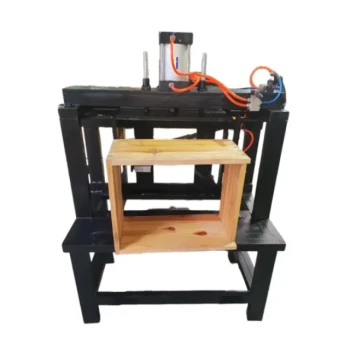
- High-Efficiency Pneumatic Bee Hive Making Machine for Rapid Box Assembly
- Mini Desktop Bee Hive Frame Forming Making Machine
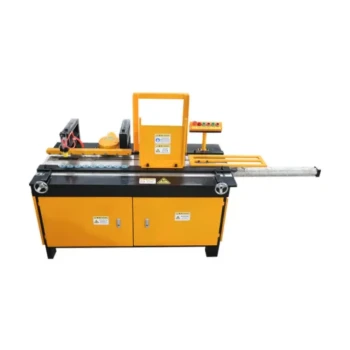
- Beehive Handle and Frame Rest Cutting Machine: Your Specialized Hive Machine
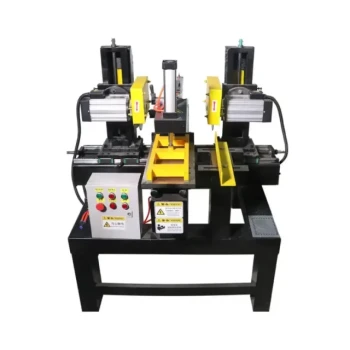
- Beehive Machine Double End Saw for Precision Hive Component Manufacturing
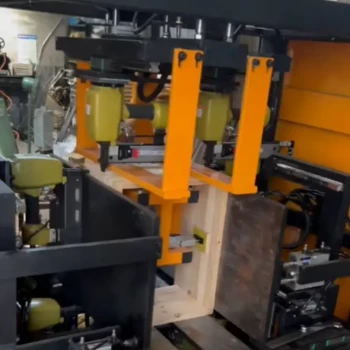
- Automatic High-Speed Bee Hive Box Stapling Machine
People Also Ask
- How does the introduction of professional beehive-making machinery benefit sustainable beekeeping? Scale Your Apiary
- Why is specialized beehive-making machinery critical for low-defense breeding? Enhance Selection with Precision Tools
- What is the industrial value of high-efficiency beehive manufacturing machinery for large-scale apiaries? Scale Efficiency
- How does the introduction of specialized beehive making machinery contribute to increasing the scale of regional beekeeping industries?
- What is the importance of specialized beehive making machinery in a circular bio-economy? Build Local Sustainability