A Systemic Problem in a Wooden Box
Picture a beekeeper on a sweltering afternoon, hive tool in hand. The goal is simple: combine a weak colony with a strong one. But a frame of brood from the first hive won't fit into the second. The gap is mere millimeters, but it might as well be a mile. The bees grow agitated. The beekeeper's focus shifts from the delicate art of colony management to a frustrating carpentry problem at the worst possible moment.
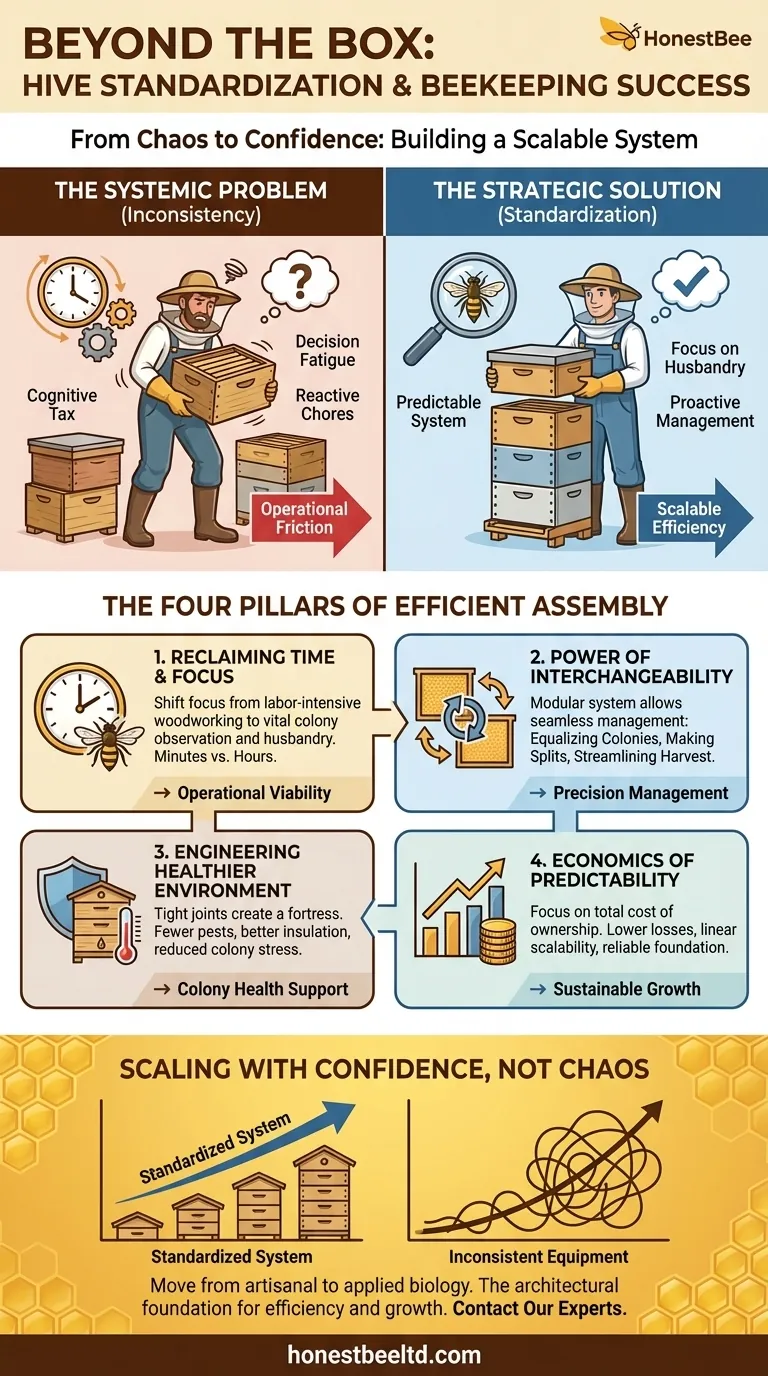
This isn't a rare inconvenience. It's a symptom of a deeper, systemic issue: the hidden cost of inconsistency.
The Psychology of a Flawed System
When your equipment is unpredictable, every action requires a small, cognitive tax. You have to stop, assess, and problem-solve. Will this frame fit? Will this super stack cleanly? This constant friction drains the mental energy that should be spent observing queen behavior, checking for mites, or judging nectar flow.
Your equipment should be an invisible, reliable partner in your work. When it becomes an adversary, it introduces decision fatigue and turns proactive management into a reactive chore. The goal isn't just to build boxes; it's to build a system that gets out of its own way.
From Craft to System: The Four Pillars of Efficient Assembly
Treating hive construction as a strategic process transforms it from a labor-intensive craft into a scalable, predictable system. This system is built on four essential pillars.
Pillar 1: Reclaiming Time and Focus
Building a hive from raw lumber is a noble skill, but it consumes hours. Assembling a precision-cut kit takes minutes. This isn't just about saving time; it's about reallocating your most valuable resource—your focus—from woodworking to animal husbandry.
For a commercial apiary, this calculation is magnified a thousand times. The hours saved are not a luxury; they are a direct driver of operational viability.
Pillar 2: The Power of Interchangeability
This is the cornerstone. When every frame, super, and hive body is dimensionally identical, your entire apiary becomes a modular system. This unlocks powerful management techniques that are impossible with mismatched gear:
- Equalizing Colonies: Move frames of brood from strong hives to boost weaker ones.
- Making Splits: Create new colonies using predictable components.
- Streamlining Harvest: Pull full supers of honey and replace them with empty ones without a second thought.
This is the quiet elegance of a well-engineered system. It allows you to manage the biological unit—the colony—with the precision of a technician.
Pillar 3: Engineering a Healthier Environment
A precisely assembled hive with tight joints is a fortress. It offers fewer drafts and entry points for pests like wax moths or small hive beetles.
This structural integrity creates better insulation against heat and cold, reducing stress on the colony. The bees can then dedicate their energy to what matters: raising brood, defending the hive, and foraging. A good box is a passive support system for colony health.
Pillar 4: The Economics of Predictability
The conversation often starts with the upfront cost of a hive kit versus scrap wood. This is the wrong conversation. The right one is about the total cost of ownership.
The true cost of inconsistent equipment includes lost time, frustrated labor, higher pest-related colony losses, and the inability to scale efficiently. For commercial beekeepers and distributors, predictability isn't a feature; it's the foundation of their business model. This is why sourcing standardized, high-quality components from a wholesale-focused supplier like HONESTBEE is a strategic imperative, ensuring that the 1st and 1,000th hive are perfectly identical.
Scaling with Confidence, Not Chaos
An apiary built on inconsistent equipment scales with exponential complexity. Every new hive adds another set of variables.
A standardized system scales linearly. Growth becomes a simple, repeatable process. This is the only sustainable path for any serious operation, moving from a handful of hives to dozens or hundreds. Reliable sourcing from a single supplier ensures this standard is maintained across the entire operation, year after year.
The Strategic Choice: Standardization Over Bespoke
There is a romance to building something unique from scratch. But beekeeping at any scale is an exercise in applied biology, not artisanal woodworking.
The Langstroth hive became the global standard for a reason: its modularity and efficiency work. Adopting this standard isn't about sacrificing creativity; it's about leveraging a century of collective wisdom. The strategic choice for growth is to stand on the shoulders of this proven system, not to reinvent it one box at a time.
Ultimately, hive assembly is not a preliminary chore. It is the architectural foundation of your entire apiary. The integrity of that foundation determines your efficiency, your capacity for growth, and the health of the colonies you manage. For operations that depend on this level of precision and scalability, building a reliable foundation is paramount. Contact Our Experts
Visual Guide
Related Products
- High-Efficiency Pneumatic Bee Hive Making Machine for Rapid Box Assembly
- HONESTBEE Wired and Assembled Wooden Bee Frames Foundation for a Thriving Hive
- Durable Plastic Interlocking Hive Connector for Beekeeping
- Heavy Duty Adjustable Hive Connector
- Assembled Wooden Bee Frames with Plastic Foundation for Durability and Convenience by HONESTBEE
Related Articles
- How Bee Box-Making Machines Transform Beekeeping Efficiency and Sustainability
- How Bee Box-Making Machines Transform Apiary Productivity and Profitability
- How Beehive Frame Making Machines Enhance Apiary Productivity and Hive Longevity
- How the Beehive Frame Machine Transforms Apiary Equipment Production
- Why Your Bee Boxes Don't Match: The Secret to Flawless Apiary Scaling