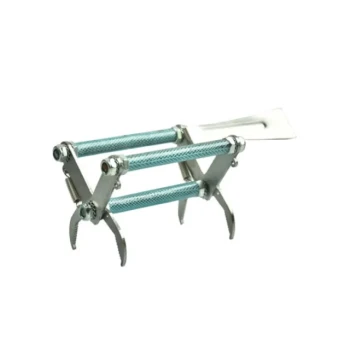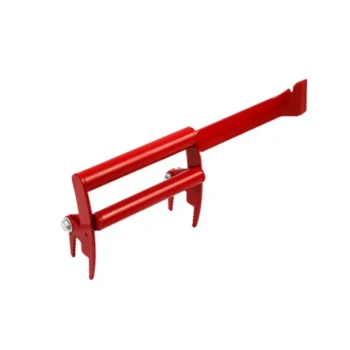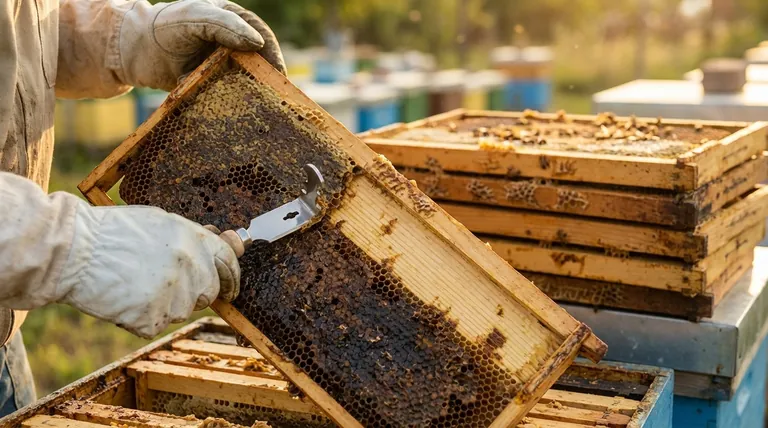
It’s a hot afternoon, the bees are agitated, and the one frame you need to inspect is glued solid with propolis. You pry and you twist, the wood groans, and when it finally jerks free, you’ve angered the colony and possibly damaged the frame. You tell yourself there has to be a better way, but the cycle repeats at the next hive, and the one after that.
Sound familiar? This frustrating scenario is a daily reality in commercial apiaries.
The Costly Cycle of "Clean Enough?"
For commercial beekeepers and distributors, frame maintenance isn't a hobby—it's a critical operational task with direct financial consequences. Faced with hundreds or thousands of frames, the central question becomes one of efficiency versus effectiveness. This tension leads to a few common, but flawed, approaches:
- The "Brute Force" Method: You consistently scrape just enough to get by. This makes inspections a constant battle. Frames are harder to remove, inspections take longer, and the cumulative stress on your equipment leads to splintered wood and broken joints.
- The "Scorched Earth" Method: You decide to get serious and boil every frame in a caustic soda solution after every harvest. While thorough, this approach is incredibly time-consuming and labor-intensive. Worse, the harsh chemicals and high heat drastically shorten the lifespan of your wooden frames, forcing you to constantly replace equipment.
- The "Risky Gamble" Method: You salvage frames from a dead-out colony, give them a quick scrape, and re-use them to save money. You hope for the best, but you're unknowingly rolling the dice with the health of your entire operation.
Each of these "solutions" creates its own set of problems. They lead to higher operational costs from wasted labor, increased capital expenditure from constant equipment replacement, and the ever-present, catastrophic risk of a disease outbreak that could wipe out productive colonies.
The Real Culprit: It's Not Your Effort, It's Your Diagnosis
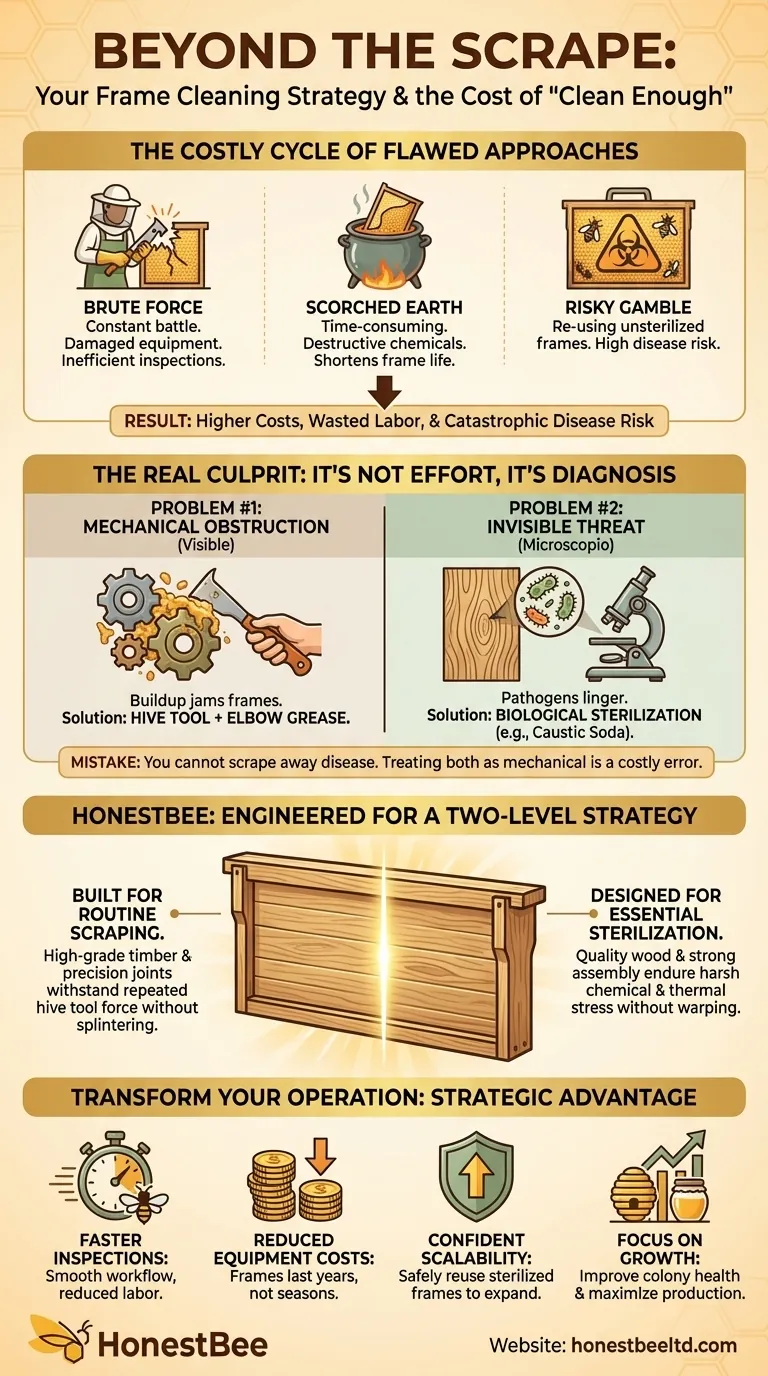
The core of the problem isn't that you're not working hard enough. The problem is that you are treating two fundamentally different issues as if they were one. The frustration and inefficiency you experience stem from a mismatch between the problem at hand and the solution you apply.
Let's break it down. Frame "dirtiness" comes in two distinct forms:
Problem #1: The Mechanical Obstruction
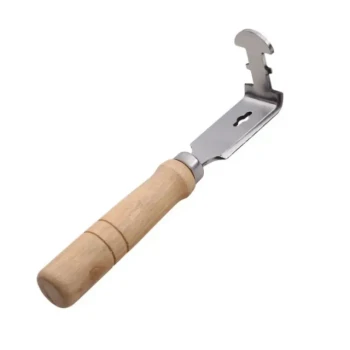
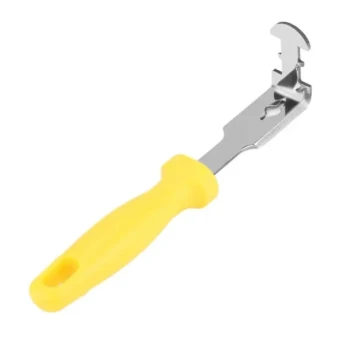
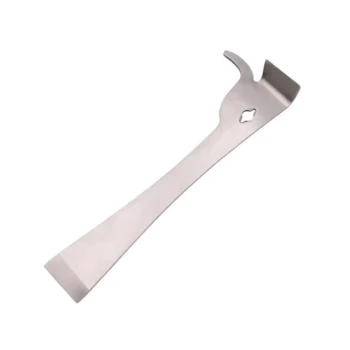
This is the visible buildup of propolis and excess wax. Bees use these materials as a sort of glue and sealant. Over time, it physically jams the frames, making them difficult to handle. This is a purely mechanical problem. A hive tool and some elbow grease are the correct tools because they solve the physical blockage.
Problem #2: The Invisible Threat
This is the microscopic world of pathogens, spores, and bacteria (like American Foulbrood) that can linger in the wood and wax of a frame, especially one from a dead or diseased colony. You cannot see this threat, and you cannot scrape it away. This is a biological problem. Simply removing the visible wax does nothing to neutralize these pathogens, which can remain dormant for years.
Here’s the "aha" moment: Using a scraper to "clean" a diseased frame is like washing your hands with water after handling a biohazard—it looks clean, but the danger is still there. Conversely, using a caustic soda bath for routine propolis buildup is like using a sledgehammer to crack a nut; it's dangerous, destructive overkill for a simple mechanical task.
The Right Tool for a Two-Level Problem
To manage a commercial apiary effectively, you don't just need a cleaning plan; you need an equipment strategy that acknowledges this two-level reality. Your frames must be able to withstand both routine mechanical cleaning and occasional, aggressive biological sterilization.
This is precisely where the design and quality of your equipment become your most valuable asset. A solution isn't a magical cleaning technique; it's having frames that are built for the specific demands of both maintenance and sterilization.
HONESTBEE equipment is engineered from a deep understanding of this challenge. Our frames are not just pieces of wood; they are tools designed for long-term operational resilience.
-
For Routine Mechanical Scraping: Our frames are built with high-grade, durable timber and precision-cut joints. This robust construction means they can withstand the repeated force of a hive tool during inspections without splintering or failing, season after season.
-
For Essential Biological Sterilization: When you face a genuine disease threat and a caustic soda bath is non-negotiable, our frames are designed to survive. The quality of the wood and the strength of the assembly ensure they can endure the harsh chemical and thermal stress that would cause inferior frames to warp, weaken, or fall apart.
Our products are the solution because they are designed to enable the correct strategy, allowing you to scrape when you need to scrape and boil when you must boil, without constantly destroying your investment.
From Maintenance Headache to Strategic Advantage
When your equipment is no longer the weakest link in your operation, everything changes. The constant struggle with cleaning and maintenance transforms into a streamlined, predictable process. This unlocks new potential for your business:
- Drastically Faster Inspections: Your team can move through hives smoothly and efficiently, reducing labor costs and stress on the bees.
- Reduced Equipment Costs: With frames that last for years instead of a single season, your capital expenditure drops significantly, directly improving your bottom line.
- Confident Scalability: You can confidently reuse sterilized equipment to expand your apiary or replace losses, knowing you aren't inadvertently spreading disease.
- Focus on Growth: Instead of being bogged down by a daily maintenance battle, you can redirect your time and resources toward what truly drives your business: improving colony health, maximizing honey production, and securing high-value pollination contracts.
Your equipment shouldn't be a source of constant struggle; it should be a reliable foundation for growth. If you're ready to move beyond the endless cycle of broken frames and cleaning frustrations, let's talk about building a more resilient and profitable apiary. Discuss your operation's specific challenges and goals with our team to see how a better equipment strategy can make all the difference. Contact Our Experts.
Visual Guide
Related Products
- Precision Stainless Steel Frame Cleaner for Hive Grooves and Corners
- Professional Stainless Steel Frame Cleaner with Ergonomic Wood Handle
- Heavy Duty Stainless Steel Frame Cleaner with Plastic Handle
- Professional Multi-Function Stainless Steel Hive Tool
- Wooden Bee Hive Frames for Beekeeping and Wholesale
Related Articles
- How to Protect Your Hives: Post-Harvest Frame Management for Beekeepers
- The Tyranny of Space: How a Simple Frame Redefined Beekeeping
- How to Transition Hive Frames Safely Without Disrupting Colony Health
- Precision in Propolis: The Compounding Gains of a Modified Hive Tool
- Leverage and Finesse: The Unseen Physics of a Simple Hive Tool