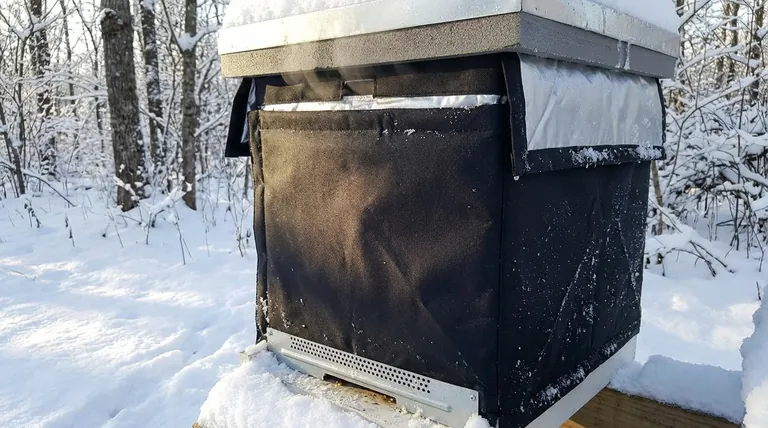
The Misguided Instinct to Keep Bees Warm
The first cold snap of autumn triggers a familiar, well-intentioned instinct in beekeepers: we must keep the bees warm. We think of adding blankets, of sealing every crack, of turning the hive into a cozy, insulated fortress.
This instinct, while born from a desire to protect, is fundamentally flawed. It misdiagnoses the problem.
The greatest threats to a beehive in winter are not the cold itself, but the twin killers of condensation and starvation. Our goal is not to heat the hive. It is to engineer a stable micro-environment where the colony can efficiently manage its own temperature and resources.
The Colony as a Self-Regulating Furnace
A honeybee colony doesn't heat its home. It heats itself.
As temperatures drop, the bees form a tight cluster, shivering their flight muscles to generate heat at the core. The bees on the outside form a dense, insulating mantle, while those on the inside tend to the queen and consume honey for fuel. The cluster is a living, breathing furnace.
Our job as beekeepers is not to provide a secondary heat source. It is to provide a better-insulated furnace room. Effective insulation simply reduces the rate at which the cluster's self-generated heat escapes, forcing the colony to burn less fuel (honey) to maintain its core temperature.
The Two Silent System Failures
Improperly winterized hives don't just freeze; they fail due to correctable system breakdowns. These failures are almost always rooted in moisture and food access.
The Physics of Interior Rain
As the bee cluster consumes honey and breathes, it releases gallons of warm, water-saturated air over the winter. Think of it as constant, humid exhaust.
When this moist air rises and hits a cold, uninsulated inner cover, it instantly condenses—the same way your breath fogs a cold window. This condensation forms droplets that drip back down.
A cold, wet bee is a dead bee. This internal rain is a far greater threat than the ambient external temperature. Sealing a hive without proper ventilation turns your insulation into a trap, creating a damp, deadly tomb.
The Psychology of a Starving Cluster
A colony can starve to death with pounds of honey just inches away. This isn't a failure of intelligence; it's a failure of risk assessment baked into their survival instincts.
During deep freezes, the cluster is extremely reluctant to break its formation. Moving across cold, empty frames to reach a distant patch of honey is a life-threatening gamble. The risk of the cluster disintegrating and freezing is too high. So, they stay put and starve.
Engineering the Hive for Resilience
The solution is not to fight the cold, but to apply simple engineering principles that mitigate moisture and support the colony's natural behavior.
The Building Envelope: Wraps and Insulation
The first step is to improve the hive's thermal efficiency, or its "R-value."
-
Hive Wraps: A simple wrap of black tar paper or plastic acts as a critical windbreak, stopping drafts that steal heat. The black surface also absorbs solar energy on sunny days, passively warming the hive walls.
-
Rigid Foam Boards: For colder climates, cutting rigid foam boards to fit the hive bodies provides a superior insulating layer. This is the equivalent of upgrading the walls of a house.
For commercial apiaries managing hundreds of hives, consistency is key. Using standardized, durable materials to create a uniform building envelope ensures predictable performance across the entire operation.
The Exhaust System: Ventilation is Non-Negotiable
To prevent the "interior rain" problem, the hive needs an exhaust port.
A small upper entrance, either a drilled hole or a notch in the inner cover, is essential. It allows the warm, moist air generated by the bees to escape before it can condense.
Think of it this way: a well-insulated but sealed box is a cooler. A well-insulated and ventilated box is a high-performance home.
The Foundation: Access Control
Winter brings opportunistic pests, especially mice seeking shelter. A reduced entrance makes the hive easier for the bees to defend.
- Entrance Reducer: Shrinks the main opening to a manageable size.
- Mouse Guard: A simple screen of hardware cloth prevents rodents from entering while allowing bees to pass.
This simple piece of engineering secures the hive's foundation, preventing drafts and invasions that would otherwise stress the colony and consume its energy reserves.
A Systems-Thinking Checklist for Winter
Success lies in viewing winterization as an integrated system. Each component has a specific job, and they must work together.
| Method | Engineering Principle | Primary Goal |
|---|---|---|
| Hive Wraps & Foam | Improve the building envelope | Reduce passive heat loss; block wind |
| Top Insulation | Prevent heat stratification | Stop chimney-effect heat loss; reduce condensation |
| Upper Ventilation | Provide an exhaust port | Eject moist air to keep the cluster dry |
| Reducer & Mouse Guard | Harden the perimeter | Protect against drafts and pests |
Ultimately, our role is to be a thoughtful systems engineer for the colony. By understanding the physics at play, we can shift our focus from a futile fight against the cold to the elegant task of creating a dry, stable, and efficient home. This approach transforms winter from a period of high losses into a predictable phase of the apiary's lifecycle.
Preparing an entire commercial operation for winter requires reliable, purpose-built equipment at scale. HONESTBEE specializes in providing durable, wholesale-focused winterizing supplies—from high-performance wraps and insulation to precisely-fit entrance reducers—that allow you to implement these engineering principles efficiently across all your colonies. Contact Our Experts
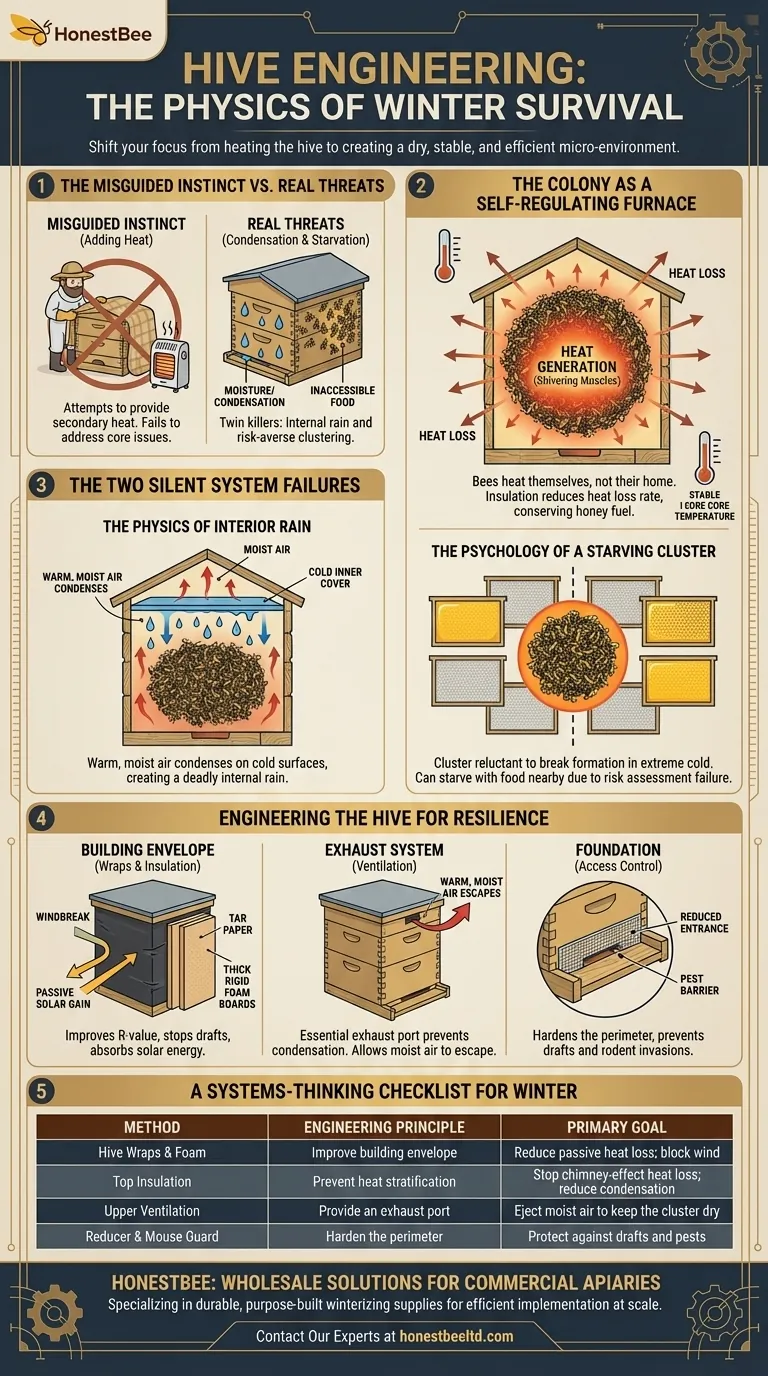
Visual Guide
Related Products
- Durable Plastic Hive Number Set for Beekeeping
- Stainless Steel Round Beehive Air Vents for Ventilation
- HONESTBEE Professional Hive Top Bee Feeder Feeding Solution
- Professional Large-Format Hive Number Set for Beekeeping
- HONESTBEE Professional Long Handled Hive Tool with Precision Cutting Blade
Related Articles
- Hive Thermodynamics: The Unseen Clock Governing Winter Survival
- How Beekeepers Can Diagnose Queen Issues and Prevent Colony Collapse
- The Tipping Point: Managing the Psychology of a Beehive to Prevent Swarming
- The Tipping Point: How the 7/10 Rule Prevents a Beehive's Silent Collapse
- The Physics of Survival: Managing the Unseen Threat in a Winter Beehive


















