A System, Not a Box
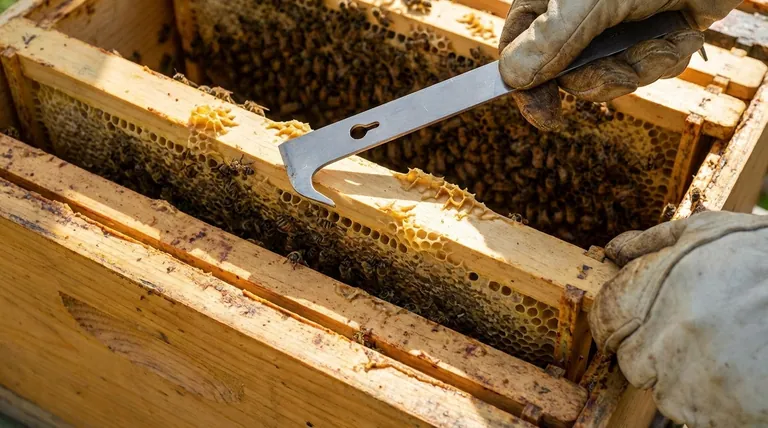
Lift the lid on a modern commercial beehive. You'll hear a low, productive hum. When you pull out a frame, it slides free with a gentle nudge, revealing a perfect, flat plane of honeycomb teeming with life. Every cell is a geometrically precise hexagon, filled with brood, pollen, or nectar.
This satisfying order is not an accident. It's the result of an elegant, century-old design.
Now imagine the opposite: a wild hive in a hollow log. The comb is a chaotic lattice, welded to every surface. To inspect the queen or check for disease, you would have to shatter the very structure the bees spent thousands of hours building. One is a library where each frame is a page; the other is a beautiful but unreadable manuscript.
The difference isn't the bees; it's the architecture they inhabit.
The Psychology of Structure
A bee colony is a superorganism—a decentralized network of tens of thousands of individuals operating on instinct. Humans manage such complexity by introducing simple, predictable rules.
The modern beehive is a masterpiece of this principle. It’s a system designed not to control the bees, but to guide their innate behaviors. It’s a dialogue, spoken in the language of wood, space, and wax. We provide a framework, and they provide the life that fills it.
This framework is built from a few simple, brilliant components.
Deconstructing the Dialogue: The Core Components
To manage a hive effectively, especially at a commercial scale, you must understand the function of each part. They are not just pieces of equipment; they are prompts in your conversation with the colony.
The Brood Chamber: The Heart of the Colony
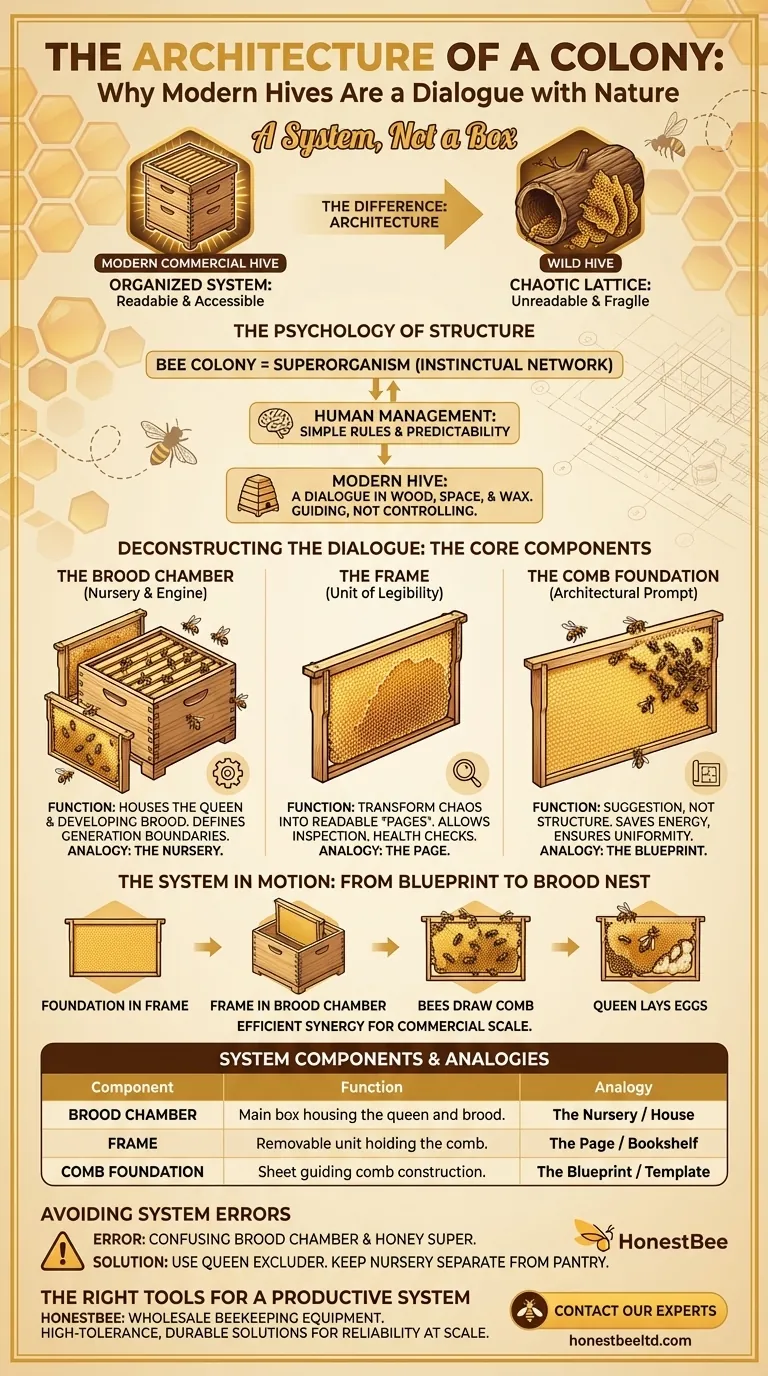
The brood chamber, or brood box, is the hive's nursery and engine room. This deep box forms the central living quarters. Its purpose is singular: to house the queen and her developing brood. It defines the physical boundaries for the colony's next generation. By keeping this area distinct, a beekeeper protects the most critical asset of the hive.
The Frame: The Unit of Legibility
Inside the brood chamber hang several removable frames. This invention transformed beekeeping. A frame turns an inscrutable mass of bees and wax into readable "pages."
Each frame can be lifted out individually, offering a clear snapshot of colony health: the queen's laying pattern, the presence of disease, the levels of food stores. It makes the invisible, visible. It turns chaos into data.
The Comb Foundation: The Architectural Prompt
Fitted inside an empty frame is the comb foundation, a thin sheet of beeswax or plastic embossed with the hexagonal base of a honeycomb cell. This is the most subtle, yet perhaps most powerful, component.
The foundation is not structure; it's a suggestion. It’s a psychological nudge for the bees, giving them a perfect blueprint. It saves them immense time and energy that would be spent creating their own wax and measuring out their own construction. They can immediately get to the work of "drawing out" the comb and preparing for the queen.
The System in Motion: From Blueprint to Brood Nest
These components work in a logical sequence.
- A beekeeper fits comb foundation into an empty frame.
- A set of these frames is placed into the brood chamber.
- The bees use the foundation as a guide to build a perfect wax comb.
- The queen fills these cells with eggs, establishing the brood nest.
This synergy creates an incredibly efficient system. For commercial apiaries, where hundreds or thousands of hives must be managed, this predictability is everything. You cannot afford the chaos of cross-comb or the wasted energy of foundationless hives. The system's success depends on the quality and uniformity of its parts.
At HONESTBEE, we specialize in supplying the high-tolerance, wholesale beekeeping equipment that makes this system reliable at scale. Durable brood chambers and perfectly milled frames ensure that every component fits and functions as intended, hive after hive.
| Component | Function | Analogy |
|---|---|---|
| Brood Chamber | The main box housing the queen and brood. | The Nursery / House |
| Frame | The removable unit holding the comb. | The Page / Bookshelf |
| Comb Foundation | A sheet guiding comb construction. | The Blueprint / Template |
Avoiding System Errors
Even in a perfect system, misunderstanding its rules can lead to failure.
A common error is confusing the brood chamber with the honey super—a shallower box placed on top for honey storage. You must keep the nursery separate from the pantry. This is often done with a queen excluder, which prevents the queen from laying eggs where your surplus honey should be.
This is not just about a clean harvest; it's about respecting the hive's internal logic.
The Right Tools for a Productive System
Ultimately, managing a beehive is an exercise in system thinking. Your equipment is the physical manifestation of your strategy. A strategy focused on health, efficiency, and productivity requires tools that support those goals.
The elegant interplay between the brood chamber, frame, and foundation is what allows a beekeeper to work in partnership with a colony, guiding its incredible natural productivity towards a shared goal. To do it effectively, every piece must be flawless.
To ensure your apiary operates with the clockwork precision this system was designed for, you need equipment that meets the highest standards. Contact Our Experts
Visual Guide
Related Products
- Stainless Steel Round Beehive Air Vents for Ventilation
- Wholesales Dadant Size Wooden Bee Hives for Beekeeping
- Metal Hive Feet Bee Hive Stand for Ant Protection
- Metal Bee Hive Stand Bee Box Stand for Beekeeping
- Wooden Bee Hive Frames for Beekeeping and Wholesale
Related Articles
- How to Optimize Beehive Ventilation: Prevent Disease and Boost Colony Health
- The Silent Killer in the Hive: Why Moisture, Not Cold, Is Winter's Greatest Threat
- Beyond the Bee Box: Why Your First Apiary Investment Determines Your Success
- The Precision of Chaos: Navigating the Biological Risks of Commercial Beehive Transportation
- Beyond the Box: Why Hive Architecture Is Your Apiary's Core Operating System













