The Bottleneck in a Box
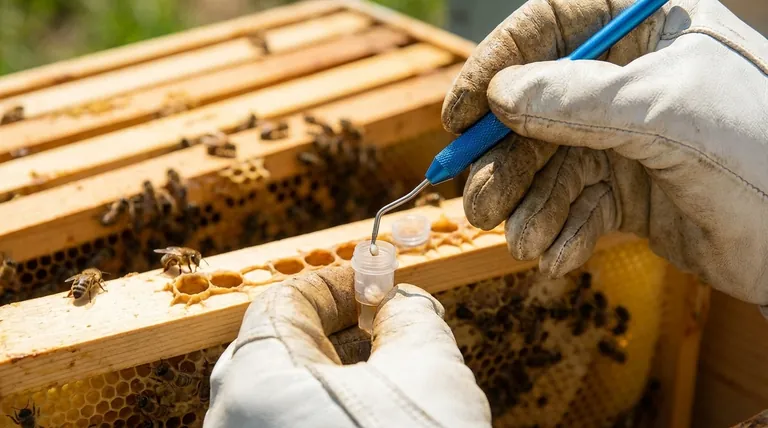
Imagine a beekeeper, hunched over a frame humming with life. Before them lies a task of immense delicacy and immense scale: transferring hundreds, perhaps thousands, of larvae, each no larger than a grain of salt, from their birth cells into queen cups.
This moment—the graft—is the critical bottleneck in queen production. The success of an entire generation of queens, and the profitability of the apiary, hinges on this microscopic transfer.
The choice of tool for this job isn't just a matter of preference. It's a commitment to a philosophy of work. It reveals how you balance the art of beekeeping with the science of production.
Two Philosophies of Design
At the heart of this decision are two elegantly simple tools, born from different engineering philosophies: the German grafting tool and the Chinese grafting tool. Both are designed to solve the same problem, but they represent two fundamentally different approaches to the relationship between the worker and the work.
The German Tool: The Surgeon's Scalpel
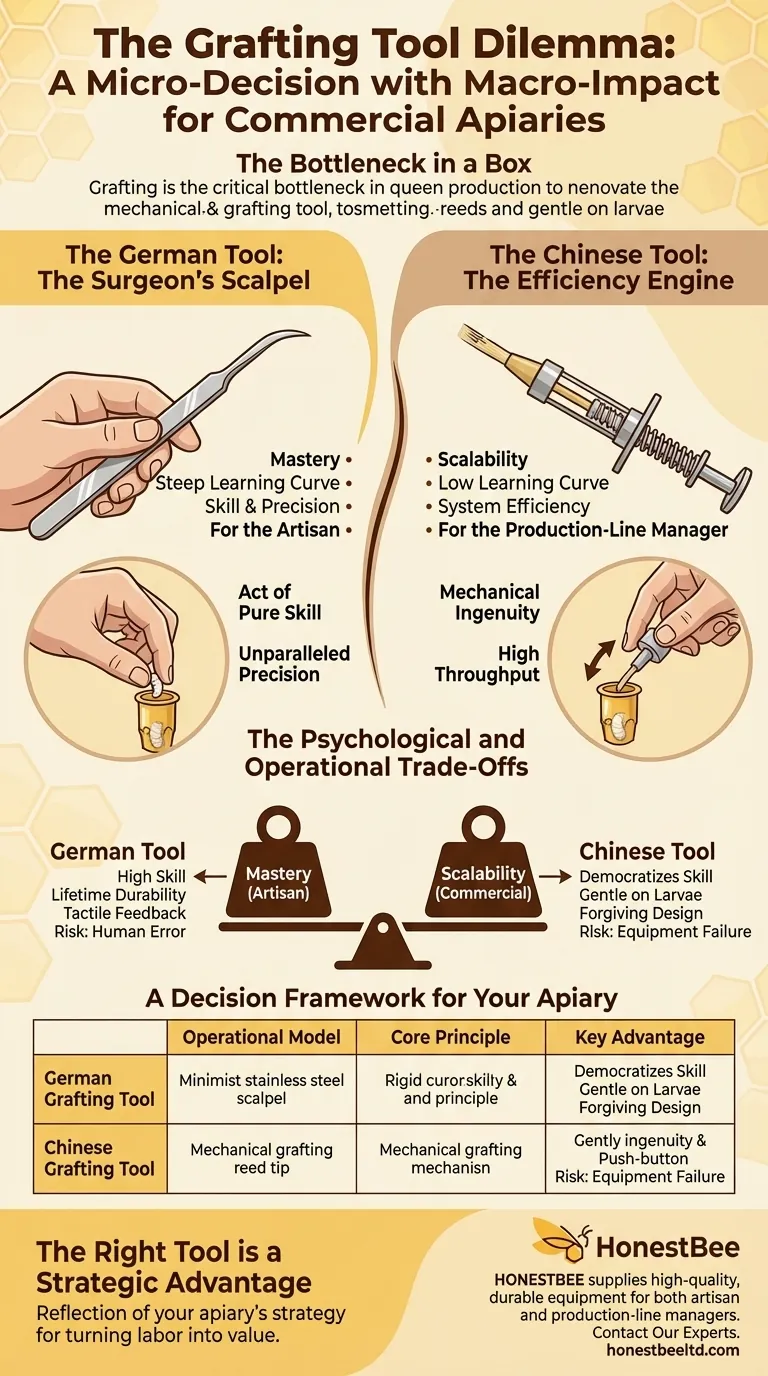
The German grafting tool is a study in minimalist design. Typically crafted from a single piece of stainless steel, its fine, curved tip is an extension of the beekeeper's own hand. There are no moving parts, no mechanisms to assist or fail.
Using it is an act of pure skill. You slide the rigid tip under the larva and its bed of royal jelly with practiced control. Success depends entirely on a steady hand and a keen eye. It is an instrument for the artisan, demanding mastery but offering unparalleled precision in return.
The Chinese Tool: The Efficiency Engine
The Chinese grafting tool is a piece of mechanical ingenuity. It features a thin, flexible reed or plastic tip connected to a spring-loaded plunger. This design brilliantly abstracts away much of the difficulty.
You don't need perfect pressure; the flexible tip cradles the larva. You don't need a delicate wiping motion to deposit it; you simply press the plunger, and the mechanism gently pushes the larva into the cup. It’s a system designed to make the difficult task reliable, repeatable, and fast.
The Psychological and Operational Trade-Offs
Choosing between these tools is a classic trade-off analysis that goes deeper than simple pros and cons. It’s about how your operation manages skill, risk, and scale.
Mastery vs. Scalability
The German tool represents a commitment to mastery. The learning curve is steep, and initial failure rates can be high. The psychological reward is craftsmanship—the deep satisfaction of executing a difficult task flawlessly. This path is ideal for boutique queen producers or breeders focused on high-value genetic lines where every single graft counts.
The Chinese tool represents a commitment to scalability. It democratizes the skill, allowing a new worker to become proficient and productive in a fraction of the time. The focus shifts from individual artistry to system throughput. For a large commercial apiary, this is a powerful operational advantage.
Risk Mitigation: Flawless Execution vs. Forgiving Design
Every operation must manage risk. With the German tool, the primary risk is human error; a slip of the hand can damage the larva. The tool itself is nearly infallible. You mitigate this risk with extensive training and practice.
With the Chinese tool, the primary risk shifts to the equipment. The delicate tip can wear or break, and the spring mechanism can fail over time. But the tool’s design is inherently more forgiving of operator inconsistency. It mitigates the risk of human error by building a safety net into the process itself.
A Decision Framework for Your Apiary
The right tool is the one that aligns with your operational model. There is no single best answer, only the best fit for your objectives.
| Tool | Operational Model | Core Principle | Key Advantage |
|---|---|---|---|
| German Grafting Tool | Boutique, High-Value Genetics | Operator Skill & Precision | Unmatched control, lifetime durability, tactile feedback. |
| Chinese Grafting Tool | High-Volume, Commercial Scale | System Efficiency & Speed | Gentle on larvae, low learning curve, high throughput. |
The Right Tool is a Strategic Advantage
Ultimately, the humble grafting tool is more than just a piece of equipment. It’s a reflection of your apiary’s strategy for turning labor into value. It dictates your training protocols, your operational speed, and your capacity to scale.
At HONESTBEE, we understand that professional beekeeping is a business of calculated decisions. We supply the high-quality, durable equipment that underpins those decisions, providing reliable tools built for both the artisan and the production-line manager.
Whether you are perfecting a premium line of queens or scaling to meet market demand, having the right tool is non-negotiable. To find the equipment that best fits your apiary's goals, Contact Our Experts.
Visual Guide
Related Products
- Stainless Steel Beekeeping Queen Grafting Tool for Honey Bee Rearing
- Stainless Steel Queen Grafting Tool for Beekeeping and Bee Queen Grafting
- Black 2 Pack Beekeeper Queen Grafting Tool for Bee Queen Larva Transferring Needle
- Plastic Chinese Queen Grafting Tool for Bee Queen Rearing
- Plastic Beekeeping Honey Bee Larvae Grafting Tools for Queen Rearing and Chinese Grafting
Related Articles
- How to Master Queen Rearing with Precision Grafting Tools
- Microsurgery in the Apiary: The Unseen Power of the Queen Grafting Tool
- How to Improve Queen-Rearing Success: Biologically Optimized Grafting Techniques
- Precision at Scale: The Operator's Guide to Queen Rearing Grafting Tools
- How to Mark Queen Bees Safely: Tools and Techniques for Hive Success