The critical labor threshold usually appears at roughly 400–500 hives. At this scale, peak activities such as hive construction, colony expansion, swarm management, transportation, and honey extraction can exceed what one operator can handle manually. However, many operations may not generate enough revenue to justify full-time labor until they reach approximately 800–1,000 hives, creating a costly expansion gap that commercial machinery can help close.
Commercial beekeeping machinery bridges the gap between manual capacity and the cost of hiring full-time workers. High-capacity honey processing, automated filling, hive assembly, transport, and monitoring equipment increase output per worker while supporting the standardized infrastructure needed for further expansion.
Where the Labor Constraint Begins
The 400–500-hive threshold
Routine apiary management may require relatively little daily labor, but labor demand rises sharply during seasonal or expansion-related peaks. Once an operation passes approximately 400–500 hives, manual work can exceed the practical capacity of a single person.
The constraint is not only the number of colonies. It also involves the timing of work, since construction, colonization, harvesting, and transport often need to be completed within limited operational windows.
Why hiring does not always solve the problem immediately
At 400–500 hives, revenue may still be insufficient to support a full-time employee. Hiring too early can increase fixed costs before the operation has achieved enough production volume to absorb them.
This creates a transition period: the apiary is too large for one person to manage efficiently, but not yet large enough to make permanent labor economically attractive.
The 800–1,000-hive labor breakpoint
Many expanding operations begin to support full-time hired labor closer to 800–1,000 hives. The exact point depends on product mix, geography, transportation requirements, colony management practices, and seasonal workload.
The important planning principle is that machinery can improve productivity during the interval between the first labor constraint and the later hiring threshold.
How Machinery Increases Capacity per Worker
Automating honey extraction and filling
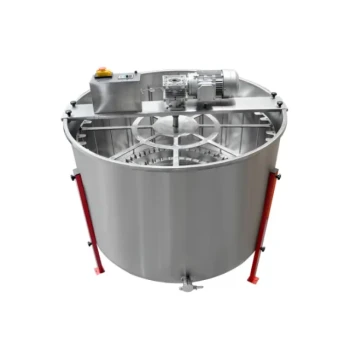
Honey extraction is one of the most labor-intensive peak activities in a commercial apiary. Motorized or high-capacity extractors can process more honey with less manual handling than hand-operated systems.
Automated or semi-automated filling equipment can further reduce repetitive bottling work, helping operators move from processing to packaging more efficiently.
Improving hive assembly and expansion
Specialized hive-making and woodworking machinery enables the production of standardized hive bodies, frames, and other components in batches. This allows an apiary to prepare expansion infrastructure faster without assigning extensive manual labor to each hive.
For distributors and B2B resellers, a coordinated portfolio of hive-production equipment, assembly tools, and processing machinery is more useful than isolated products because it addresses the full expansion workflow.
Reducing handling and transport effort
Electric transport equipment, including suitable forklifts, can reduce the physical burden of moving hives, materials, and harvested honey. This is particularly valuable when colonies must be relocated for pollination services or when equipment is managed across multiple apiary sites.
Reducing handling time also helps workers spend more time on tasks that require judgment, such as colony inspection and swarm management.
Supporting operational monitoring
Intelligent monitoring systems can improve the precision and efficiency of environmental and colony observation. They do not eliminate the need for experienced beekeepers, but they can reduce unnecessary intervention and help focus attention where it is most needed.
This is especially relevant when labor shortages make it difficult to inspect every colony with equal frequency.
Why Standardization Matters During Expansion
Interchangeable components simplify maintenance
Industrial hive-manufacturing machinery produces components to consistent dimensions. Standardized frames and hive parts can therefore be exchanged between colonies, apiaries, and operating sites.
This reduces the complexity of repairs and lowers the risk that a replacement component will be incompatible with existing equipment.
Uniform hives support mechanized workflows
Consistent hive dimensions make it easier to organize transport, storage, and mechanized handling. They also support palletized movement and a more integrated warehousing system.
For a growing commercial operation, standardization is not merely a manufacturing benefit. It is an operational foundation for managing more colonies with fewer disruptions.
Reliable construction protects the expansion investment
Commercial-grade woodworking and hive-production machinery can provide structurally consistent and weather-resistant components. This matters when hives face long-distance transportation, repeated handling, and changing climatic conditions.
More reliable infrastructure can reduce maintenance demands and help preserve operational continuity as hive numbers increase.
Building a Machinery-Based Expansion Strategy
Start with the dominant bottleneck
An apiary should first identify where labor is being consumed:
- If harvesting is the constraint, prioritize extraction and filling capacity.
- If expansion is delayed by hive construction, consider standardized prefabricated components or hive-making machinery.
- If relocation is labor-intensive, evaluate transport and material-handling equipment.
- If inspections consume too much time, consider monitoring systems that improve targeting and visibility.
The right investment is determined by the bottleneck, not simply by the number of machines available.
Match equipment capacity to the growth path
Machinery should be selected for the operational range the apiary expects to reach, rather than only its current hive count. Equipment that is too small may recreate the labor problem, while equipment that is unnecessarily large can create avoidable capital costs.
Distributors and wholesalers can add value by matching a complete equipment configuration to the customer’s expansion stage, facility conditions, and expected throughput.
Treat the equipment portfolio as an integrated system
Hive production, colony management, transportation, honey extraction, and filling are connected processes. Improving only one stage may shift the bottleneck to another.
A one-stop sourcing model is therefore valuable when it combines a broad product portfolio with technical guidance, responsive communication, and coordinated fulfillment.
Understanding the Trade-offs
Machinery requires upfront investment
Commercial equipment can reduce labor intensity, but it requires capital before the operation reaches the 800–1,000-hive range where full-time labor may become more supportable. The purchase decision should therefore be based on expected throughput, utilization, maintenance, and expansion timing.
Automation does not replace expertise
Machines improve processing and handling efficiency; they do not replace sound colony management, disease control, or experienced decision-making. Operators still need the skills to manage biological variability and respond to changing environmental conditions.
Over-automation can create a new bottleneck
A high-capacity extractor is of limited value if hive preparation, transport, or packaging cannot keep pace. Equipment must be balanced across the workflow so that increased capacity in one area does not create idle time elsewhere.
Standardization must be maintained consistently
Interchangeability benefits depend on using compatible dimensions and specifications across the operation. Mixing non-standard components can weaken the advantages of industrial hive production and complicate maintenance.
Service and fulfillment affect real productivity
Equipment downtime can erase the labor savings that justified the investment. Reliable technical support, rapid response, spare-parts access, and efficient order fulfillment are therefore operational requirements—not merely purchasing conveniences.
Making the Right Choice for Your Growth Stage
The labor threshold should be treated as a planning signal rather than a fixed rule, because seasonal workload and operating conditions vary.
- If your primary focus is delaying full-time labor: Invest first in high-capacity extraction, automated filling, and labor-saving handling equipment that increases throughput per worker.
- If your primary focus is rapid colony expansion: Use standardized prefabricated hives or hive-making machinery to accelerate infrastructure production and reduce assembly labor.
- If your primary focus is multi-site operation: Prioritize interchangeable hive components, transport equipment, and standardized workflows that simplify relocation and maintenance.
- If your primary focus is dependable procurement: Work with suppliers that combine a full-spectrum product portfolio, professional technical expertise, rapid customer service, and fast, coordinated delivery.
The most effective expansion strategy uses machinery to raise per-worker productivity until the apiary can support additional labor without sacrificing profitability.
Summary Table:
| Growth Stage | Hive Count | Key Labor Constraint | Machinery Solution |
|---|---|---|---|
| Early Expansion | 400-500 | Manual capacity exceeded during peaks | Automated extraction and filling equipment |
| Transition Gap | 500-800 | Revenue insufficient for full-time hires | Hive-making machinery, standardized components |
| Professional Operation | 800-1,000 | Full-time labor becomes viable | Integrated processing, transport, and monitoring systems |
Ready to overcome labor bottlenecks and scale your apiary profitably? HONESTBEE provides comprehensive commercial beekeeping equipment—from automated honey processing and hive production to transport and monitoring solutions. As a one-stop wholesale partner, we support commercial apiaries and distributors with a full-spectrum product portfolio, OEM/ODM support, certifications, and rapid fulfillment. Our team offers tailored advice to match equipment to your growth stage, ensuring you maximize efficiency and ROI. Contact us today to discuss your expansion needs and receive a customized solution—get in touch now and experience premium trading services with ultra-fast delivery!
Related Products
- 40 Frame Commercial Electric Honey Extractor for Beekeeping
- Professional Wide Blade Honey Scraper for Beekeeping and Honey Processing
- Stainless Steel J Hook Hive Tool for Beekeeping
- Commercial Grade Vertical Electric Bee Sweeper for Bee Removal
- High-Performance Langstroth Bee Hives for Global Professional Beekeeping
People Also Ask
- Who are commercial honey extractors designed for? Scaling Your Industrial Beekeeping Success
- How is honey extracted commercially? Maximize Your Apiary's Efficiency and Honey Yield
- What are commercial honey extractors used for? Boost Your Apiary's Efficiency & Profitability
- What is a commercial honey extractor? The Essential High-Volume Solution for Large Apiaries
- What defines a commercial honey extractor? High-Efficiency Industrial Solutions for Large-Scale Beekeeping Operations