Commercial royal jelly producers should schedule grafting and harvesting around nurse bees aged 6–12 days, while separately managing larvae at approximately 2.5–3 days old. This requires synchronized brood production, strong nutritional support, and equipment that maintains a consistent supply of nurse bees and graftable larvae. The objective is not simply to add more hives or cups, but to make colony age structure, larval availability, and harvesting capacity operate on the same production cycle.
The highest-value management window is created by matching 6–12-day-old nurse bees with correctly aged larvae and a repeatable grafting-and-harvest schedule. Specialized frames, cell cups, grafting tools, feeders, chamber dividers, and harvesting equipment help turn this biological window into a reliable commercial process.
Build the Production Schedule Around Nurse-Bee Physiology
Maintain a core population of 6–12-day-old nurse bees
The hypopharyngeal glands responsible for royal jelly secretion are most active when nurse bees are approximately 6–12 days old. Colony management should therefore aim to maintain a large, stable population within this age range during each production cycle.
This means scheduling brood emergence, grafting, and harvesting as connected activities rather than treating them as separate tasks. If grafting begins when the colony lacks sufficient young nurse bees, the available cells may not receive adequate feeding or royal jelly deposition.
Separate nurse-bee age from larval age
Two different biological clocks control production:
- Nurse bees: Most productive for royal jelly secretion at approximately 6–12 days old.
- Queen-destined larvae: Must be transferred during the early 2.5–3-day larval window, before worker larvae shift from a full royal jelly diet to a honey-pollen mixture.
Confusing these two timelines is a common source of inefficiency. Grafting tools and queen cell cups handle the larval transfer, while brood frames, chamber management, and feeding programs support the nurse bees that care for the grafts.
Use rolling production cycles
A commercial apiary should use staggered cycles instead of relying on one large, irregular harvest. Each cycle can be organized around:
- Producing or positioning larvae at the correct age.
- Ensuring the receiving colony contains abundant 6–12-day-old nurse bees.
- Grafting larvae into prepared queen cell cups.
- Maintaining nutrition and colony conditions during royal jelly deposition.
- Harvesting and resetting equipment for the next cycle.
A rolling schedule improves labor utilization, equipment turnover, and order reliability for distributors and bulk buyers.
Control Larval Supply With Chamber Management
Create a dependable supply of same-age larvae
Royal jelly production becomes more efficient when larvae are available at a consistent age each day. Queen excluders, chamber dividers, and dedicated egg-laying or hatching zones can help concentrate the queen in a defined comb area.
By moving combs according to larval age, producers can create a more predictable daily supply of larvae suitable for grafting. This reduces the time spent searching through mixed-age brood and improves the consistency of production batches.
Use queen-rearing frames and cell cups systematically
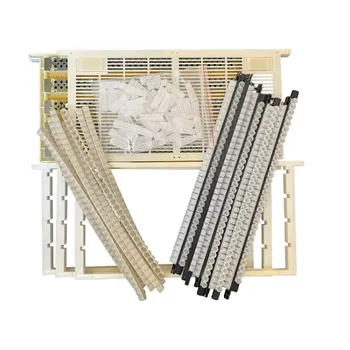
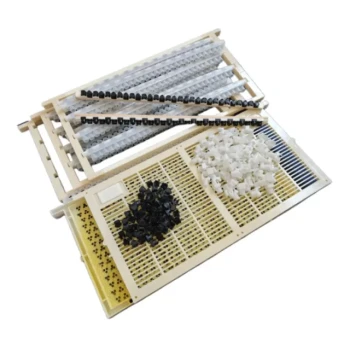
Specialized queen-rearing frames and royal jelly cell cups should be organized as a reusable production system. Frames can be prepared, loaded, inspected, harvested, cleaned, and returned to service according to a defined rotation.
Consistent cup spacing and frame configuration also make it easier to estimate labor requirements, prepare harvesting tools, and fulfill recurring customer orders. For B2B operations, this standardization is as important as biological performance.
Match grafting capacity to nurse-bee capacity
Adding more cell cups does not automatically increase output. The number of grafts should be limited by the receiving colony’s ability to feed and maintain them.
Overloading a colony can reduce royal jelly per cell, increase handling losses, and make production less predictable. A practical schedule should therefore balance available nurse bees, graft count, colony strength, and harvesting labor.
Support the Nurse-Bee Phase With Nutrition
Maintain uninterrupted access to feed
Storage proteins such as hex71, also referred to as hex70a, support nutrient uptake and metabolic storage in young adult worker bees. Adequate nutrition can help sustain the nursing role and delay the transition toward foraging behavior.
In commercial production, colony feeders and in-hive feeding equipment should be integrated into the production plan rather than used only after colony condition declines. The goal is to prevent nutritional interruptions during the grafting and secretion cycle.
Protect the colony’s workforce balance
The receiving colony needs enough young workers to care for grafted larvae while still performing brood care, temperature regulation, food processing, and other essential tasks. Strong colonies are better positioned to maintain a high proportion of nurse bees.
Producers should monitor brood pattern, adult bee population, food stores, and queen performance before assigning a colony to intensive royal jelly production. A weak colony may consume equipment and labor without delivering consistent cell yields.
Treat honey as a secondary output when appropriate
For operations focused primarily on royal jelly, colony management should prioritize nurse-bee availability and larval feeding rather than maximizing honey storage. Honey can remain a valuable byproduct, but production decisions should reflect the primary commercial objective.
This is especially relevant when planning feed inputs, chamber use, harvest labor, and equipment allocation across the season.
Design Equipment Around Fast, Repeatable Handling
Use a complete queen-rearing equipment set
A commercial setup generally benefits from coordinated access to:
- Queen-rearing frames
- Grafting tools
- Royal jelly cell cups
- Brood and chamber-management equipment
- Queen excluders or dividers
- In-hive feeders
- Systematic royal jelly harvesting tools
- Spare hive bodies and frames for colony expansion or recovery
A complete equipment package reduces compatibility problems and prevents one missing component from interrupting the entire production cycle.
Prepare equipment before the biological window opens
Grafting should not begin while frames, cups, tools, or harvesting containers are still being assembled. Equipment should be cleaned, inspected, labeled, and staged before larvae reach the target age.
This preparation is particularly important for large apiaries, where a delay of even one handling cycle can cause larvae to pass beyond the preferred grafting window.
Build equipment redundancy into the operation
High-output apiaries should maintain spare frames, cups, grafting tools, feeders, and hive components. Redundancy protects the schedule against damaged equipment, sanitation downtime, colony failure, and sudden order increases.
For distributors and resellers, dependable availability of replacement components is a practical supply-chain requirement, not merely a convenience.
Manage Queens and Colony Turnover
Monitor queen productivity proactively
Queen productivity typically has one especially strong peak year, after which colony performance may decline. Because royal jelly production depends on a strong and well-organized workforce, queen condition should be included in production planning.
A failing queen can reduce brood replacement and eventually shrink the nurse-bee population. This decline may not be immediately visible in harvested output, but it can undermine later production cycles.
Combine weak colonies when replacement is unlikely to succeed
If a queen fails late in the season, introducing a replacement queen may be unsuccessful because the worker population is already declining. Combining the weak colony with a robust, queen-right colony in late autumn can be a more reliable way to preserve colony strength.
Standard colony-combining equipment and procedures help consolidate resources before overwintering and reduce the risk of losing an economically important colony.
Rebuild capacity in spring
A strong overwintered colony can be divided in spring using new hive bodies, frames, and fresh queen stock. This creates an opportunity to restore production capacity while turning over worn or contaminated equipment.
The approach also helps align new colony formation with the seasonal increase in brood production and the next royal jelly production schedule.
Understanding the Trade-offs
Higher graft counts can reduce consistency
Increasing the number of grafted cups may raise theoretical output, but only when nurse-bee supply, nutrition, and colony strength can support the additional workload. Beyond that point, production per cell and acceptance rates may decline.
Commercial operators should optimize usable royal jelly per healthy colony, not simply the number of cups placed in a hive.
Intensive production increases management demands
Royal jelly production requires more frequent inspections, precise larval-age control, feeding oversight, equipment sanitation, and harvest handling than a less specialized honey operation.
The additional labor can be justified by higher-value output, but the schedule must be realistic. An operation that cannot service colonies on time will lose more value through missed biological windows than it gains from adding equipment.
Feeding supports production but does not replace colony quality
Feeders can help maintain nutrient availability and support the nursing phase, but they cannot compensate indefinitely for poor queen performance, inadequate worker populations, disease pressure, or unsuitable brood structure.
Nutrition should be treated as one part of an integrated colony-management system.
Equipment standardization can limit flexibility
Standardized frames, cup systems, and chamber layouts improve speed and repeatability. However, they may require changes to existing hive configurations and staff practices.
Before standardizing across an entire apiary, producers should confirm compatibility, cleaning procedures, replacement-part availability, and operator training requirements.
Making the Right Choice for Your Goal
A practical commercial program should connect biological scheduling with equipment planning and supplier reliability.
- If your primary focus is maximum royal jelly yield: Maintain strong colonies with a high proportion of 6–12-day-old nurse bees, provide continuous nutrition, and synchronize grafting with the 2.5–3-day larval window.
- If your primary focus is production consistency: Use same-age brood management, queen-rearing frames, standardized cell cups, and rolling grafting-and-harvest cycles.
- If your primary focus is scaling an apiary: Match graft volume to nurse-bee capacity, maintain spare equipment, and source frames, cups, feeders, and harvesting tools as a coordinated product system.
- If your primary focus is reducing seasonal losses: Monitor queen performance, combine weak colonies before winter when appropriate, and rebuild with new hive bodies, frames, and queen stock in spring.
- If your primary focus is reliable B2B fulfillment: Work with suppliers that offer a full equipment portfolio, rapid response, dedicated technical support, and dependable delivery of replacement components.
When colony age structure, larval timing, nutrition, and equipment turnover are managed as one system, the 6–12-day nurse-bee window becomes a repeatable commercial advantage rather than a narrow biological limitation.
Summary Table:
| Factor | Optimal Timing/Value | Impact on Royal Jelly Production |
|---|---|---|
| Nurse bee age | 6-12 days | Peak hypopharyngeal gland activity maximizes jelly secretion |
| Larval age at grafting | 2.5-3 days | Ensures larvae accept grafts and feed continuously |
| Production cycle | Rolling cycles | Maintains consistent output and better labor/equipment use |
| Nutrition | Continuous access to feed | Supports nurse bee longevity and secretion |
| Graft count | Match to nurse bee capacity | Avoids overloading and reduces per-cell yield |
| Queen quality | Regular monitoring | Maintains strong workforce and brood replacement |
| Equipment readiness | Prepare before window | Avoids delays that miss biological windows |
Optimize your royal jelly production with HONESTBEE's comprehensive beekeeping equipment and expert support. Our wholesale portfolio includes specialized queen-rearing frames, grafting tools, cell cups, feeders, and harvesting systems designed for commercial apiaries and distributors. Benefit from rapid response, tailored OEM/ODM services, and ultra-fast delivery to keep your schedule on track. Contact our specialists today to discuss your production needs and secure reliable supply—reach out now!
Related Products
- HONESTBEE Improved No Grafting Queen Rearing Kit For Queen Rearing and Royal Jelly Production
- No Grafting Queen Rearing Kit: System for Royal Jelly Production and Queen Rearing
- Plastic Chinese Queen Grafting Tool for Bee Queen Rearing
- Mini Desktop Bee Hive Frame Forming Making Machine
- High-Efficiency Pneumatic Bee Hive Making Machine for Rapid Box Assembly
People Also Ask
- How can commercial queen rearers and royal jelly producers align their harvesting schedules and equipment with the biological timing of larval development? Master the 48-Hour Grafting Window and 72-Hour Harvest Cycle
- How do honeybee reproductive traits affect queen rearing and hive equipment?
- What biological principles govern honeybee queen rearing, and why should commercial beekeepers use controlled queen-rearing equipment rather than relying on natural queen cells?
- How does sex allele genetics cause shot brood patterns in honeybee colonies, and what management strategies and queen-rearing equipment are used to prevent this issue during line breeding?
- How does the importation of non-native queen bees impact disease risks in commercial apiaries, and how can localized queen-rearing equipment help mitigate these risks? Reduce biosecurity threats with controlled breeding