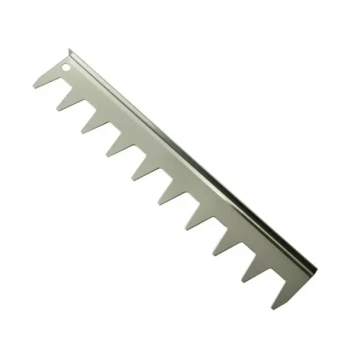
10-frame Langstroth hives equipped with screen bottom boards facilitate monitoring through a combination of physical isolation and non-invasive sample collection. These systems utilize the natural drop behavior of Varroa destructor mites, allowing them to pass through a mesh screen into a collection device below. This enables beekeepers to accurately quantify mite populations without opening the hive or disrupting the colony's internal environment.
Core Takeaway Screen bottom boards transform the hive floor from a passive surface into an active diagnostic tool. By separating falling mites from the bee colony, this system prevents re-infestation and provides the accurate, high-contrast data necessary for effective Integrated Pest Management (IPM).
The Mechanics of Non-Invasive Monitoring
Leveraging Natural Drop Behavior
The primary mechanism for monitoring is gravity-assisted separation. As mites die naturally or are groomed off by bees, they fall from the colony cluster.
In a standard 10-frame Langstroth setup, the screen bottom board replaces the solid floor. This allows the mites to pass immediately through the mesh, rather than accumulating on the hive floor where they might be disturbed.
Physical Isolation of Data
Crucially, the screen serves as a one-way physical barrier. Once a mite passes through the mesh, it lands on a collection tray or pad located beneath the screen.
This isolation prevents honeybees from accessing the fallen mites. Without the screen, hygienic bees would likely remove the mite carcasses, corrupting the data. The screen ensures that every mite that falls remains available for counting.
High-Contrast Visualization
To facilitate accurate counting, collection pads (often white or sticky boards) are placed below the screen.
The high-contrast background of a white board makes the small, reddish-brown Varroa mites easily visible to the naked eye. This visibility is essential for technicians to perform quick, accurate weekly counts of mite mortality.
Advantages Over Traditional Solid Boards
Eliminating Re-infestation Errors
Solid wooden bottom boards introduce a significant margin of error and risk. Studies indicate that 40% to 50% of fallen mites can survive on a solid floor and crawl back up to re-parasitize the bees.
Screen bottom boards eliminate the physical conditions required for this secondary infestation. By permanently separating the fallen mite from the host, the system ensures the count reflects true "drop" rather than a fluctuating population of survivors.
Standardized Data Collection
The 10-frame Langstroth hive provides a standardized physical space for colony management.
When combined with screen bottom boards, this standardization allows beekeepers to compare infestation data across different colonies and apiaries reliably. It creates a consistent baseline for evaluating colony health.
The Role in Integrated Pest Management (IPM)
Establishing Treatment Thresholds
Monitoring natural mite drop is a critical step in determining the optimal timing for ecological or chemical controls.
By tracking daily natural drops, beekeepers can assess the infection dynamics within the population. This data allows for intervention only when infestation levels reach a specific economic or health threshold, rather than treating blindly.
Monitoring Resistance and Efficacy
Screen bottom boards are essential consumables for validating pesticide performance.
By counting mites during and after treatment, beekeepers can quantitatively calculate the efficacy of acaricides. This is the primary method for identifying treatment failures (such as amitraz resistance) in commercial apiaries.
Understanding the Trade-offs
While screen bottom boards are powerful tools, they are not standalone solutions.
- Indirect Measurement: The system measures fallen mites, which acts as a proxy for the total population. It requires consistent monitoring to identify trends accurately.
- Maintenance: The collection trays or pads must be checked and cleaned regularly. If debris accumulates, it can obscure mites or reduce ventilation efficiency.
- Environmental Exposure: While they improve ventilation, open screens can alter the hive's internal microclimate. Users must ensure the setup is appropriate for their specific climate conditions to avoid chilling the brood.
Making the Right Choice for Your Goal
To maximize the utility of screen bottom boards in your apiary management:
- If your primary focus is Baseline Assessment: Implement a weekly counting schedule using white sticky boards to establish a reliable natural drop average for each colony.
- If your primary focus is Resistance Testing: Perform counts immediately before and after applying acaricides to mathematically verify that the mortality rate has spiked as expected.
- If your primary focus is Mechanical Control: Ensure the screen mesh remains clear of debris to maximize the number of mites that are permanently removed from the colony ecosystem.
The screen bottom board is more than a piece of hardware; it is a fundamental control mechanism that bridges the gap between passive observation and active, data-driven colony management.
Summary Table:
| Feature | Function in Monitoring | Key Benefit |
|---|---|---|
| Mesh Screen | Facilitates gravity-assisted separation of mites | Prevents re-infestation and data corruption |
| Collection Tray | Captures fallen Varroa on high-contrast boards | Enables fast, accurate manual mite counts |
| Standard 10-Frame Design | Provides consistent internal volume | Allows standardized data comparison across apiaries |
| One-Way Barrier | Isolates mites from hygienic bee behavior | Ensures count reflects true mortality levels |
Optimize Your Apiary’s Health with HONESTBEE
Accurate Varroa monitoring is the cornerstone of a successful commercial operation. HONESTBEE specializes in empowering commercial apiaries and distributors with high-performance beekeeping infrastructure. From precision-engineered 10-frame Langstroth hives and diagnostic screen bottom boards to advanced honey-filling machinery, we provide the full spectrum of tools you need to scale efficiently.
Why partner with HONESTBEE?
- Wholesale Excellence: Bulk supplies of essential consumables and specialized hardware.
- Industrial Efficiency: Streamline your honey production with our professional-grade machinery.
- Tailored Solutions: Dedicated support for large-scale distributors and commercial keepers.
Ready to elevate your beekeeping productivity? Contact our expert team today to discuss your wholesale needs!
References
- Maxcy P. Nolan, Keith S. Delaplane. Distance between honey bee Apis mellifera colonies regulates populations of Varroa destructor at a landscape scale. DOI: 10.1007/s13592-016-0443-9
This article is also based on technical information from HonestBee Knowledge Base .
Related Products
- Langstroth Screen Bottom Board for Beekeeping Wholesale
- Australian Pine Wood Langstroth Screen Bottom Board for Wholesale
- Solid Bottom Board Australian Pine Wood Langstroth Bottom Board for Wholesale
- Durable Plastic Frame Spacer
- Langstroth Solid Bottom Board for Beekeeping
People Also Ask
- What role do screen bottom boards and monitoring inserts play in assessing Varroa mite mortality and maintaining hive hygiene in Langstroth hives?
- What is the primary function of a standard screen bottom board when assessing honeybee grooming behavior? - Key Mite Data
- What is the primary function of a screen bottom board? Achieve Accurate Varroa Mite Assessment in Your Apiary
- Why is the combination of a screen bottom board and a sticky trap board essential for monitoring Varroa mite? Guide
- Why might a screen bottom board be less effective for pest control? Understanding the 'Mixed Sunlight' Complication