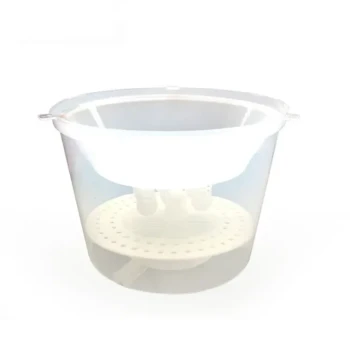
Bottom pollen traps function mechanically by placing a specialized grid barrier directly at the hive entrance. As foraging bees return and attempt to enter the hive through this grid, the physical dimensions of the apertures gently strip the pollen pellets from their hind legs, causing the loads to fall into a dedicated collection drawer positioned below.
The core function of a bottom pollen trap is to automate the harvesting of fresh pollen by intercepting a calculated percentage of incoming forage. It balances the need for high-volume, clean collection with the necessity of maintaining colony flight patterns and hive health.
The Mechanics of Collection
The Physical Barrier
The trap operates on a simple exclusion principle. It features a grid or fence with precisely sized openings installed at the main entry point of the hive.
Stripping the Pollen Baskets
As the bee squeezes through the grid, the apertures are large enough to admit the insect's body but too narrow for the pollen loads attached to the hind legs.
The friction from the grid mechanically dislodges these pellets from the bee's "pollen baskets" without harming the insect.
Gravity-Fed Separation
Once dislodged, the pollen falls immediately into a collection drawer or tray located beneath the grid.
This immediate physical separation ensures the pollen remains clean and prevents it from being tracked into the hive or consumed by the colony.
Operational Efficiency and Design
Collection Efficiency Rates
These devices are not designed to capture 100% of the forage. Depending on the grid size relative to the pollen pellet size, traps typically collect between 30% and 70% of the incoming pollen.
Advantages Over Top-Mounted Traps
Bottom-mounted traps generally cause less interference with bee flight frequency compared to top-mounted alternatives.
Because they are situated at the entrance, they are highly effective for intercepting fresh pollen carriers immediately upon return.
Applications in Analysis
Beyond commercial production, this mechanism is critical for scientific analysis.
By intercepting specific batches of pollen, researchers can perform physicochemical analysis to determine floral resources, plant species, and potential pesticide exposure levels.
Understanding the Trade-offs
Resource Reduction
While the trap effectively harvests raw material, it inherently deprives the colony of a significant portion of its protein source.
Because the trap intercepts up to 70% of pollen, it must be used strategically to ensure the hive retains enough food for brood rearing.
Opening Size Sensitivity
The effectiveness of the trap is strictly dictated by the size of the grid openings.
If openings are too large, pollen collection drops significantly; if too small, they may obstruct the bees' movement or damage the insects.
Making the Right Choice for Your Goal
- If your primary focus is Commercial Production: Utilize bottom traps to maximize the volume of clean, fresh pollen while minimizing disruption to the colony's daily flight activity.
- If your primary focus is Scientific Research: Use these traps to isolate specific foraging windows for accurate palynological studies or pesticide residue analysis.
- If your primary focus is Colony Health: Monitor collection rates closely to ensure the 30-70% capture rate does not lead to nutritional deficits within the hive.
Effective pollen trapping turns a biological process into a measurable resource stream without compromising the workforce that creates it.
Summary Table:
| Feature | Description | Impact on Operation |
|---|---|---|
| Mechanism | Specialized grid barrier at hive entrance | Mechanically strips pollen from hind legs |
| Collection Rate | 30% to 70% of incoming forage | Balances harvest volume with colony nutrition |
| Storage | Gravity-fed collection drawer | Keeps pollen clean and prevents hive tracking |
| Main Advantage | Bottom-mounted entry design | Minimizes flight interference compared to top traps |
| Primary Use | Commercial & Scientific | Ideal for high-volume production and floral analysis |
Maximize Your Apiary’s Potential with HONESTBEE
At HONESTBEE, we understand that professional beekeepers and distributors need more than just tools—they need precision-engineered solutions. Whether you are scaling up commercial pollen production or outfitting a large-scale apiary, we provide a comprehensive wholesale range including:
- Advanced Pollen Traps & Collection Systems
- High-Capacity Honey-Filling & Hive-Making Machinery
- Essential Consumables & Specialized Hardware
- Honey-Themed Cultural Merchandise
Partner with us to access professional-grade beekeeping equipment designed for durability and efficiency. Contact us today to discuss your wholesale needs and see how HONESTBEE can streamline your operations.
References
- Dariusz Teper, W. Skowronek. Exploitation of Rape Flow by Bee Colonies in Stationary and Migratory Apiary. DOI: 10.2478/jas-2013-0010
This article is also based on technical information from HonestBee Knowledge Base .
Related Products
- Removable Plastic Pollen Trap With Ventilated Tray for Bees Pollen Collector
- 30 cm Plastic Entrance Hole Bee Pollen Trap and Collector
- Plastic Bee Pollen Trap Strips Comb Catcher Collector
- High-Efficiency Diamond Maze Bee Escape for Clearing Supers
- Professional Bucket Style Wasp and Moth Pheromone Trap
People Also Ask
- What are the design principles and advantages of pollen traps in the collection of bee pollen? Boost Your Apiary Yield
- What is the function of professional pollen traps in evaluating honey plants? Quantifying Pollination and Crop Potential
- What functions do pollen traps serve for bee bread production? Optimize Your Raw Material Collection
- What maintenance and pest prevention measures should be taken for pollen traps? Protect Your Hive and Harvest Quality
- How does the use of pollen traps in honeybee hives enhance crop fertilization? Boost Your Yield Through Induced Activity