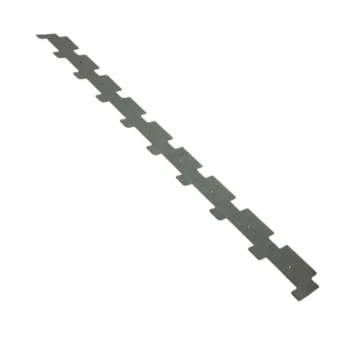
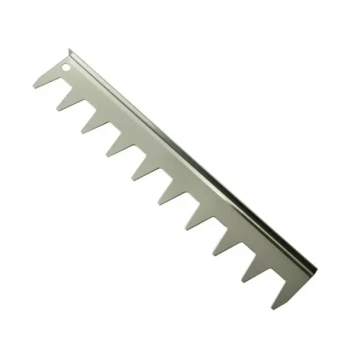
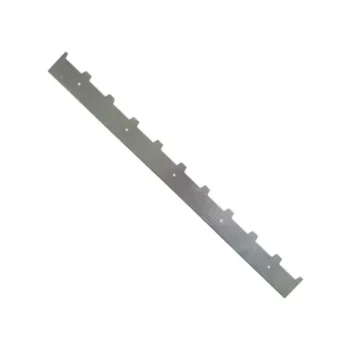
Custom-designed slanted sensor spacers function as a geometric corrective tool that aligns the irregular contact points of beehive frames with flat weighing sensors. Because many frame "ears" feature an inherent slope, these spacers are 3D-printed to mirror that specific angle and create a perfectly level interface. This allows the frame's mass to exert vertical, uniform pressure directly onto the sensor's center, eliminating errors caused by diagonal force vectors.
Standard beehive frames often feature sloped connection points that prevent uniform contact with horizontal scale sensors. Custom spacers compensate for this angle, ensuring weight is applied vertically to eliminate measurement deviations.
The Mechanics of Measurement Deviations
The Inherent Slope of Frame Ears
Beehive frame ears are frequently designed with a built-in slope rather than a flat bottom.
When these angled surfaces are placed directly onto a standard horizontal sensor, they fail to make uniform contact.
The Problem with Diagonal Force
This slope prevents the frame's weight from exerting vertical pressure.
Instead, the force is applied at an angle, leading to uneven distribution across the sensor's surface. This misalignment causes the sensor to register inaccurate values because load cells are optimized for perpendicular force.
How Spacers Restore Accuracy
Creating a Level Contact Surface
Custom 3D-printed spacers are designed to match the specific angle of the frame ear.
When installed, they effectively cancel out the slope, creating a level contact surface between the frame and the sensor. This creates a mechanical bridge that translates the frame's geometry into a format the sensor can read accurately.
Centralizing the Load
The primary goal of the spacer is to ensure total weight is directed vertically.
By leveling the interface, the spacer forces the load onto the center of the sensor. This eliminates the measurement deviations that occur when force is distributed unevenly toward the edges of the weighing mechanism.
Understanding the Trade-offs
Customization vs. Convenience
This solution relies on precise customization.
You cannot use a generic spacer; the 3D-printed component must be tailored to the specific angle of your hive frames. If the angles do not match perfectly, the measurement will remain distorted.
Complexity of Installation
Adding spacers introduces an additional component into the hive assembly.
This requires the capability to design and 3D print parts, or access to someone who can. It adds a layer of complexity compared to simply placing a hive on a standard industrial scale.
Making the Right Choice for Your Goal
To maximize the accuracy of your hive scale, consider the following regarding the implementation of spacers:
- If your primary focus is absolute precision: Measure the angle of your frame ears with calipers to ensure the 3D-printed spacer creates a perfectly perpendicular load path.
- If your primary focus is equipment longevity: Ensure the spacers are printed with high structural integrity to prevent them from compressing or deforming under the weight of a honey-laden hive.
By mechanically correcting the interface between the frame and the sensor, you convert a variable physical connection into a source of reliable data.
Summary Table:
| Feature | Standard Contact (No Spacer) | Custom Slanted Spacer |
|---|---|---|
| Force Direction | Diagonal/Uneven vectors | Vertical/Perpendicular load |
| Load Distribution | Edge-concentrated (High Error) | Centered on sensor (High Accuracy) |
| Interface Type | Angled frame-to-flat sensor | Geometric corrective bridge |
| Data Reliability | Variable & inaccurate | Stable & highly precise |
| Requirement | Simple installation | Custom 3D-printing & measurement |
Optimize Your Apiary Operations with HONESTBEE
At HONESTBEE, we specialize in empowering commercial apiaries and distributors with high-performance beekeeping technology. Whether you need specialized hive-making machinery to create perfectly aligned components or robust honey-filling machines for post-harvest efficiency, we provide the full spectrum of professional tools and consumables.
Why choose HONESTBEE?
- Precision Engineering: From hardware to machinery, our products are designed for industrial-scale reliability.
- Comprehensive Catalog: We supply everything from hive hardware to honey-themed cultural merchandise.
- Tailored for Growth: Our wholesale offerings are built to support the scaling needs of large-scale bee farms.
Ready to elevate your beekeeping accuracy and production? Contact us today to discuss your wholesale needs!
References
- Navid Shaghaghi, Peter Ferguson. Identifying Beehive Frames Ready For Harvesting. DOI: 10.1109/ghtc46095.2019.9033045
This article is also based on technical information from HonestBee Knowledge Base .
Related Products
- Heavy Duty Castellated Iron Frame Spacer for Honey Supers
- Stainless Steel 9 Frame Hive Spacer Durable Precise for Commercial Beekeeping
- Durable Plastic Frame Spacer
- Professional Castellated Iron Frame Spacer for Multiple Hive Types
People Also Ask
- What are honey super frames and what foundation options are available? Choose the Best Support for Your Bees
- What are the reasons and drawbacks of using nine frames in a ten-frame honey super? Boost Extraction Speed Today
- What are honey super frames and how many are needed per box? A Beekeeper's Essential Guide
- What are honey super frames and their foundation options? Choose the Best Support for Your Hive's Honey Production
- Why might a beekeeper use fewer than the standard number of frames in a honey super? Boost Extraction Efficiency